
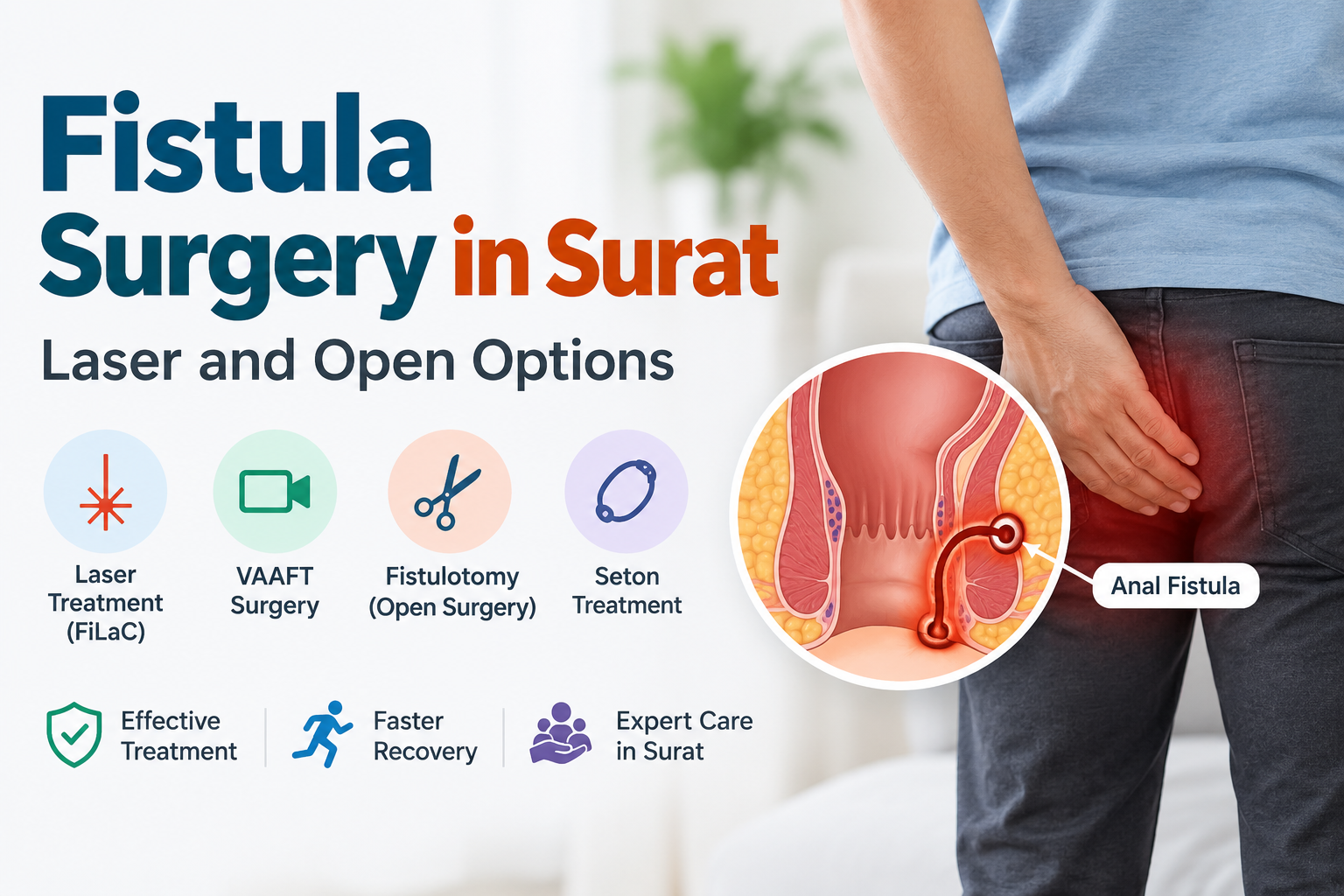
Anal fistula treatment usually requires a procedure or surgery because the abnormal tract rarely heals permanently on its own. Options include fistulotomy, seton placement, laser treatment (FiLaC), video-assisted treatment (VAAFT), LIFT, and advancement flap surgery. The best approach depends on the fistula’s location, complexity, sphincter involvement, and recurrence risk. If you are researching fistula surgery Surat, understanding the available procedures can help you discuss treatment options with a qualified surgeon.
An anal fistula can cause repeated discharge, swelling, pain, and irritation near the anus. Some patients experience temporary relief after an abscess drains, only for symptoms to return.
This guide explains the differences between laser and conventional fistula surgery, expected recovery, recurrence risks, and factors affecting treatment costs.
What Is an Anal Fistula?
An anal fistula is an abnormal tunnel connecting the inside of the anal canal to the skin near the anus.
Most anal fistulas develop after an infection in an anal gland causes an abscess.
When the abscess drains, an abnormal tract may remain between the anal canal and surrounding skin.
This tract can cause repeated infection and discharge.
Other less common causes include Crohn’s disease, previous surgery, trauma, and certain infections.
An anal fistula is different from piles and anal fissures.
- Piles: Enlarged or symptomatic vascular cushions in or around the anus.
- Anal fissure: A small tear in the lining of the anal canal.
- Anal fistula: An abnormal tunnel between the anal canal and nearby skin.
Correct diagnosis matters because these conditions require different treatments.
What Are the Symptoms of an Anal Fistula?
Common symptoms include repeated discharge, pain, swelling, and a small opening near the anus.
Patients may experience:
- Pus or fluid discharge near the anus
- Recurrent swelling
- Pain while sitting or passing stool
- Irritation or itching around the opening
- An unpleasant odour from discharge
- Repeated episodes of an anal abscess
- Fever when an active infection develops
Symptoms may temporarily improve after an abscess drains.
However, the fistula tract can remain and cause further infections.
Does Every Anal Fistula Need Surgery?
Most anal fistulas require a procedure or surgery because they rarely close permanently without treatment.
Medicines may help control infection, inflammation, or pain, but they generally do not eliminate a typical cryptoglandular fistula tract.
Antibiotics alone usually cannot cure an established anal fistula.
Some patients with Crohn’s-related fistulas need medical treatment alongside surgical management.
The treatment plan depends on the underlying cause, fistula anatomy, and patient health.
How Do Doctors Diagnose an Anal Fistula?
Doctors diagnose anal fistulas through clinical examination and, when necessary, imaging to identify the tract and its relationship with the anal sphincter muscles.
Evaluation may include:
1. Medical History
The surgeon asks about discharge, swelling, pain, previous abscesses, and earlier procedures.
2. Physical Examination
The surgeon examines the anal area for external openings, swelling, and signs of infection.
3. MRI Fistulogram
An MRI can help identify complex fistula tracts, branches, abscesses and their relationship with sphincter muscles.
Not every simple fistula requires an MRI.
4. Examination Under Anaesthesia
In selected cases, the surgeon examines the fistula under anaesthesia to assess its anatomy and plan treatment.
The main goal is to identify the fistula accurately while protecting bowel control.
What Are the Different Types of Anal Fistula?
Doctors classify fistulas according to their relationship with the anal sphincter muscles.
| Fistula Type | Description |
|---|---|
| Intersphincteric | Passes between the internal and external sphincter muscles |
| Transsphincteric | Crosses part of the external sphincter |
| Suprasphincteric | Extends above the external sphincter before reaching the skin |
| Extrasphincteric | Passes outside the sphincter complex; uncommon |
Surgeons also describe fistulas as simple or complex.
Complex fistulas may involve substantial sphincter muscle, multiple branches, recurrent disease, or conditions such as Crohn’s disease.
This distinction strongly influences the choice of surgery.
What Are the Available Fistula Surgery Options?
The main surgical options include fistulotomy, seton placement, FiLaC laser treatment, VAAFT, LIFT, and advancement flap surgery.
1. Fistulotomy
Fistulotomy opens the fistula tract so the wound can heal gradually from the inside out.
The surgeon identifies the tract and lays it open.
This approach can provide effective treatment for selected simple, low fistulas that involve little sphincter muscle.
However, cutting significant sphincter muscle can increase the risk of bowel-control problems.
Therefore, fistulotomy is not appropriate for every fistula.
2. Laser Fistula Treatment (FiLaC)
FiLaC, or Fistula-tract Laser Closure, uses laser energy delivered through a fibre inside the fistula tract.
The treatment aims to shrink and close the tract while avoiding deliberate division of sphincter muscle.
Potential advantages include a smaller external wound and sphincter preservation.
However, success varies with fistula anatomy, previous treatment, and the technique used.
Some fistulas persist or recur after laser treatment and require additional procedures.
3. VAAFT Surgery
VAAFT stands for Video-Assisted Anal Fistula Treatment.
The surgeon uses a small fistuloscope to inspect the tract from within.
Specialised instruments help identify and treat the fistula pathway.
VAAFT aims to preserve sphincter function, but long-term success rates vary, and the procedure is not suitable for every fistula.
4. Seton Placement
A seton is a surgical thread or loop that the surgeon places through a fistula tract.
A loose seton helps maintain drainage and control infection while protecting the sphincter muscles.
Doctors may use it as part of a staged treatment plan for complex fistulas.
A seton may remain in place for weeks or longer, depending on the clinical situation.
A cutting seton works differently and may carry a greater risk of continence problems; surgeons consider its use carefully.
5. LIFT Procedure
LIFT stands for Ligation of the Intersphincteric Fistula Tract.
During this procedure, the surgeon accesses the tract between the sphincter muscles, closes or divides the tract, and aims to preserve sphincter function.
LIFT may suit selected transsphincteric fistulas.
6. Advancement Flap Surgery
During advancement flap surgery, the surgeon uses nearby healthy tissue to cover the internal fistula opening.
This approach may help treat selected complex fistulas when sphincter preservation is important.
Laser vs Open Fistula Surgery: Which Is Better?
Neither laser nor conventional surgery is automatically better for every anal fistula. The best option depends on tract anatomy, sphincter involvement, previous operations, and individual risk factors.
| Treatment | Main Approach | Common Suitability | Important Limitation |
|---|---|---|---|
| Fistulotomy | Opens the fistula tract | Selected for simple, low fistulas | Can affect continence if significant sphincter muscle is divided |
| FiLaC laser | Uses laser energy inside the tract | Selected fistulas where sphincter preservation is important | Persistence or recurrence may require further treatment |
| VAAFT | Uses a camera to identify and treat the tract | Selected fistulas | Long-term results vary |
| Loose seton | Maintains drainage through the tract | Complex fistulas or staged treatment | Often does not provide definitive closure alone |
| LIFT | Closes the tract between sphincter muscles | Selected transsphincteric fistulas | Healing failure or recurrence remains possible |
| Advancement flap | Covers the internal opening with healthy tissue | Selected complex fistulas | Flap failure or recurrence can occur |
Is Laser Fistula Surgery Always Painless?
No.
Patients may experience discomfort, discharge, swelling, or pain after laser treatment.
Pain levels vary according to the procedure and individual recovery.
Does Laser Surgery Guarantee No Recurrence?
No.
Laser treatment cannot guarantee permanent closure.
Some patients require additional treatment if the tract remains open or returns.
How Is Fistula Surgery Performed?
The surgeon identifies the fistula tract, selects a suitable treatment technique, and aims to treat the abnormal connection while protecting the anal sphincter muscles.
The procedure generally involves the following steps.
Step 1: Examination and Surgical Planning
The surgeon reviews symptoms, examination findings, and imaging when appropriate.
Step 2: Anaesthesia
The anaesthesia team administers general, regional, or another suitable form of anaesthesia according to the procedure and patient.
Step 3: Fistula Treatment
The surgeon performs fistulotomy, laser treatment, seton placement, or another selected procedure.
Step 4: Wound Care
The surgical team applies an appropriate dressing and explains how to manage the wound.
Step 5: Follow-Up
The surgeon monitors healing, discharge, infection, and bowel-control symptoms during recovery.
What Is the Recovery Time After Fistula Surgery?
Recovery after fistula surgery varies according to the treatment technique, wound size, fistula complexity, and individual healing.
Some patients return to light activities within several days, while complete wound healing may take several weeks or months.
Fistula Surgery Recovery Timeline
| Recovery Stage | What Patients May Experience |
|---|---|
| First 24–48 hours | Discomfort, dressing care, and monitoring for bleeding |
| Days 3–7 | Gradual return to light activities when comfortable |
| Weeks 2–4 | Continued wound care and follow-up; healing varies |
| Weeks 4–8 | Some wounds continue closing, and discharge may decrease |
| Following months | Complex fistulas or staged procedures may need longer follow-up |
These are general expectations, not guaranteed recovery periods.
Patients with a seton may require ongoing drainage care and additional procedures.
How Can You Support Healing?
Follow your surgeon’s instructions and:
- Keep the surgical area clean.
- Change dressings as advised.
- Take prescribed medicines correctly.
- Avoid constipation and excessive straining.
- Eat a balanced, fibre-rich diet unless your doctor advises otherwise.
- Drink adequate fluids.
- Attend scheduled follow-up appointments.
- Report increasing pain, fever, or worsening discharge.
For additional guidance, read wound care after surgery.
Can an Anal Fistula Return After Surgery?
Yes. An anal fistula can persist or recur after any treatment, including laser surgery, fistulotomy, VAAFT, or sphincter-preserving procedures.
Recurrence risk depends on:
- Fistula complexity
- Multiple or branching tracts
- Previous fistula operations
- Persistent infection
- Underlying Crohn’s disease
- Treatment technique
- Individual healing
A fistula may return if part of the tract remains active or an associated infection persists.
Regular follow-up helps doctors identify healing problems and determine whether additional treatment is necessary.
What Is the Cost of Fistula Surgery Surat?
Fistula surgery cost in Surat depends on the treatment method, complexity, anaesthesia, hospital facilities, and whether the patient requires staged procedures.
Fistula Surgery Cost Comparison
| Procedure | Current Cost Range |
|---|---|
| Fistulotomy | Confirm with clinic |
| FiLaC laser treatment | Confirm with clinic |
| VAAFT surgery | Confirm with clinic |
| Seton placement | Confirm with clinic |
| LIFT procedure | Confirm with clinic |
| Complex or recurrent fistula surgery | Confirm with clinic |
Arora Elite Care has not supplied verified procedure-specific prices for this article.
The clinic should confirm its current charges before publishing numerical estimates as hospital prices.
What Affects the Final Cost?
The main factors include:
- Simple or complex fistula
- Surgical technique
- MRI and other investigations
- Anaesthesia
- Operating theatre charges
- Hospital stay
- Additional procedures
- Medicines and follow-up care
Ask for a written estimate that explains the package inclusions and possible additional charges.
Does Health Insurance Cover Fistula Surgery?
Some health insurance policies in India cover medically necessary anal fistula surgery, subject to waiting periods, exclusions, policy limits, and insurer approval.
Before treatment, confirm:
- Whether the policy covers fistula surgery
- a waiting period applies
- The hospital offers cashless treatment under your policy
- The proposed technique is covered
- Whether pre-authorisation is necessary
- Which expenses the insurer may exclude
Cashless approval is not guaranteed.
Contact your insurer and the hospital billing team for policy-specific information.
When Should You Seek Urgent Medical Care?
Seek prompt medical evaluation if you experience severe anal pain, fever, increasing swelling, or symptoms of a developing abscess.
Warning signs include:
- Severe or worsening pain near the anus
- Fever or chills
- Rapidly increasing swelling
- Significant redness around the anal area
- Difficulty passing urine
- Heavy bleeding
- Feeling seriously unwell
An anal abscess may require urgent drainage.
Do not wait for a routine consultation if you develop severe symptoms.
Fistula Surgery Consultation With Dr Hitesh Arora in Surat
Patients researching fistula surgery Surat can seek a surgical consultation at Arora Elite Care.
Dr. Hitesh Arora is an Advanced Laparoscopic and General Surgeon associated with Arora Elite Care in Surat.
During a consultation, the doctor can review symptoms, examine the affected area, and recommend further investigations when necessary.
The treatment plan should consider the fistula’s anatomy, previous infections, sphincter involvement, and the patient’s overall health.
Patients should confirm the surgeon’s experience with the recommended procedure and which fistula treatments the clinic currently provides.
Clinic Address: Arora Elite Care, Solaris Kode 202–203, VIP Road, Surat, Gujarat 395007.
Book a surgery consultation in Surat to discuss your symptoms and available treatment options.
Conclusion
Anal fistulas rarely heal permanently without appropriate treatment.
Surgical options include fistulotomy, laser FiLaC, VAAFT, seton placement, LIFT, and advancement flap procedures.
Each technique has different benefits, limitations, and recurrence risks.
If you are considering fistula surgery Surat, consult a qualified surgeon who can assess the fistula tract and recommend treatment that balances healing with protection of bowel-control function.
Frequently Asked Questions
1. Can an Anal Fistula Heal Without Surgery?
Most anal fistulas do not heal permanently without a procedure or surgery. Medicines may help manage infection or inflammation, but they usually cannot close a typical fistula tract. Crohn’s-related fistulas may require specialised medical treatment alongside surgical care.
2. Is Laser Fistula Surgery Better Than Open Surgery?
Not always. Laser treatment may preserve sphincter muscle in selected patients, but recurrence and treatment failure remain possible. Fistulotomy can be effective for suitable simple, low fistulas. The surgeon chooses treatment according to fistula anatomy and individual risks.
3. How Long Does Recovery Take After Fistula Surgery?
Some patients resume light activities within several days, while complete healing can take weeks or months. Recovery depends on the procedure, fistula complexity, wound size, and individual health.
4. Can a Fistula Return After Laser Treatment?
Yes. A fistula can persist or recur after laser treatment. The risk depends on tract anatomy, infection, previous procedures, and other factors. Follow-up helps identify incomplete healing and determine whether further treatment is necessary.
5. What Is the Cost of Fistula Surgery Surat?
The cost varies according to the procedure, fistula complexity, investigations, anaesthesia, and hospital services. Contact Arora Elite Care for a current itemised estimate because verified clinic-specific prices are not available in this article.
6. Which Doctor Should I Consult for Anal Fistula Treatment?
Consult a general surgeon or colorectal surgeon experienced in treating anal fistulas. Complex or recurrent fistulas may benefit from specialist colorectal assessment because treatment must protect the anal sphincter muscles and bowel-control function.