
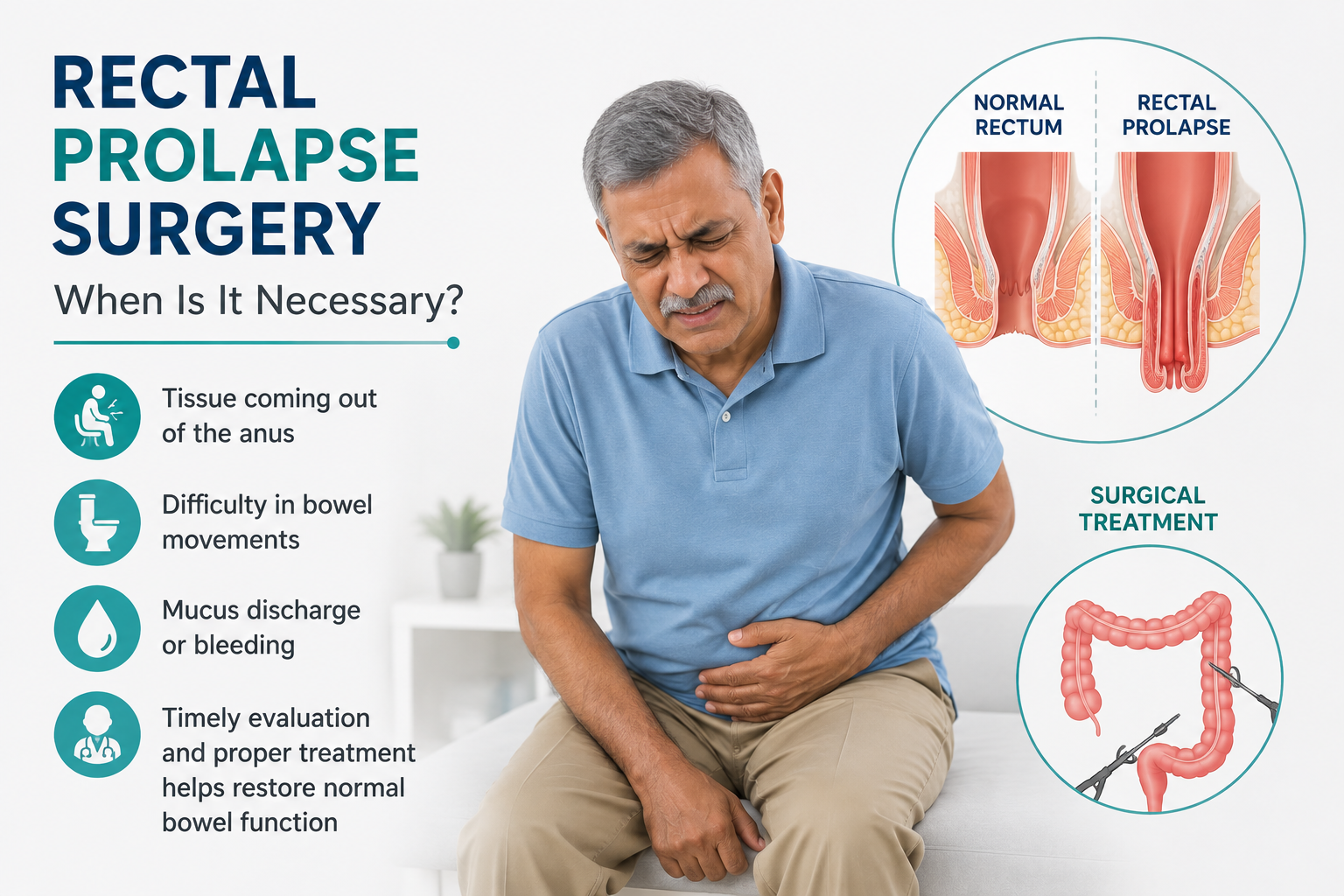
Rectal prolapse can be uncomfortable, embarrassing, and sometimes mistaken for piles. It occurs when part or all of the rectum moves downward from its normal position and may protrude through the anal opening. For adults with established or troublesome prolapse, rectal prolapse surgery treatment may be considered when symptoms persist, the prolapse repeatedly comes out, bowel control becomes difficult, or conservative measures cannot adequately manage the problem.
The correct treatment depends on the type and severity of prolapse, bowel function, age, overall health, and surgical assessment.
What Is Rectal Prolapse?
Rectal prolapse occurs when the rectum loses its normal support and moves downward. In more advanced cases, rectal tissue can become visible outside the anus, particularly during a bowel movement.
Different forms of prolapse can occur. A doctor needs to determine whether the problem involves the full thickness of the rectal wall, only the inner lining, or internal prolapse that does not protrude outside.
This distinction is important because treatment varies.
What Are the Symptoms of Rectal Prolapse?
A common symptom is red or pink tissue protruding from the anus, initially during bowel movements. As the condition progresses, the prolapse may occur during coughing, walking, or other activities.
Other symptoms may include:
- A lump or tissue coming out during bowel movements
- Mucus discharge
- Rectal bleeding
- Constipation
- Difficulty emptying the bowel completely
- Feeling that something remains after passing stool
- Difficulty controlling gas or stool
- Anal discomfort or irritation
Any new rectal bleeding or protruding tissue deserves medical evaluation rather than self-diagnosis.
Is Rectal Prolapse the Same as Piles?
No. Rectal prolapse and piles are different conditions, although patients can easily confuse them.
Piles, or hemorrhoids, involve enlarged vascular tissue in and around the anal canal. Rectal prolapse involves the rectum itself descending from its normal position.
Both conditions can cause a protruding lump, bleeding, discomfort, or mucus discharge.
Similarly, conditions such as an anal fissure or fistula can produce anorectal symptoms but require different treatment.
A physical examination helps determine what is actually causing the symptoms before treatment begins.
Does Every Rectal Prolapse Need Surgery?
Not every symptom around the anus requires an operation. Treatment depends on what type of prolapse is present and how significantly it affects the patient.
Measures such as treating constipation, increasing appropriate dietary fibre and fluids, avoiding excessive straining, and improving bowel habits may help reduce symptoms and prevent additional strain.
However, these measures do not physically restore an established full-thickness rectal prolapse to its normal anatomical position.
Adults with significant full-thickness prolapse commonly require surgical assessment to discuss definitive correction.
When Is Rectal Prolapse Surgery Necessary?
A surgeon may consider rectal prolapse surgery treatment when:
- The prolapse repeatedly protrudes outside
- Symptoms progressively worsen
- The prolapse interferes with normal bowel movements
- The patient develops difficulty controlling stool
- Bleeding or mucus discharge becomes troublesome
- The prolapse significantly affects everyday activities
- Conservative measures cannot adequately control associated symptoms
A prolapse that becomes severely painful, swollen, dark in colour, or cannot be returned inside requires urgent medical assessment, because trapped tissue can potentially develop problems with its blood supply.
How Is Rectal Prolapse Surgery Performed?
There is no single operation that suits every patient.
Surgeons generally use either an abdominal approach or a perineal approach.
Abdominal Approach
The surgeon accesses the rectum through the abdomen and restores it toward its normal position. Some operations secure the rectum to surrounding structures, a procedure generally known as rectopexy.
Surgeons may perform selected abdominal procedures through laparoscopic or minimally invasive techniques when appropriate.
Perineal Approach
With a perineal procedure, the surgeon operates through the area around the anus rather than through the abdomen.
Doctors may consider this approach for selected patients depending on age, overall fitness, prolapse characteristics, and other medical factors.
The surgeon chooses the technique after considering the patient’s anatomy, constipation, continence, previous operations, general health, and risk of recurrence.
What Is Recovery Like After Rectal Prolapse Surgery?
Recovery varies according to the procedure and individual patient.
The medical team may encourage appropriate movement after surgery and gradually restart food according to the patient’s condition. Patients also receive instructions about pain management and bowel care.
During recovery, follow your surgeon’s recommendations regarding:
- Medicines
- Diet and hydration
- Bowel habits
- Wound care
- Walking
- Heavy lifting
- Returning to work
- Follow-up visits
Avoid straining during bowel movements, and follow the bowel-management plan provided by your healthcare team.
Can Rectal Prolapse Return After Surgery?
Yes, recurrence is possible after rectal prolapse surgery.
The likelihood varies according to the type of prolapse, surgical technique, individual health, bowel function, and other factors.
For this reason, a responsible surgeon should discuss both the expected benefits and the possibility of recurrence before treatment. No procedure should be presented as having a guaranteed zero-recurrence result.
Why Is a Proper Surgical Evaluation Important?
Rectal prolapse can resemble piles and other anorectal conditions, so establishing the correct diagnosis is the priority.
At Arora Elite Care, patients with relevant general and anorectal surgical concerns can consult Dr. Hitesh Arora, an Advanced Laparoscopic and General Surgeon.
Dr. Hitesh Arora has 15+ years of surgical experience, is an M.S. Gold Medalist, holds an FMAS (Fellowship in Minimal Access Surgery), and his professional profile reports experience across 10,000+ surgeries.
An evaluation can help establish whether symptoms come from rectal prolapse, piles, fissure, fistula, or another condition and determine the appropriate next step.
Conclusion
Rectal prolapse surgery treatment becomes an important consideration when established prolapse repeatedly protrudes, causes troublesome bowel symptoms, affects continence, or interferes with daily life.
The operation should not be selected based solely on an online description. The patient’s age, overall health, bowel habits, prolapse characteristics, and individual surgical risks all influence treatment planning.
Most importantly, do not assume that every lump or bleeding from the anus is piles. Correct diagnosis comes before correct treatment.
FAQs
Can rectal prolapse heal without surgery?
Measures that reduce constipation and straining can improve associated symptoms, but established full-thickness rectal prolapse in adults usually requires surgical assessment for definitive anatomical correction.
Is rectal prolapse dangerous?
It is not always an immediate emergency, but complications can occur. Severe pain, significant swelling, darkening tissue, or a prolapse that cannot be returned inside requires urgent assessment.
How do I know whether I have piles or rectal prolapse?
Both can cause protruding tissue and bleeding. A medical examination is the most reliable way to distinguish between them.
Is rectal prolapse surgery painful?
Some postoperative discomfort can occur. The amount varies according to the procedure and patient, and the surgical team provides an appropriate pain-management plan.
Can rectal prolapse come back after surgery?
Yes. Recurrence can occur after treatment, and the risk varies according to the procedure, prolapse characteristics, bowel function, and individual patient factors.