
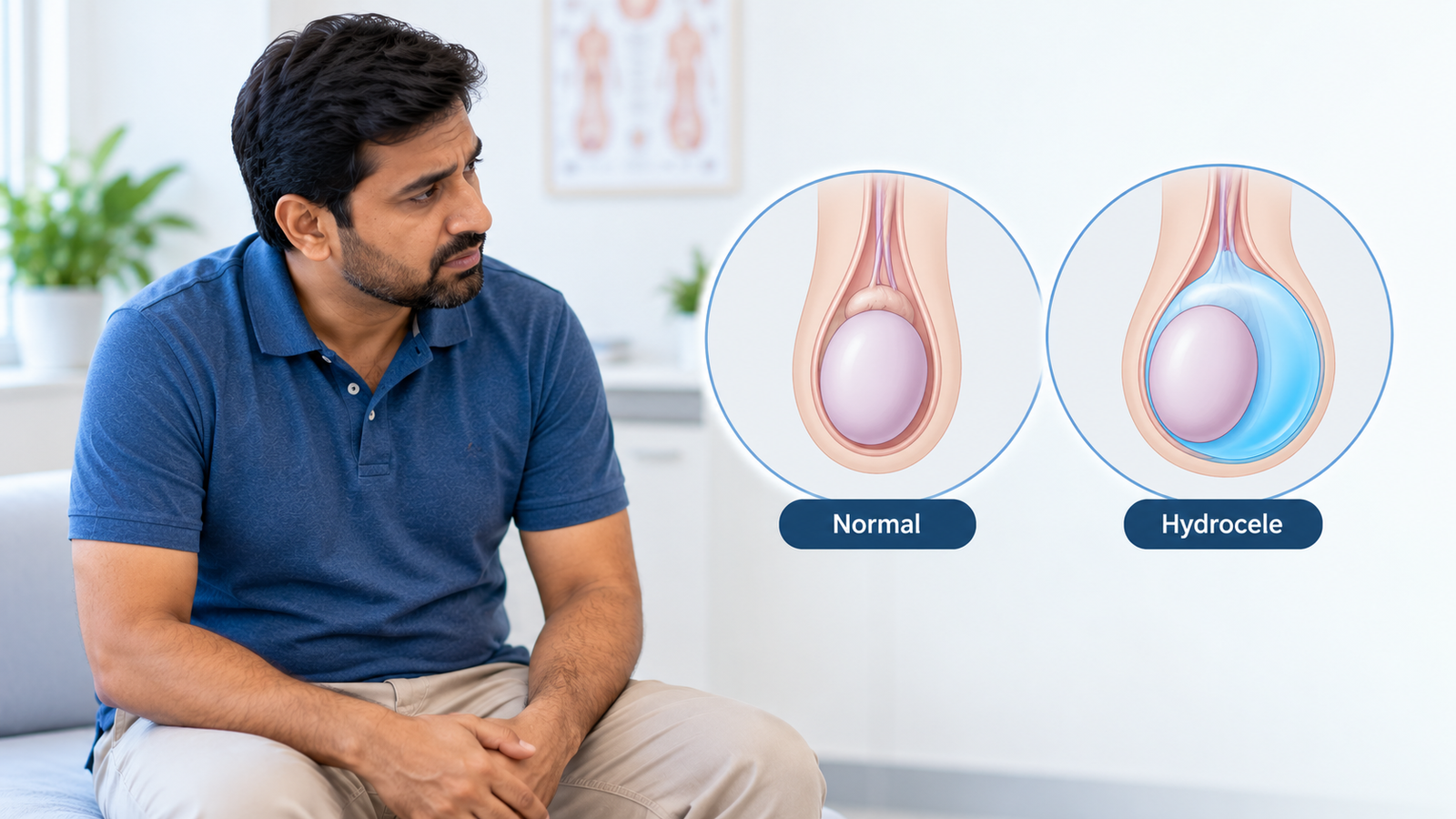
Hydrocele treatment without surgery in adults mainly involves observation when the swelling is small and causes little or no discomfort. Medicines and home remedies do not remove the fluid-filled sac. Aspiration can drain the fluid, but the hydrocele commonly returns after aspiration alone. Hydrocelectomy offers a more definitive treatment when a persistent or symptomatic hydrocele requires intervention.
A hydrocele is a collection of fluid around a testicle that causes swelling within the scrotum. Many people searching for hydrocele treatment without surgery want to know whether medicines, exercise, home remedies, or fluid drainage can make the swelling disappear permanently. The answer depends on the size of the hydrocele, symptoms, underlying cause, and whether treatment is actually necessary.
Not every adult hydrocele needs surgery. An asymptomatic hydrocele can sometimes remain under observation, while a large, persistent, or uncomfortable hydrocele may require treatment. NHS clinical guidance supports observation for confirmed asymptomatic hydroceles and notes that aspiration alone commonly leads to recurrence.
What Is a Hydrocele?
A hydrocele is a collection of fluid around the testicle that causes swelling in the scrotum. It commonly affects one side, although both sides can develop hydroceles.
The swelling may develop gradually and may initially cause little discomfort. As a hydrocele becomes larger, some men notice heaviness, discomfort, difficulty during physical activity, or inconvenience with clothing.
A doctor should evaluate new or persistent scrotal swelling rather than assuming that every swelling represents a hydrocele. Other conditions can produce similar symptoms.
Patients can learn more about hydrocele treatment in Surat and discuss whether observation or treatment better suits their condition.
Can a Hydrocele Go Away on Its Own?
In adults, a persistent hydrocele does not necessarily disappear on its own. However, a small hydrocele that causes no significant symptoms may not require immediate treatment and can sometimes remain under observation.
This distinction matters when considering hydrocele treatment without surgery. “No surgery” does not necessarily mean that another treatment must replace surgery. Sometimes the appropriate approach involves monitoring the hydrocele rather than actively treating it.
NHS clinical guidance states that ultrasound-confirmed hydroceles can remain under observation when they do not cause troublesome symptoms.
Patients should still seek reassessment if the swelling:
- increases noticeably in size
- becomes painful
- develops suddenly
- feels hard or different
- causes significant heaviness
- interferes with walking or daily activities
If you are asking can hydrocele go away on its own, the answer therefore depends partly on what caused the swelling and whether it remains stable.
Do Medicines or Home Remedies Cure a Hydrocele?
No established medicine or hydrocele home remedy removes the hydrocele sac or reliably cures a persistent adult hydrocele. Observation may suit a small, painless hydrocele, but it does not actively remove the fluid collection.
People may come across claims involving herbal products, massage, dietary changes, supplements, compression, or particular exercises. These methods should not delay proper assessment of unexplained scrotal swelling.
Pain-relieving medication may help with discomfort when a clinician considers it appropriate, but reducing discomfort is different from curing the hydrocele.
Similarly, avoiding strenuous activity may make a large swelling feel more comfortable, but exercise modification does not remove the sac responsible for the fluid collection.
Effective hydrocele treatment without surgery therefore has limitations. Observation can avoid unnecessary intervention in selected patients, while aspiration can physically remove fluid but has an important recurrence problem.
What Is Hydrocele Aspiration and Does It Last?
Hydrocele aspiration uses a needle to drain fluid from the hydrocele. It can reduce the swelling without an operation, but aspiration alone often provides temporary relief because it leaves the hydrocele sac in place and the fluid can collect again.
During aspiration, a clinician inserts a needle into the fluid collection and withdraws the fluid.
The immediate reduction in swelling can make aspiration appear to be a straightforward non-surgical hydrocele treatment. The main limitation is recurrence.
An NHS surgical information resource specifically describes aspiration as an alternative that removes the fluid but allows it to reaccumulate quickly and does not provide a curative treatment.
Some treatment approaches combine aspiration with sclerotherapy, in which clinicians introduce an agent intended to reduce recurrence. Evidence and availability vary, and this option does not suit every patient. NHS commissioning guidance notes that aspiration with sclerotherapy can perform better than aspiration alone, while hydrocelectomy remains preferred for large and persistent hydroceles.
A surgeon should determine whether aspiration has a reasonable role in an individual patient’s care.
Which Hydrocele Treatment Option Does What?
| Treatment | What it does | How long it may last | Recurrence | When doctors may choose it |
|---|---|---|---|---|
| Wait and watch | Monitors the hydrocele without intervention | Can continue while symptoms remain minimal | The hydrocele remains present | Small or asymptomatic confirmed hydrocele |
| Aspiration | Drains fluid through a needle | Often temporary | Common after aspiration alone | Selected situations, particularly when surgery is unsuitable |
| Hydrocelectomy | Drains the fluid and surgically repairs or removes the sac | Intended as definitive treatment | Recurrence can occur, but the operation addresses the sac | Persistent, large, uncomfortable, or otherwise symptomatic hydrocele |
The key difference is that aspiration removes the fluid, whereas hydrocele surgery also addresses the sac surrounding the fluid collection. Current NHS hydrocele-repair guidance describes surgery as draining the fluid and closing or removing the sac to help prevent the fluid from returning.
When Is Surgery Necessary?
Surgery becomes more relevant when a hydrocele causes significant symptoms, grows large, persists, or creates functional problems. The decision should reflect the patient’s symptoms and clinical findings rather than the presence of fluid alone.
Not every hydrocele needs an operation. However, continued observation may become less suitable when the swelling causes:
- persistent discomfort
- troublesome heaviness
- difficulty walking or exercising
- interference with everyday activities
- substantial enlargement
- other functional problems
Hydrocelectomy allows the surgeon to drain the fluid and treat the surrounding sac. NHS guidance describes the operation as making a small scrotal incision, draining the fluid, and repairing or removing the sac.
If surgery becomes appropriate, read our detailed guide to hydrocele surgery, procedure, recovery and cost once the 11 September hydrocelectomy article is published.
What Happens If a Hydrocele Is Left Untreated?
A small hydrocele that causes no symptoms may remain under observation without immediate intervention. A larger or symptomatic hydrocele can continue to cause swelling, heaviness, discomfort, or functional inconvenience and should receive medical review.
Leaving a confirmed, asymptomatic hydrocele untreated is different from ignoring unexplained scrotal swelling.
A clinician should first establish that the swelling actually represents a hydrocele. Ultrasound may help confirm the diagnosis and assess the scrotal contents when clinically appropriate.
If a previously stable hydrocele changes significantly, reassessment can determine whether continued observation remains appropriate.
When Should You See a Doctor?
See a doctor for new, persistent, increasing, or uncomfortable scrotal swelling. Seek urgent medical care for sudden severe scrotal pain or rapidly developing swelling because other conditions can require immediate treatment.
You should arrange an assessment if:
- the swelling persists
- the hydrocele becomes larger
- discomfort increases
- you notice a hard or unusual lump
- the swelling interferes with daily activities
- you remain uncertain about the diagnosis
Do not rely solely on a hydrocele home remedy when the cause of scrotal swelling has not been established.
An examination can help distinguish a hydrocele from other conditions and determine whether observation, additional investigation, aspiration, or surgery deserves consideration.
Hydrocele Care at Arora Elite Care
Arora Elite Care in Surat includes hydrocele among its general surgery services. Patients can consult Dr. Hitesh Arora for assessment of scrotal swelling and an individualized discussion about whether observation or treatment is appropriate.
The consultation can establish whether the swelling is consistent with a hydrocele and whether further investigation is necessary.
For a small and minimally symptomatic hydrocele, the surgeon may discuss observation when clinically appropriate. If symptoms become troublesome or the hydrocele grows, treatment options can be reviewed.
Patients considering treatment can read more about hydrocele treatment at Arora Elite Care.
For non-emergency concerns, patients can also schedule a surgical consultation with Arora Elite Care.
The important point is that hydrocele treatment without surgery does not mean every patient needs an alternative procedure. Some patients need only observation, while others may eventually benefit from surgical treatment.
Key Takeaways
- Hydrocele treatment without surgery primarily means observation in selected adults or aspiration in specific circumstances.
- A hydrocele is a collection of fluid around a testicle.
- Small, painless hydroceles may not require immediate treatment.
- Medicines, exercises, and home remedies do not reliably remove a persistent adult hydrocele.
- Aspiration drains the fluid but commonly allows it to return when performed without additional treatment.
- Aspiration with sclerotherapy represents another option in selected cases, but suitability varies.
- Hydrocelectomy treats the fluid collection and the surrounding sac.
- New, enlarging, painful, or unexplained scrotal swelling deserves medical assessment.
Frequently Asked Questions
Can a hydrocele disappear naturally in adults?
A small adult hydrocele may remain stable and cause few or no symptoms, allowing doctors to observe it rather than treat it immediately. However, a persistent adult hydrocele does not reliably disappear naturally. A clinician should assess ongoing or changing scrotal swelling and determine whether continued observation remains appropriate.
Is hydrocele aspiration painful?
Hydrocele aspiration involves inserting a needle into the fluid collection, so patients may experience temporary discomfort. Clinicians can use appropriate measures to minimize discomfort during the procedure. Aspiration avoids an operation but does not necessarily provide permanent treatment because fluid can collect again after the clinician drains it.
How often does a hydrocele come back after aspiration?
Recurrence after aspiration alone is common because the procedure removes the accumulated fluid without eliminating the sac responsible for the collection. NHS guidance states that hydroceles typically reappear after aspiration alone. Individual recurrence varies, so discuss the likely benefits and limitations with your treating clinician.
Does a hydrocele affect fertility?
Many hydroceles do not cause clinically significant fertility problems, particularly when they remain uncomplicated. However, scrotal swelling can have different causes, and individual circumstances vary. Men with fertility concerns, very large swelling, pain, or other testicular symptoms should discuss these concerns with a clinician rather than assuming the hydrocele is responsible.
Is a hydrocele dangerous?
A hydrocele itself is often benign, and an asymptomatic confirmed hydrocele may not require treatment. However, patients should not self-diagnose scrotal swelling because other conditions can produce similar symptoms. Sudden severe pain, rapidly developing swelling, or other concerning changes require prompt medical assessment to identify the underlying cause.
Can exercise reduce a hydrocele?
Exercise does not remove the fluid-filled sac or provide a proven cure for an adult hydrocele. Certain activities may make a large hydrocele feel more uncomfortable, so modifying activity can sometimes improve comfort. Persistent swelling still needs appropriate assessment, particularly when it enlarges, becomes painful, or interferes with everyday activities.
Excerpt
Hydrocele treatment without surgery may involve observation for a small, painless hydrocele or aspiration in selected patients. Learn why medicines and home remedies do not cure a persistent adult hydrocele, why fluid commonly returns after aspiration alone, and when hydrocelectomy may become the more appropriate treatment.