
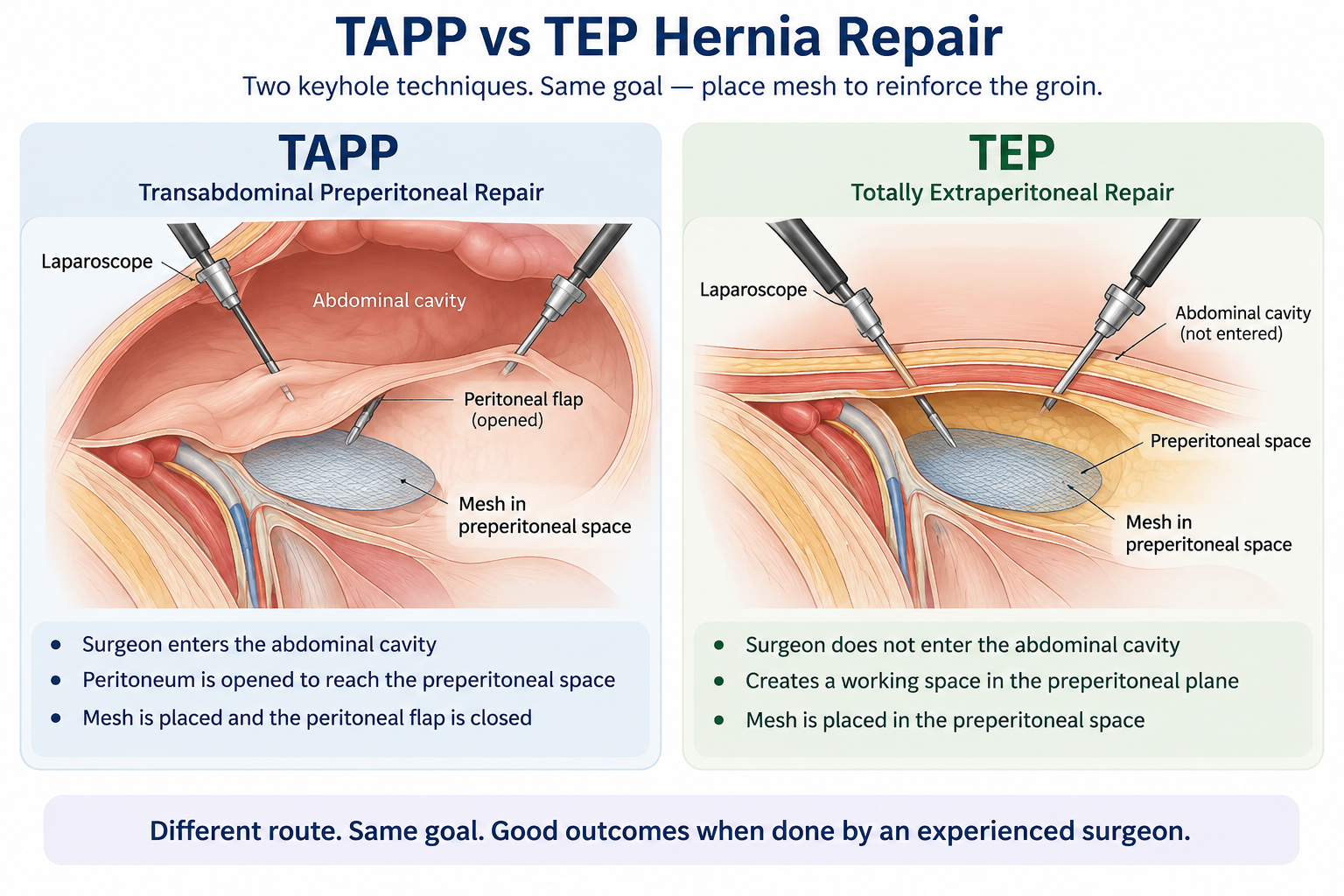
TAPP and TEP are both keyhole repairs for inguinal hernia. In TAPP, the surgeon enters the abdominal cavity and lifts a flap of peritoneum to place the mesh; in TEP, the mesh is placed outside the abdominal cavity without entering it. Both can provide good outcomes, so the choice depends on the hernia, patient factors, and the surgeon’s judgement. So, is TAPP surgery better than TEP? There is no single answer for every patient. Current international guidance supports both TAPP and TEP as established laparoscopic approaches when appropriate expertise and resources are available.
Patients considering laparoscopic inguinal hernia surgery often come across two terms: TAPP and TEP. Both are minimally invasive techniques used to reinforce the weakened groin area with mesh, but the route the surgeon takes to reach that area is different.
What Is Laparoscopic Hernia Repair?
Laparoscopic hernia repair is a keyhole operation in which a surgeon uses small abdominal incisions, a camera, and specialized instruments to repair an inguinal hernia, usually by placing mesh in the preperitoneal space.
An inguinal hernia develops when tissue pushes through a weak area in the groin. During laparoscopic repair, the aim is not simply to push the bulge back. The surgeon covers the weakened area with an appropriately positioned mesh to reinforce the groin.
Two commonly used laparoscopic approaches are:
- TAPP: Transabdominal Preperitoneal repair
- TEP: Totally Extraperitoneal repair
Both ultimately aim to reinforce the groin from the posterior, preperitoneal side. The major difference is how the surgeon reaches this space.
You can learn more about laparoscopic hernia treatment at Arora Elite Care.
What Does TAPP Mean and How Is It Done?
TAPP stands for Transabdominal Preperitoneal repair. During TAPP surgery, the surgeon enters the abdominal cavity, opens the peritoneum, and reaches the preperitoneal space to repair the hernia with mesh.
A typical TAPP procedure involves several steps.
First, the anesthesia team gives general anesthesia. The surgeon then makes small keyhole incisions and inserts a laparoscope to get a magnified view inside the abdomen.
Next, the surgeon identifies the hernia from inside the abdominal cavity and creates a flap in the peritoneum, the thin lining that covers the abdominal cavity.
The surgeon then enters the preperitoneal space, carefully manages the hernia sac, and exposes the important structures of the groin.
Next, the surgeon positions a suitably sized mesh over the weak areas to reinforce the groin and reduce the risk of the hernia returning.
Finally, the surgeon closes the peritoneal flap, which keeps the mesh separated from the abdominal organs.
Although the surgeon enters the abdominal cavity during TAPP surgery, the mesh sits in the preperitoneal plane rather than lying freely against the bowel.
What Does TAPP Mean and How Is It Done?
TAPP stands for Transabdominal Preperitoneal repair. During TAPP surgery, the surgeon enters the abdominal cavity, opens the peritoneum, and reaches the preperitoneal space to repair the hernia with mesh.
A typical TAPP procedure involves several steps.
First, the anesthesia team gives general anesthesia. The surgeon then makes small keyhole incisions and inserts a laparoscope to get a magnified view inside the abdomen. Next, the surgeon identifies the hernia from inside the abdominal cavity and creates a flap in the peritoneum, the thin lining that covers the abdominal cavity. The surgeon then enters the preperitoneal space, carefully manages the hernia sac, and exposes the important structures of the groin.
Next, the surgeon positions a suitably sized mesh over the weak areas to reinforce the groin and reduce the risk of the hernia returning. Finally, the surgeon closes the peritoneal flap, which keeps the mesh separated from the abdominal organs. Although the surgeon enters the abdominal cavity during TAPP surgery, the mesh sits in the preperitoneal plane rather than lying freely against the bowel.
What Is the Difference Between TAPP and TEP?
The main difference between TAPP and TEP is the route used to reach the preperitoneal space. TAPP enters the abdominal cavity first, whereas TEP reaches the repair area without intentionally entering that cavity.
Here is a practical comparison:
| Feature | TAPP | TEP |
|---|---|---|
| Full name | Transabdominal Preperitoneal | Totally Extraperitoneal |
| How surgeon enters | Enters abdominal cavity before accessing preperitoneal space | Develops preperitoneal space without intentional abdominal-cavity entry |
| Mesh position | Preperitoneal | Preperitoneal |
| View | Allows inspection from within the abdominal cavity | Operates mainly within the extraperitoneal working space |
| May be considered for | Selected unilateral, bilateral or recurrent groin hernias depending on circumstances | Selected unilateral, bilateral or recurrent groin hernias depending on circumstances |
| Learning curve | Requires advanced laparoscopic hernia skills | Also technically demanding; creation and maintenance of the extraperitoneal space is important |
| Typical recovery | Usually similar overall to TEP when uncomplicated | Usually similar overall to TAPP when uncomplicated |
This is why TAPP vs TEP should not be presented as a simple winner-versus-loser comparison.
International HerniaSurge guidance recognizes both TAPP and TEP as established laparo-endoscopic techniques. Outcomes depend substantially on appropriate patient selection and surgical expertise.
Which Is Better for Bilateral or Recurrent Hernia?
A laparo-endoscopic approach can work well for selected bilateral inguinal hernias and some recurrent hernias. The surgeon chooses between TAPP and TEP based on the individual case, hernia characteristics, previous surgery, and surgical expertise.
For a bilateral hernia, the posterior keyhole approach allows the surgeon to evaluate and repair both sides during the same operation when appropriate.
For a recurrent inguinal hernia, the type of previous repair plays an important role.
If the patient previously underwent an anterior or open repair, the surgeon may use a posterior laparoscopic approach to access a different tissue plane. Previous abdominal or pelvic surgery and individual anatomy can also affect the choice between TAPP and TEP.
Does TAPP Surgery Use Mesh?
Yes. Standard TAPP surgery commonly uses a surgical mesh placed in the preperitoneal space to reinforce the weak area associated with the inguinal hernia. TEP commonly uses mesh in the same anatomical plane.
Mesh-based repair is recommended for the majority of patients undergoing inguinal hernia repair, although selected patients may be considered for non-mesh techniques after appropriate discussion.
Mesh choice and fixation are also more nuanced than simply choosing a “light” or “heavy” mesh.
For example, the updated HerniaSurge guideline makes specific recommendations concerning mesh characteristics in laparo-endoscopic repair, particularly for larger direct defects.
Similarly, mesh does not always need traumatic fixation. International guidance specifically recommends fixation for large direct hernias undergoing TAPP or TEP to reduce recurrence risk.
This is why laparoscopic hernia repair mesh selection, size, positioning, and fixation should be individualized by the operating surgeon.
What Are the Risks of TAPP and TEP?
Both TAPP and TEP are established operations, but neither is risk-free. Possible complications include bleeding, infection, seroma, urinary problems, injury to nearby structures, persistent groin discomfort, and hernia recurrence.
Because the operative routes differ, some technique-specific considerations also differ.
With TAPP, the surgeon enters the peritoneal cavity. This means careful access, handling, and closure of the peritoneum are important.
With TEP, the abdominal cavity is not intentionally entered, but creating and maintaining the correct extraperitoneal working space can be technically challenging.
Possible risks after laparoscopic inguinal hernia repair may include:
- Bleeding or hematoma
- Seroma or temporary swelling
- Infection
- Difficulty passing urine temporarily
- Injury to blood vessels or nearby structures
- Mesh-related complications
- Persistent or chronic groin pain
- Hernia recurrence
- Anesthesia-related complications
The individual risk varies according to age, health, hernia characteristics, previous operations, and surgical factors.
Is TAPP Better Than TEP?
Neither TAPP nor TEP is universally better. For many patients, both are reasonable techniques, and surgeon experience with the chosen approach is an important part of achieving a good repair.
This is especially important when reading online comparisons.
A claim such as “TEP is always safer because the abdomen is not entered” is too simplistic. Likewise, saying “TAPP is always better because the surgeon can see inside the abdomen” overstates its advantage.
International guidance supports both approaches rather than declaring one universal winner.
The appropriate question is therefore:
Which technique is more suitable for this patient and this particular hernia?
How Long Is Recovery After Keyhole Hernia Surgery?
Many patients can begin walking soon after uncomplicated keyhole hernia surgery and progressively return to normal daily activities, but full recovery varies between individuals.
Mild groin discomfort, abdominal soreness, bruising, or swelling can occur during the early recovery period.
Doctors generally encourage patients to start walking and moving soon after surgery instead of staying continuously in bed. The surgeon guides the return to work, exercise, and heavier activities according to the patient’s comfort and recovery.
International evidence shows that, in appropriately selected patients, laparo-endoscopic approaches can support faster recovery and less postoperative or chronic pain compared with some traditional anterior open repairs when surgeons have appropriate expertise.
However, keyhole does not mean zero pain or instant recovery.
Seek medical advice after surgery if you develop worsening pain, persistent vomiting, significant swelling, fever, increasing wound redness, or another unexpected symptom.
Hernia Repair at Arora Elite Care
Patients considering TAPP surgery, TEP, or another inguinal hernia repair should first have the type and characteristics of the hernia properly assessed.
At Arora Elite Care in Surat, Dr. Hitesh Arora, Advanced Laparoscopic and General Surgeon, evaluates patients with inguinal and other hernias and discusses an appropriate surgical approach based on the individual case.
The decision may consider:
- Whether the hernia is unilateral or bilateral
- Whether it is a first-time or recurrent hernia
- Size and type of the defect
- Previous abdominal or pelvic operations
- General health and anesthesia considerations
- Open versus laparoscopic options
- Technical suitability for TAPP or TEP
- Surgeon experience with the planned technique
Learn more about laparoscopic hernia surgery in Surat.
For evidence-based background, the European Hernia Society guidelines and the updated international HerniaSurge guidelines provide detailed recommendations for groin hernia management.
Conclusion: TAPP vs TEP — Which Should You Choose?
TAPP and TEP are two established forms of keyhole hernia surgery. Both place mesh in the preperitoneal plane, but they reach that space differently.
In TAPP surgery, the surgeon enters the abdominal cavity and opens the peritoneum before positioning the mesh. In TEP, the surgeon develops the preperitoneal space without intentionally entering the abdominal cavity.
The choice should be individualized according to the type of inguinal hernia, whether it is unilateral, bilateral, or recurrent, previous operations, patient factors, and the surgeon’s experience.
If you have an inguinal hernia and want to understand which repair may be appropriate, a surgical examination is more useful than choosing TAPP or TEP based only on an online comparison.