
Reviewed for patient education by Dr. Tanu Arora, Arora Elite Care, Surat. Most ovarian cysts are benign, and many functional cysts disappear without treatment. Ovarian cyst treatment depends on the cyst’s type, size, appearance, symptoms, age, and menopausal status. Surgery may be considered when a cyst is large, persistent, painful, or concerning on imaging. When a cyst appears benign, laparoscopic ovarian cystectomy can often remove the cyst while preserving healthy ovarian tissue.
Finding an ovarian cyst on an ultrasound can naturally raise questions about surgery, fertility, periods, and whether the cyst could be serious.
However, finding a cyst does not automatically mean you need an operation.
Many ovarian cysts, particularly functional cysts during the reproductive years, resolve without treatment. ACOG notes that functional cysts often disappear within about 6–8 weeks, while other cysts may need monitoring or treatment depending on their characteristics.
The first goal of ovarian cyst treatment is therefore to identify what type of cyst you have and whether observation, follow-up imaging, or surgery is appropriate.
What Is an Ovarian Cyst?
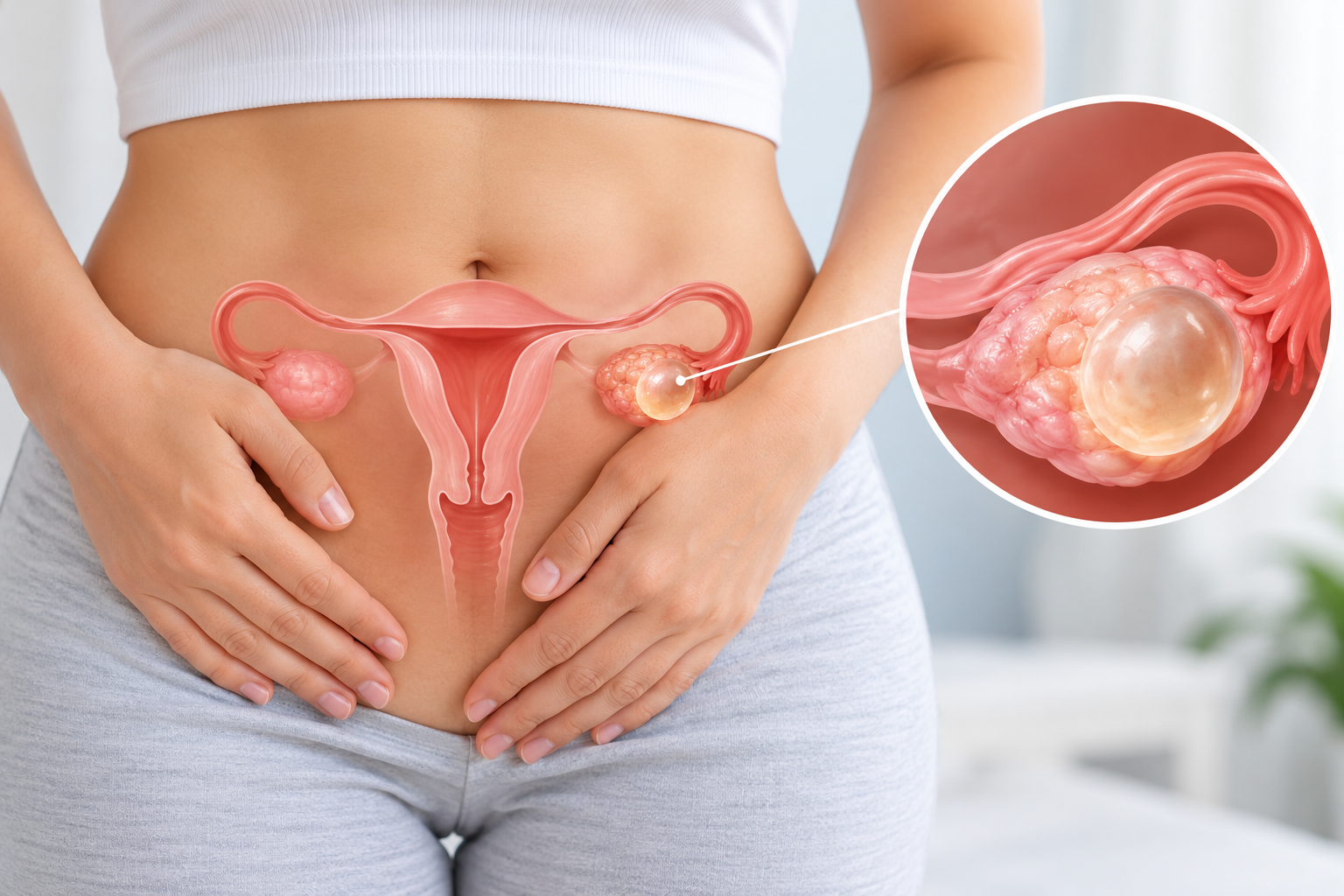
An ovarian cyst is a fluid-filled or tissue-containing sac that develops in or on an ovary. Most ovarian cysts are benign, and many cause no symptoms.
The ovaries naturally change during the menstrual cycle, so some cysts form as part of normal ovarian function.
Common types include:
- Functional cysts
- Dermoid cysts or mature teratomas
- Endometriomas associated with endometriosis
- Cystadenomas
- Other benign or suspicious ovarian masses
Others may cause pelvic pain, pressure, bloating, discomfort during certain activities, or sudden pain if complications such as rupture or torsion occur.
Which Ovarian Cysts Need Treatment?
Not every ovarian cyst requires active treatment. The decision depends on symptoms, cyst size and appearance, whether it persists on repeat scans, age, menopausal status, and whether imaging raises concern about malignancy.
For a simple functional cyst without concerning features, the doctor may recommend watchful waiting.
This means repeating an ultrasound after an appropriate interval to see whether the cyst has disappeared, remained stable, or changed.
ACOG notes that many cysts disappear after one or two menstrual cycles.
Treatment becomes more relevant when the cyst:
- Persists on follow-up
- Becomes larger
- Causes significant symptoms
- Has complex or concerning ultrasound features
- Causes complications
- Raises concern about cancer
There is therefore no single ovarian cyst treatment that suits every patient.
What Are the Common Types of Ovarian Cysts?
Different cysts behave differently, which is why ultrasound findings matter when planning treatment.
| Cyst Type | Typical Behaviour | Usual Management | When Surgery May Be Considered |
|---|---|---|---|
| Functional cyst | Often resolves naturally | Observation and follow-up when appropriate | Persistent, large, symptomatic, or complicated cyst |
| Dermoid cyst | Usually benign but may persist or grow | Monitoring or surgery depending on circumstances | Symptoms, size, growth, torsion risk, or other concerns |
| Endometrioma | Associated with endometriosis | Individualized according to symptoms and fertility plans | Selected cases involving pain, fertility considerations, size, or other clinical factors |
| Suspicious cyst | May have complex features requiring further assessment | Specialist evaluation and investigations | Surgery may be required for diagnosis and treatment |
A cyst’s size alone should not be interpreted without considering its appearance, symptoms, age, and other clinical factors.
When Is Ovarian Cyst Surgery Necessary?
Ovarian cyst surgery may be recommended when a cyst is very large, persistent, symptomatic, or concerning for cancer. The decision should consider the patient’s age, fertility plans, cyst characteristics, and overall clinical picture.
According to ACOG, surgery may be recommended when a cyst is very large, causes symptoms, or raises suspicion of cancer.
The purpose of surgery can differ between patients.
For one patient, surgery may aim to relieve persistent pain.
For another, the goal may be to remove a growing dermoid cyst.
In another case, imaging findings may require removal so the tissue can undergo laboratory examination.
This is why there is no universal cyst size at which every patient automatically needs surgery.
How Is Laparoscopic Ovarian Cyst Removal Done?
Laparoscopic ovarian cystectomy uses small abdominal incisions and a camera to access the ovary and remove the cyst. When appropriate, the surgeon aims to separate the cyst from the ovary while preserving as much healthy ovarian tissue as possible.
The procedure generally takes place under general anaesthesia.
A laparoscope, a thin camera, is introduced through a small incision. Additional small incisions allow the surgeon to use specialized instruments.
The surgeon identifies the affected ovary, assesses the cyst, and performs the planned procedure.
When the cyst appears benign and cystectomy is technically appropriate, the surgeon removes the cyst while attempting to preserve the remaining ovary.
ACOG recommends minimally invasive surgery when a cyst is thought to be benign. Open surgery may instead be necessary when a cyst is particularly large, or cancer is suspected.
Patients considering minimally invasive treatment can learn more about gynecological laparoscopy in Surat.
Will the Ovary Be Removed Too?
Not necessarily. In many premenopausal patients with a benign ovarian cyst, the goal is to remove the cyst while preserving the ovary whenever clinically and technically appropriate.
Removing only the cyst is called an ovarian cystectomy.
Removing an ovary is called an oophorectomy.
An ovary may need to be removed in some situations, for example, when the cyst has replaced most of the normal ovarian tissue, the ovary has been severely damaged, or there is concern about malignancy.
NHS guidance states that surgeons generally try to preserve as much of the reproductive system as possible in patients who have not reached menopause.
Your surgeon should discuss this possibility before surgery whenever reasonably predictable.
Does Ovarian Cyst Surgery Affect Fertility?
Ovarian cyst surgery does not automatically cause infertility. When possible, ovarian cystectomy aims to remove the cyst while preserving healthy ovarian tissue, but the effect on fertility depends on the cyst, the amount of healthy ovarian tissue, the procedure performed, and the patient’s underlying reproductive health.
For many benign cysts, the surgeon can remove the cyst and leave both ovaries intact.
Even when one ovary needs removal, the remaining ovary can continue releasing hormones and eggs. NHS guidance notes that fertility may remain preserved with one functioning ovary, although individual circumstances vary.
Fertility deserves particular discussion when treating:
- Endometriomas
- Cysts affecting both ovaries
- Recurrent ovarian cysts
- Large cysts that have replaced normal ovarian tissue
- Patients with reduced ovarian reserve
- Patients already experiencing difficulty conceiving
If future pregnancy matters to you, discuss fertility goals with the gynecologist before surgery, not only after the operation.
What Is Recovery Like After Ovarian Cyst Surgery?
Recovery depends on whether surgery is laparoscopic or open, the cyst’s size, the extent of surgery, and individual healing. Laparoscopy generally causes less postoperative pain and allows quicker recovery than open abdominal surgery.
After laparoscopic surgery, some patients can return home the same day or the following day.
During early recovery, you may experience:
- Abdominal soreness
- Mild bloating
- Tiredness
- Discomfort around the small incisions
- Temporary shoulder discomfort related to the gas used during laparoscopy
- Light vaginal bleeding or discharge in some cases
Walking and gentle activity usually increase gradually according to comfort and the surgeon’s instructions.
Avoid treating a fixed “two-week recovery” as a guarantee. The NHS notes that complete return to normal activities after ovarian cyst surgery can take longer for some patients.
Contact your healthcare team if you develop severe or increasing abdominal pain, heavy bleeding, fever, significant swelling, or dark or unpleasant-smelling vaginal discharge.
What Are the Side Effects After Ovarian Cyst Removal?
Most early effects after ovarian cyst removal relate to surgery and anaesthesia and improve during recovery. The exact experience depends on whether you had cystectomy, removal of an ovary, laparoscopy, or open surgery.
Possible short-term effects can include:
- Abdominal discomfort
- Bloating
- Fatigue
- Incision discomfort
- Temporary changes in activity levels
- Mild vaginal bleeding in some patients
Periods may not necessarily change permanently after a straightforward ovarian cystectomy in which healthy ovarian tissue remains.
The longer-term effects depend more on what surgery was required.
For example, removing one ovary differs considerably from removing both ovaries. Removal of both ovaries before natural menopause has major hormonal and fertility consequences and requires detailed counselling.
What Is Ovarian Torsion and Why Is It an Emergency?
Ovarian torsion occurs when an ovary twists around its supporting tissues, potentially reducing or cutting off its blood supply. Sudden severe pelvic or lower abdominal pain requires urgent medical assessment, particularly when accompanied by nausea or vomiting.
Larger ovarian cysts or masses can increase the possibility of ovarian twisting. ACOG notes that larger cysts may cause ovarian torsion and sudden pain.
Torsion is different from routine ovarian cyst discomfort.
Possible warning symptoms include:
- Sudden severe one-sided pelvic pain
- Nausea
- Vomiting
- Rapidly worsening pain
These symptoms should not wait for a routine outpatient appointment.
Prompt assessment matters because prolonged loss of blood supply can damage ovarian tissue.
Ovarian Cyst Treatment with Dr. Tanu Arora in Surat
At Arora Elite Care, ovarian cyst assessment and gynecological laparoscopic care are provided by Dr. Tanu Arora. Treatment planning starts with identifying the cyst type and deciding whether monitoring or intervention is appropriate.
The consultation may include a review of:
- Symptoms
- Menstrual history
- Previous scans
- Cyst size and ultrasound appearance
- Previous ovarian or pelvic surgery
- Fertility plans
- Menopausal status
- Other relevant health conditions
When surgery becomes necessary, the goal is to select an appropriate approach while considering ovarian preservation and future fertility where relevant.
You can learn more about Dr. Tanu Arora and the clinic’s gynecological laparoscopy services in Surat.
If you have been diagnosed with an ovarian cyst or have been advised to consider surgery, you can book an appointment at Arora Elite Care for an individualized assessment.
For independent patient information about ovarian cyst diagnosis and management, see the American College of Obstetricians and Gynecologists ovarian cyst guide and NHS ovarian cyst treatment guide.
Frequently Asked Questions
Do Ovarian Cysts Go Away on Their Own?
Yes, many functional ovarian cysts disappear without treatment. ACOG notes that functional cysts often resolve within about six to eight weeks. Other cysts may persist and require monitoring or treatment. Your doctor will consider the cyst’s size, appearance, symptoms, and your age when recommending follow-up.
What Size Ovarian Cyst Needs Surgery?
There is no single cyst size that automatically means every patient needs surgery. Size is considered alongside symptoms, ultrasound appearance, persistence, age, menopausal status, and concern about complications or malignancy. Large, persistent, symptomatic, or suspicious cysts are more likely to require surgical treatment.
Does Ovarian Cyst Removal Affect Periods?
A cystectomy that preserves functioning ovarian tissue does not necessarily cause permanent menstrual changes. Temporary cycle changes can occur around surgery. If one ovary is removed, the remaining ovary can usually continue hormonal and ovulatory function. The effect depends on the operation and underlying ovarian condition.
Can I Get Pregnant After Ovarian Cyst Surgery?
Yes, pregnancy can remain possible after ovarian cyst surgery. Surgeons generally try to preserve healthy ovarian tissue when appropriate. Fertility outcomes depend on the cyst type, ovarian reserve, whether one or both ovaries are affected, other reproductive conditions, and how much ovarian tissue the surgery must remove.
What Are the Side Effects After Ovarian Cyst Removal?
Temporary abdominal pain, bloating, tiredness, incision discomfort, and light vaginal bleeding can occur after surgery. Recovery varies according to whether you undergo laparoscopy or open surgery and how extensive the procedure is. Severe pain, fever, heavy bleeding, or abnormal discharge should prompt medical advice.
Is Ovarian Cyst Surgery Painful?
Some postoperative discomfort is expected, but the amount varies by procedure and patient. Laparoscopic surgery generally causes less pain and provides quicker recovery than open abdominal surgery. Your surgical team can explain expected discomfort, pain-relief options, activity restrictions, and warning symptoms before you leave the hospital.
The Key Point
Most ovarian cysts do not automatically require an operation.
Effective ovarian cyst treatment begins by identifying the type of cyst, its ultrasound characteristics, symptoms, persistence, and the patient’s reproductive goals.
When surgery is necessary, laparoscopic ovarian cystectomy can often remove a benign cyst while preserving healthy ovarian tissue. However, some large or suspicious cysts may require a different surgical approach.
Fertility concerns should form part of treatment planning, particularly for younger patients, recurrent cysts, endometriomas, or cysts affecting both ovaries.