
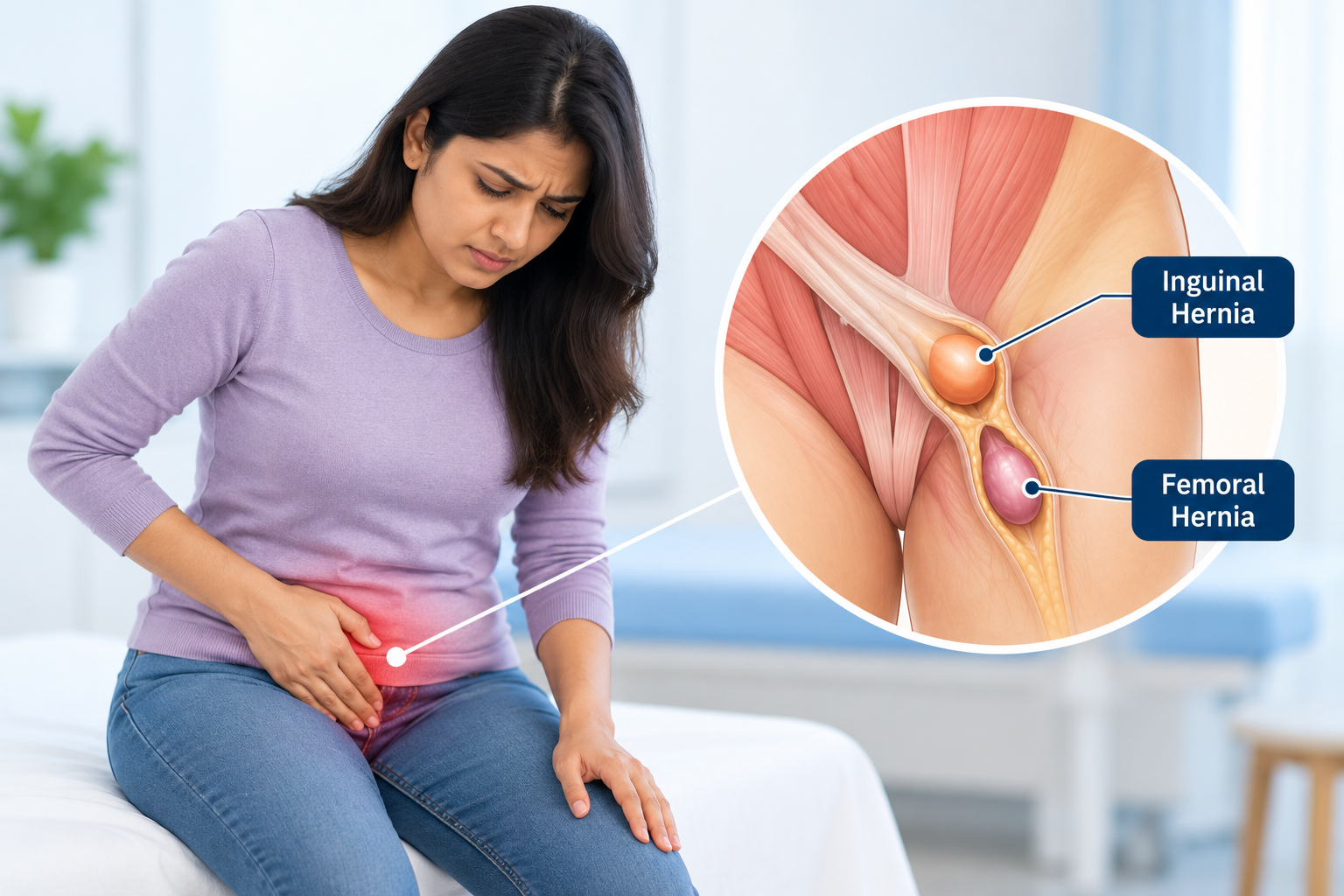
A hernia in women occurs when fatty tissue or part of an internal organ pushes through a weakened area of the abdominal wall. Common symptoms include groin pain, swelling, heaviness, or a lump near the groin or upper thigh. Inguinal hernias develop in the inguinal canal, while femoral hernias occur below the inguinal ligament. Femoral hernias are particularly important to recognise because they have a higher risk of trapping bowel and causing serious complications.
Many people associate hernias with men, but women can also develop groin hernias. In some cases, symptoms are subtle, and there may be no visible swelling.
A woman may experience discomfort while walking, coughing, lifting objects, or performing daily activities without realising that a hernia could be responsible.
Understanding the symptoms of a hernia in women can help patients seek timely medical assessment and avoid complications.
What Is a Hernia in Women?
A hernia in women develops when abdominal tissue pushes through a weak spot or opening in the surrounding muscle or connective tissue.
Groin hernias mainly include inguinal and femoral hernias.
An inguinal hernia occurs through the inguinal region, while a femoral hernia develops through the femoral canal near the upper thigh.
Both conditions may cause discomfort, swelling, or a noticeable lump.
However, some women experience pain without a clearly visible bulge.
Groin hernias do not usually repair themselves. Treatment depends on the type of hernia, symptoms, and risk of complications.
What Are the Common Symptoms of Hernia in Women?
The most common symptoms of a hernia in women include groin discomfort, swelling, heaviness, and pain that becomes more noticeable during physical activity.
Symptoms may include:
-
A lump or swelling in the groin
-
Pain while coughing or straining
-
A pulling or dragging sensation
-
Groin discomfort during walking or exercise
-
Pressure near the lower abdomen
-
Swelling near the upper inner thigh
-
Discomfort while lifting heavy objects
-
A bulge that becomes more noticeable while standing
Some women notice that the swelling becomes smaller when lying down.
Others experience intermittent groin pain without any obvious lump.
Symptoms alone cannot confirm a hernia because several other conditions can produce similar discomfort.
What Is an Inguinal Hernia in Women?
An inguinal hernia in women occurs when tissue protrudes through a weakened area in the inguinal canal of the groin.
Although inguinal hernias are more common in men, women can develop them.
The inguinal canal contains structures such as the round ligament of the uterus.
A weakness in this region may allow abdominal fat or other tissue to protrude.
Symptoms of Inguinal Hernia in Women
Common symptoms include:
-
Swelling in the groin
-
Pain during coughing or lifting
-
A dragging sensation in the lower abdomen
-
Discomfort while standing for long periods
-
A lump that changes in size with activity
Some inguinal hernias cause minimal symptoms.
However, women with suspected groin hernias should undergo surgical evaluation because a femoral hernia can sometimes be mistaken for an inguinal hernia.
What Is a Femoral Hernia in Women?
A femoral hernia occurs when abdominal tissue pushes through the femoral canal, creating a bulge below the inguinal ligament near the upper inner thigh.
Femoral hernias are less common than inguinal hernias overall, but they account for a greater proportion of groin hernias in women.
The femoral canal is a relatively narrow space.
Because of this narrow opening, tissue trapped inside a femoral hernia may be more likely to become incarcerated or strangulated.
Symptoms of Femoral Hernia
Possible symptoms include:
-
A small lump in the upper inner thigh
-
Pain near the groin crease
-
Discomfort while walking
-
Tenderness around the swelling
-
A persistent or increasing bulge
Some femoral hernias produce few symptoms until complications develop.
This makes early diagnosis particularly important.
Femoral vs Inguinal Hernia: Key Differences
The main difference between femoral and inguinal hernias is their anatomical location and risk of complications.
| Factor | Inguinal Hernia | Femoral Hernia |
|---|---|---|
| Location | Above the inguinal ligament | Below the inguinal ligament |
| Frequency | More common overall | Less common overall |
| Occurrence in women | Possible | Proportionally more frequent than in men |
| Typical swelling | Groin region | Lower groin or upper inner thigh |
| Symptoms | Pain, pressure, or bulging | Groin or upper-thigh discomfort |
| Complication risk | Can become trapped or strangulated | Higher risk of incarceration and strangulation |
| Treatment | Surgical repair commonly recommended in women | Timely surgical repair usually recommended |
The exact diagnosis requires examination and sometimes imaging.
Why Are Femoral Hernias More Concerning in Women?
Femoral hernias carry a relatively high risk of incarceration and strangulation because tissue can become trapped within the narrow femoral canal.
Incarceration occurs when the herniated tissue becomes stuck and cannot return to its normal position.
Strangulation occurs when the blood supply to the trapped tissue becomes compromised.
If the trapped tissue includes part of the intestine, strangulation can cause bowel damage and become life-threatening.
For this reason, doctors generally recommend timely surgical repair for femoral hernias rather than prolonged observation.
Women with suspected femoral hernias should not rely on a hernia belt or home remedies as a substitute for medical assessment.
What Causes Groin Hernias in Women?
Groin hernias develop because of weakness in the abdominal wall, sometimes combined with increased pressure inside the abdomen.
Factors that may contribute include:
1. Natural Tissue Weakness
Some women have anatomical weaknesses that make certain areas of the groin more vulnerable to hernia formation.
2. Pregnancy
Pregnancy increases abdominal pressure and stretches abdominal tissues.
However, not every groin lump during pregnancy is a hernia.
3. Chronic Constipation
Repeated straining during bowel movements increases abdominal pressure.
4. Persistent Coughing
Chronic coughing repeatedly increases pressure on the abdominal wall.
5. Heavy Physical Exertion
Lifting heavy objects or performing strenuous activities may reveal or aggravate an existing weakness.
6. Age-Related Tissue Changes
Connective tissues may weaken with age, increasing susceptibility to certain hernias.
These factors do not guarantee that a hernia will develop.
Can Women Have a Hernia Without a Visible Lump?
Yes. Some women experience groin pain from an occult or hidden hernia without a clearly visible or palpable bulge.
Symptoms may occur during exercise, coughing, prolonged standing, or other activities that increase abdominal pressure.
A small hernia may not be obvious during a routine examination.
In selected cases, ultrasound or MRI may help identify an occult groin hernia.
However, not all unexplained groin pain results from a hernia.
Doctors must also consider other causes, including:
-
Muscle strain
-
Hip joint disorders
-
Enlarged lymph nodes
-
Tendon injuries
-
Gynaecological conditions
-
Nerve-related pain
A careful examination helps avoid unnecessary treatment.
How Do Doctors Diagnose a Hernia in Women?
Doctors diagnose groin hernias through medical history, physical examination, and imaging when necessary.
The surgeon asks about the location of pain, swelling, physical activity, and changes in symptoms.
During the examination, the doctor may assess the groin while the patient stands, lies down, or coughs.
Ultrasound
Ultrasound can help detect a hernia and distinguish it from certain other causes of groin swelling.
Dynamic ultrasound may be useful when symptoms occur during straining.
MRI
MRI may help investigate suspected occult hernias when the examination and ultrasound findings remain inconclusive.
CT Scan
A CT scan may be useful in selected complex cases or when doctors suspect complications.
Not every patient requires all these investigations.
Learn more about hernia symptoms and treatment to understand how doctors evaluate different hernia conditions.
Can a Hernia in Women Heal Without Surgery?
A true groin hernia does not usually close permanently without surgery because the underlying tissue weakness remains.
Lifestyle measures may reduce discomfort, but they do not repair the defect.
Patients may benefit from:
-
Avoiding unnecessary straining
-
Treating constipation
-
Managing chronic coughing
-
Maintaining a healthy weight
-
Following medical advice about physical activity
Can Women Use a Hernia Belt?
A hernia belt or truss may provide temporary support in selected situations, but it does not cure a hernia.
An incorrectly fitted belt may also cause discomfort.
Women should not use a hernia belt to delay assessment of a suspected femoral hernia.
International groin hernia guidelines generally favour timely repair in non-pregnant women with groin hernias because femoral hernias may be overlooked and have a higher emergency complication risk.
What Are the Treatment Options for Hernia in Women?
Surgical repair is commonly recommended for groin hernias in women, particularly when a femoral hernia is suspected or confirmed.
The main surgical approaches include open and laparoscopic repair.
Open Hernia Repair
During open surgery, the surgeon makes an incision near the hernia.
The surgeon returns the protruding tissue to its normal position and repairs the weakened area.
Mesh reinforcement may be used depending on the hernia and repair technique.
Laparoscopic Hernia Repair
Laparoscopic surgery uses small incisions, a camera, and specialised instruments.
Common laparoscopic groin hernia procedures include:
-
TAPP: Transabdominal Preperitoneal Repair
-
TEP: Totally Extraperitoneal Repair
These approaches allow the surgeon to inspect and reinforce the groin region, including areas where femoral hernias may develop.
For appropriately selected women, laparoscopic repair is often preferred when suitable expertise is available because it can help identify femoral defects and may reduce chronic postoperative pain compared with some open approaches.
However, the surgeon considers previous operations, pregnancy status, overall health, and other factors before selecting a technique.
Read more about laparoscopic hernia surgery in Surat and the available treatment approaches.
When Is a Hernia in Women an Emergency?
A groin hernia becomes an emergency when tissue becomes trapped, bowel obstruction develops, or the blood supply to the herniated tissue is compromised.
Seek immediate emergency medical care if you experience:
-
Sudden, severe groin or abdominal pain
-
A painful lump that cannot be reduced
-
Persistent vomiting
-
Increasing abdominal swelling
-
Skin redness or discolouration over the bulge
-
Inability to pass stool or gas with abdominal pain
These symptoms may indicate incarceration, bowel obstruction, or strangulation.
Do not attempt to force a severely painful hernia back into place.
Prompt emergency treatment can prevent serious complications.
Hernia Treatment at Arora Elite Care, Surat
At Arora Elite Care, Dr. Hitesh Arora, Advanced Laparoscopic and General Surgeon, evaluates patients with inguinal, femoral, and other abdominal wall hernias.
A surgical consultation may include:
-
Assessment of groin pain and swelling
-
Examination for inguinal and femoral hernias
-
Imaging when clinically necessary
-
Discussion of open and laparoscopic repair
-
Assessment of individual surgical risks
-
Recovery and follow-up planning
The aim is to identify the type of hernia and recommend an appropriate treatment plan.
Women experiencing persistent groin discomfort or swelling can book a surgery consultation in Surat for an individual evaluation.
If severe pain, vomiting, or other emergency symptoms occur, seek immediate emergency care instead of waiting for a routine appointment.
Conclusion
A hernia in women can cause groin pain, swelling, heaviness, or discomfort, even when no visible lump is present.
Inguinal and femoral hernias are the main types of groin hernias in women.
Femoral hernias deserve particular attention because they have a higher risk of incarceration and strangulation.
Although a hernia belt or lifestyle changes may temporarily reduce discomfort, they cannot repair the underlying weakness.
Timely surgical assessment helps establish the diagnosis, distinguish a hernia from other causes of groin pain, and determine whether open or laparoscopic repair is appropriate.
Frequently Asked Questions
1. What Are the First Signs of a Hernia in Women?
The first signs may include groin pain, swelling, heaviness, or a pulling sensation that becomes more noticeable during coughing, lifting, or prolonged standing. Some women notice a small lump, while others experience pain without visible swelling. A surgical examination helps confirm whether a hernia is present.
2. Where Does a Femoral Hernia Cause Pain?
A femoral hernia may cause pain or discomfort in the lower groin or upper inner thigh, near the femoral canal. Some women notice a small lump in this region. Sudden severe pain, vomiting, or a painful irreducible lump requires immediate emergency assessment.
3. Can Women Have an Inguinal Hernia Without a Lump?
Yes. Small or occult inguinal hernias may cause groin discomfort without an obvious bulge. Symptoms may become more noticeable during physical activity or straining. Doctors may recommend dynamic ultrasound or MRI when examination findings are inconclusive and clinical suspicion remains.
4. Is a Femoral Hernia More Dangerous Than an Inguinal Hernia?
Femoral hernias generally have a higher risk of incarceration and strangulation because they pass through a narrow anatomical opening. This can lead to bowel obstruction or compromised blood supply. Timely surgical evaluation and repair are usually recommended when a femoral hernia is diagnosed.
5. Can a Hernia in Women Be Treated Without Surgery?
A true groin hernia generally does not heal permanently without surgery. Lifestyle changes may reduce symptoms but cannot close the defect. Because femoral hernias are more common among women with groin hernias and carry a higher complication risk, surgeons generally recommend timely assessment rather than prolonged watchful waiting.
6. Is Laparoscopic Hernia Surgery Suitable for Women?
Yes. Laparoscopic surgery is suitable for many women with inguinal or femoral hernias. Techniques such as TAPP and TEP allow surgeons to assess the groin region and repair suitable defects. However, previous operations, pregnancy status, medical conditions, and surgeon expertise influence the final treatment decision.