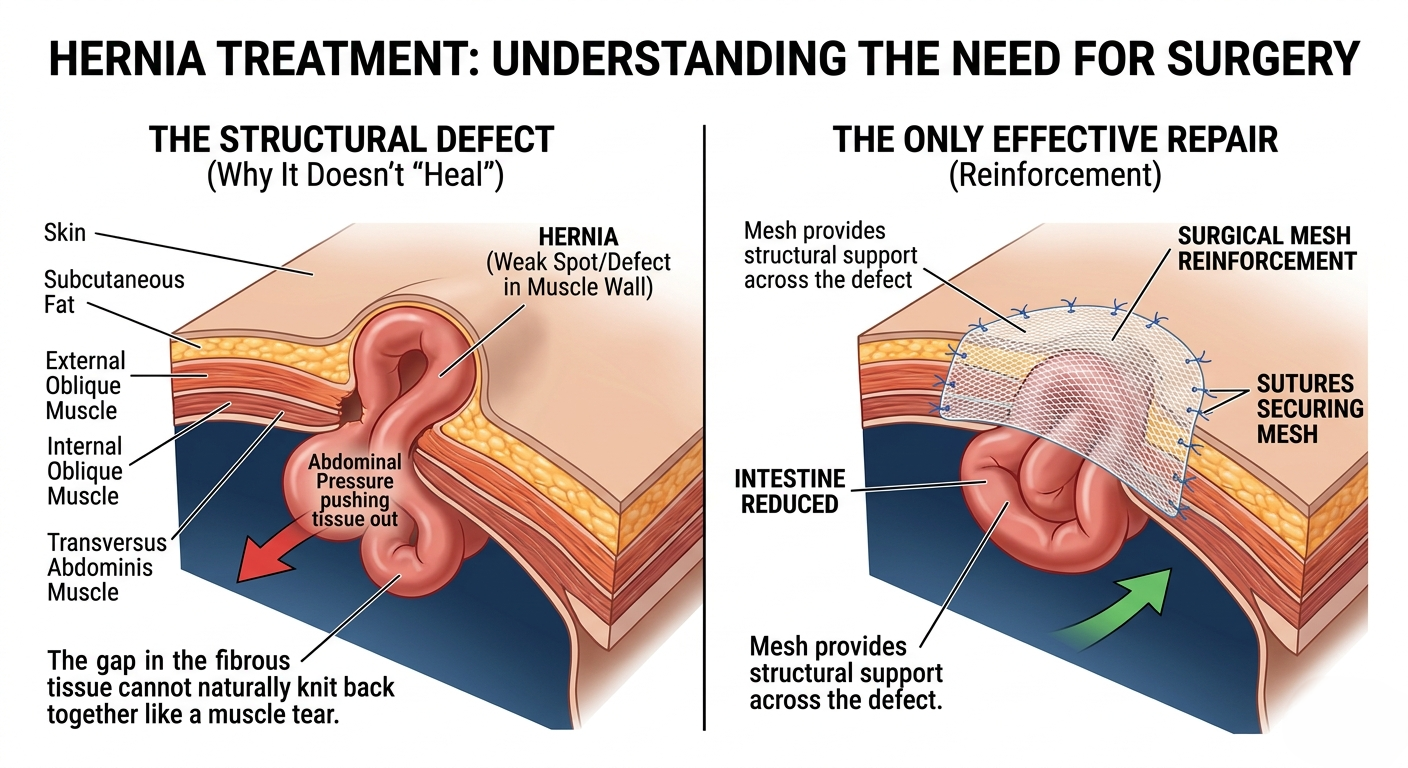
A hernia without surgery may sometimes remain stable when it causes little or no discomfort, but the abdominal wall defect does not close on its own. Medicines, exercise, or a hernia belt may help manage certain symptoms, but surgery is the only treatment that repairs the actual opening in the abdominal wall. Many people ask, can a hernia heal without surgery? The answer depends on what you mean by “heal.” Some small or minimally symptomatic hernias can remain stable with watchful waiting after a medical assessment. However, watchful waiting does not close the abdominal wall defect.
A hernia develops when tissue pushes through a weak area in the abdominal wall. Some hernias cause only a small, painless lump, while others cause discomfort during coughing, lifting, walking, or other activities.
Can a hernia close on its own?
No. An adult hernia does not normally close on its own. The weakness or opening in the abdominal wall remains, although the size of the bulge and the symptoms may change over time.
If a hernia without surgery causes little or no discomfort, your surgeon may recommend monitoring it instead of immediate surgery. However, increasing size, pain, difficulty pushing the bulge back, or other changes require medical review.
Why do hernias not heal without surgery?
A hernia develops because of a structural weakness or opening in the abdominal wall. Medicines can help manage certain symptoms, but they cannot rebuild the damaged or weakened abdominal wall.
Exercise can improve general muscle strength and fitness, but it cannot close an established hernia. Likewise, losing excess weight, treating constipation, or controlling a chronic cough can reduce pressure on the abdominal wall, but these measures do not repair the existing defect.
Therefore, a hernia without surgery may remain manageable in some people, but the underlying defect remains present.
Do hernia belts and trusses work?
A hernia belt or truss may provide temporary support and reduce discomfort for some people, but it does not repair the hernia. A poorly fitted support can also cause problems, so patients should discuss its use with a healthcare professional.
A belt may make a hernia without surgery feel more comfortable during certain activities, but it should not be considered a permanent cure. Some NHS guidance also advises caution with trusses because they may not hold a groin hernia effectively and incorrect fitting can cause complications.
| Approach | What it actually does | When it is appropriate | What it cannot do |
|---|---|---|---|
| Watchful waiting | Monitors symptoms and hernia changes | Small or minimally symptomatic hernias after medical assessment | Does not close the abdominal wall defect |
| Hernia belt | May provide temporary support or comfort | Selected patients when advised by a clinician | Does not cure or repair the hernia |
| Exercise | Maintains general strength and fitness | Gentle activity that does not cause pain or strain | Cannot close an established hernia |
| Surgery | Repairs the abdominal wall defect | Symptomatic, enlarging, difficult-to-reduce, or complicated hernias | Carries normal surgical risks that require individual assessment |
Can exercise or yoga cure a hernia?
No. Exercise or yoga cannot cure an established adult hernia. However, staying active can support general health when you choose activities that do not cause pain or excessive pressure around the hernia.
If you have a hernia without surgery, avoid exercises or heavy lifting that make the bulge painful or increase your symptoms. Your surgeon can guide you on suitable activities based on the type and size of your hernia.
NHS guidance also recommends staying active while avoiding activities that cause discomfort or place excessive stress around the hernia.
Is it safe to wait and watch?
Watchful waiting can be appropriate for some people, particularly those with small inguinal hernias that cause no or minimal symptoms. It means monitoring the hernia rather than ignoring it.
During watchful waiting, pay attention to changes in pain, size, and whether you can gently push the bulge back. A hernia without surgery may remain stable for some time, but any significant change should prompt medical review.
If your hernia starts causing regular pain, interferes with daily activities, becomes larger, or becomes difficult to push back, arrange a surgical assessment.
What are the warning signs of a strangulated hernia?
Seek urgent medical care if a hernia suddenly becomes very painful, firm, swollen, or difficult to push back. These symptoms become more concerning when they occur with nausea, vomiting, abdominal pain, or difficulty passing stool or gas.
A strangulated hernia can cut off the blood supply to trapped tissue and requires urgent assessment. Do not try to manage severe or rapidly worsening symptoms with a belt or home treatment.
When must you have surgery?
Surgery becomes more important when a hernia causes significant pain, interferes with daily activities, continues to enlarge, becomes difficult or impossible to reduce, or creates concern about complications.
The decision depends on the type of hernia, symptoms, size, reducibility, overall health, and other risk factors. Some minimally symptomatic inguinal hernias can undergo watchful waiting, while other hernia types may need earlier specialist assessment.
For patients asking Can a Hernia Heal Without Surgery?, it is important to understand that watchful waiting manages the situation but does not repair the abdominal wall defect.
Hernia repair can use open or laparoscopic techniques. For inguinal hernia repair, laparoscopic surgery uses small abdominal incisions and a camera. The surgeon repairs the weak area, often with mesh. The appropriate technique depends on the individual case.
Hernia Treatment at Arora Elite Care
At Arora Elite Care, Surat, Dr. Hitesh Arora provides evaluation and surgical treatment for different types of hernias. With more than 15 years of surgical experience, an M.S. qualification, FMAS training, and extensive laparoscopic experience, Dr. Hitesh Arora assesses the hernia type, symptoms, and overall health before recommending treatment.
Explore Your Hernia Treatment Options
If you want to understand your options, you can learn more about our inguinal hernia doctor in Surat, read about hernia recurrence after surgery, or compare laparoscopic TAPP and TEP approaches in our related post. You can also book an appointment for an.
Frequently Asked Questions
Does a hernia get bigger over time?
A hernia may increase in size over time, although the rate varies between people and hernia types. Some remain small and cause few symptoms for years, while others gradually become more noticeable or uncomfortable. A growing lump, increasing pain, or difficulty reducing the hernia deserves a surgical evaluation.
Can a hernia go back in on its own?
Some reducible hernias can move back into the abdominal cavity when you lie down or relax, and the bulge may disappear temporarily. This does not mean the hernia has healed. The underlying abdominal wall weakness remains, so the bulge can return when pressure increases.
Is a hernia belt safe to wear daily?
A hernia belt may provide temporary support for selected patients, but it does not repair the abdominal wall defect. Daily use should follow medical advice and proper fitting. A poorly fitted belt can cause discomfort or complications. Discuss long-term belt use with your surgeon rather than relying on it as a cure.
What happens if a hernia is left untreated for years?
Some small, minimally symptomatic inguinal hernias can remain stable under watchful waiting. However, a hernia does not repair itself during this time. It may enlarge or become more painful, and some hernias can become difficult to reduce or develop complications. Regular medical review helps monitor changes.
Is hernia surgery always necessary?
No. Surgery is not automatically necessary for every hernia at the time of diagnosis. Some people with small or minimally symptomatic inguinal hernias may choose watchful waiting after medical assessment. Surgery becomes more relevant when symptoms increase, the hernia enlarges, or complications become a concern.
What is an emergency hernia?
An emergency hernia occurs when the hernia becomes trapped and may compromise the blood supply to the tissue inside it. Severe or sudden pain, a firm non-reducible bulge, vomiting, and abdominal symptoms can indicate a serious complication. Such symptoms require urgent medical assessment rather than home treatment.