
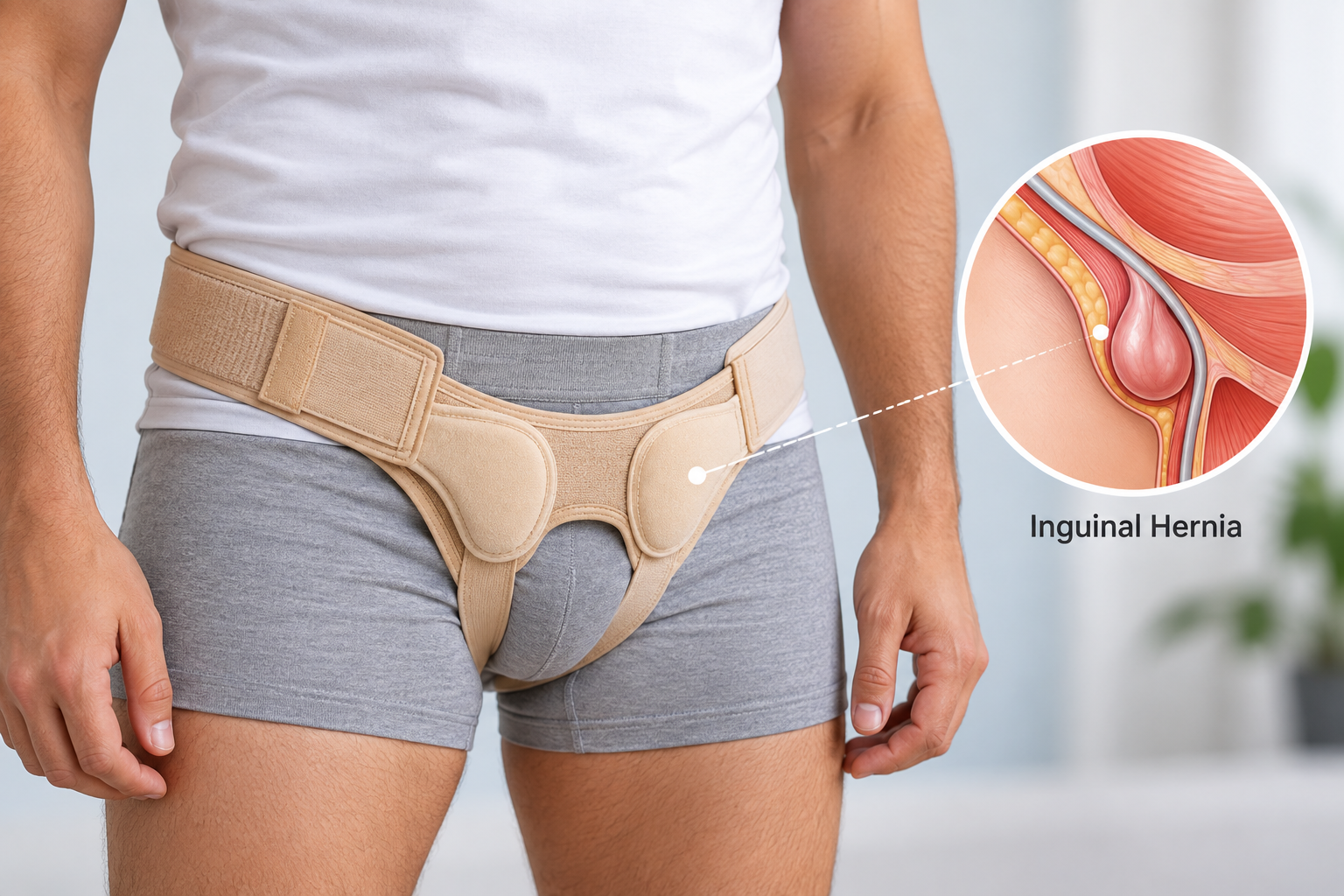
Reviewed for patient education by Dr. Hitesh Arora, Advanced Laparoscopic and General Surgeon at Arora Elite Care, Surat. A hernia belt for men may temporarily support a reducible groin hernia and reduce discomfort in selected patients, but it does not close the weakness in the abdominal wall or cure the hernia. Some people use a properly fitted belt while waiting for surgery or when surgery is not currently suitable. A painful, irreducible, or worsening hernia needs medical assessment rather than tighter external support.
Seeing a bulge in the groin often leads to a practical question: can you simply support it with a belt instead of having surgery?
Hernia belts, also called trusses, have been used for many years. They apply external pressure over the hernia area and may help keep a reducible hernia supported while a person is standing or moving.
However, support is not the same as repair.
A hernia develops because tissue pushes through a weakness or opening in the abdominal wall. Wearing a belt does not close this opening. This is why the decision to use a belt should depend on the type of hernia, symptoms, and a medical assessment rather than an online product advertisement.
What Is a Hernia Belt for Men?
A hernia belt for men is a supportive garment designed to apply pressure over a groin hernia and help maintain a hernia that has already reduced back into the abdomen. It is mainly a symptom-management device, not a cure.
Some belts have a pad positioned over the hernia. Others use straps or supportive fabric to provide compression around the groin or lower abdomen.
A truss may sometimes help reduce:
- A feeling of dragging or heaviness
- Mild discomfort while standing
- Discomfort during everyday movement
- Anxiety about a reducible bulge appearing during activity
However, the correct fit matters.
Too little support may fail to control the bulge. Incorrect or excessive pressure can cause discomfort, skin problems, or potentially other complications.
A belt should therefore not become a substitute for finding out what type of hernia you actually have.
Can a Hernia Belt Cure a Hernia?
No. A hernia belt cannot cure a hernia because it does not repair the weakness or opening in the abdominal wall. It can only provide external support while it is being worn.
This is the most important limitation to understand.
Imagine supporting a weak area from the outside. The support may reduce movement through that area, but once you remove the support, the underlying defect remains.
This explains why someone may feel better while wearing a truss but notice the bulge again after removing it.
If you are wondering whether a hernia belt can cure a hernia, the answer is different from asking whether it can relieve symptoms. Temporary symptom control may occur, but anatomical repair requires a different approach.
For more information about whether hernias can disappear without an operation, read ” Can a hernia heal without surgery?.
When Can a Hernia Belt Help?
A belt may be considered for temporary symptom support in selected patients with a reducible hernia, particularly while waiting for treatment or when an operation is not currently appropriate.
NHS England’s inguinal-hernia decision aid notes that some people find a hernia belt, truss or abdominal binder helpful. It advises putting one on while lying down after the hernia has reduced.
However, recommendations are not universally enthusiastic about trusses. The American College of Surgeons cautions against routine use because belts can cause complications when used incorrectly.
This is why a hernia belt for men should not simply be bought and tightened over any unexplained groin lump.
A healthcare professional should first confirm:
- That the lump actually represents a hernia
- The type and location of the hernia
- Whether it is reducible
- watchful waiting is appropriate
- A truss is suitable
- Whether surgery should instead be considered
How Should You Wear a Hernia Belt?
A traditional hernia truss should generally support a hernia after it has reduced, not be tightened over a trapped bulge. Correct positioning and fit are essential.
NHS orthotics guidance advises applying a truss while lying down after the hernia has reduced. The supporting pad then sits over the hernia site.
General fitting principles include:
- Lie down as instructed so the hernia can reduce.
- Position the support over the correct hernia site.
- Secure the belt according to professional or manufacturer guidance.
- Stand and check whether the support continues to control the hernia.
- Stop using it if it causes significant pain, rubbing, sores, or other problems.
Do not force a painful or stuck hernia back simply so that you can put a belt on.
If the bulge does not reduce as it normally does, seek medical advice.
Anyone searching for how to wear a hernia belt should ideally receive fitting advice rather than relying solely on product photographs or videos.
Should You Exercise While Wearing a Hernia Belt?
A belt should not be used as permission to perform activities that cause hernia pain or significant strain. Activity should remain within comfortable limits and follow medical advice.
NHS England advises people with inguinal hernias to remain active but avoid activities that cause discomfort, pain or excessive stress around the hernia.
This means putting on a support belt does not automatically make heavy lifting safe.
Walking and suitable daily activity may be comfortable for many people, but gym exercises and strenuous work need individual consideration.
For more detailed guidance, read Exercise with a Hernia.
Stop an activity if you notice:
- Increasing pain
- A rapidly enlarging bulge
- Difficulty reducing the hernia afterwards
- New tenderness
- Nausea or vomiting
Do not use a belt to repeatedly push through symptoms.
What About a Hernia Belt for Women?
Women can also develop groin hernias, but a groin lump in a woman deserves proper medical assessment rather than self-treatment with a belt.
The phrase hernia belt for women appears frequently in online shopping searches, but choosing a product based only on gender or body size can miss the more important issue: the type of hernia.
Femoral hernias occur proportionately more often in women than men and have different clinical implications.
Therefore, a woman with a new groin swelling should obtain a diagnosis before assuming that a generic truss is the correct solution.
The same principle applies to men: diagnose first, support second.
Does Wearing a Belt Delay Hernia Surgery?
A belt does not necessarily “delay” necessary surgery if it forms part of an appropriate watchful-waiting or temporary management plan. The problem arises when symptom relief causes someone to ignore a worsening or symptomatic hernia without reassessment.
Not every inguinal hernia requires immediate surgery.
For men with an asymptomatic or minimally symptomatic inguinal hernia, watchful waiting can be an appropriate option after assessment.
NHS England currently describes watchful waiting as a safe option for minimally symptomatic inguinal hernias.
However, watchful waiting means monitoring, not ignoring.
You should pay attention to changes such as:
- Increasing discomfort
- Increasing size
- Difficulty reducing the hernia
- Interference with normal activity
- New or worsening pain
A belt can make someone more comfortable without changing the underlying defect. That comfort should not be mistaken for evidence that the hernia has healed.
When Is Surgery Considered?
Surgery may be considered when a hernia causes troublesome symptoms, becomes difficult to reduce, enlarges, or interferes significantly with everyday activities. Emergency surgery may be necessary when obstruction or strangulation is suspected.
Hernia surgery repairs the abdominal-wall defect rather than simply supporting it externally.
Depending on the hernia and individual patient, repair may use an open or laparoscopic approach.
The choice can depend on:
- Hernia type
- Hernia size
- Whether one or both sides are affected
- Previous surgery
- Recurrent hernia
- General health
- Surgeon assessment
You can learn more about laparoscopic hernia surgery in Surat and discuss whether repair is appropriate for your situation.
What Warning Signs Mean You Should Stop Relying on a Belt?
Severe pain, a hernia that suddenly will not go back in, vomiting, or significant tenderness can indicate a complication and require urgent medical assessment. Do not simply tighten a belt over these symptoms.
Seek urgent medical care if you develop:
- Sudden or severe pain
- A previously reducible hernia that becomes stuck
- Marked tenderness
- Redness or concerning skin changes over the swelling
- Nausea or vomiting
- Fever or feeling acutely unwell
- Abdominal swelling or symptoms suggesting bowel obstruction
NHS orthotics guidance specifically warns against placing a truss over an unreduced or strangulated hernia.
A belt is designed for support. It is not an emergency treatment.
Hernia Belt vs Hernia Surgery
| Feature | Hernia Belt / Truss | Hernia Surgery |
|---|---|---|
| Main purpose | Temporary support or symptom management in selected patients | Repair the abdominal-wall defect |
| Can it cure the hernia? | No | Repairs the defect, although recurrence remains possible |
| When may it be considered? | Selected reducible hernias, temporary support, or when surgery is deferred/not appropriate | Symptomatic or otherwise clinically appropriate hernias |
| Works when removed? | No ongoing mechanical support after removal | Repair remains after healing |
| Needs medical assessment? | Yes, especially before relying on it long term | Yes |
| Suitable for a painful, stuck hernia? | No | Requires urgent assessment; emergency surgery may sometimes be necessary |
Hernia Assessment at Arora Elite Care
At Arora Elite Care in Surat, Dr. Hitesh Arora evaluates hernias to determine the type, symptoms, and whether observation or surgical treatment is appropriate.
A consultation does not automatically mean surgery.
The assessment may consider:
- Location of the bulge
- Whether it reduces
- Pain or discomfort
- Changes in size
- Effect on daily activities
- Previous hernia repairs
- General health
- Suitability for observation or surgery
If you already use a hernia belt for men, tell your surgeon how often you wear it, whether it controls the bulge, and whether you still experience pain or discomfort.
The important question is not simply, “Which belt should I buy?”
It is, “What type of hernia do I have, and what is the safest long-term plan?”
Frequently Asked Questions
Can a Hernia Belt Cure an Inguinal Hernia?
No. A hernia belt can support a reducible inguinal hernia and may reduce discomfort in selected people, but it does not close the abdominal-wall defect. The bulge can therefore return when support is removed. Ask a healthcare professional whether observation, temporary support or surgical repair is appropriate.
Is a Hernia Belt Safe to Wear Every Day?
Daily use may be appropriate for some patients when a properly fitted truss has been recommended. Incorrect fit can cause rubbing, skin problems, or ineffective pressure. Never place a conventional truss over a hernia that cannot be reduced, and seek medical advice if the hernia becomes painful or stuck.
Can I Work While Wearing a Hernia Belt?
Some people can continue normal activities with a hernia, but a belt should not be used to force yourself through painful heavy work. Avoid activities that significantly increase discomfort or strain around the hernia. Your surgeon can advise according to your hernia and the physical demands of your job.
Can I Exercise with an Inguinal Hernia?
Many people can remain active, particularly when activities do not cause pain or excessive pressure around the hernia. Avoid exercises that clearly worsen symptoms. A belt does not make every exercise safe. Seek individualized advice if your exercise routine includes heavy lifting or high abdominal pressure.
Should I Wear a Hernia Belt While Sleeping?
Do not assume that a hernia belt should remain on overnight. Some orthotic guidance recommends removing conventional trusses at night unless a healthcare professional specifically advises otherwise. The correct schedule depends on the support device and your circumstances, so follow individualized fitting instructions.
When Should I Stop Using a Hernia Belt and See a Surgeon?
Arrange reassessment if pain increases, the bulge enlarges, the hernia becomes harder to reduce, or symptoms interfere with normal activities. Seek urgent medical attention for severe pain, vomiting, marked tenderness, or a hernia that becomes stuck. Do not tighten a belt over an acutely painful, irreducible hernia.
The Key Point
A hernia belt for men can provide temporary support for some reducible hernias, but it does not repair the abdominal-wall weakness.
For selected men with minimally symptomatic inguinal hernias, watchful waiting may be reasonable after medical assessment. A support belt may sometimes form part of symptom management during that period.
However, symptom relief should not be confused with a cure.
If the hernia becomes increasingly painful, larger, difficult to reduce, or begins affecting everyday life, arrange a surgical review.
At Arora Elite Care, Dr. Hitesh Arora can assess the hernia and discuss whether observation, temporary support, or surgical repair is appropriate for your individual situation.