
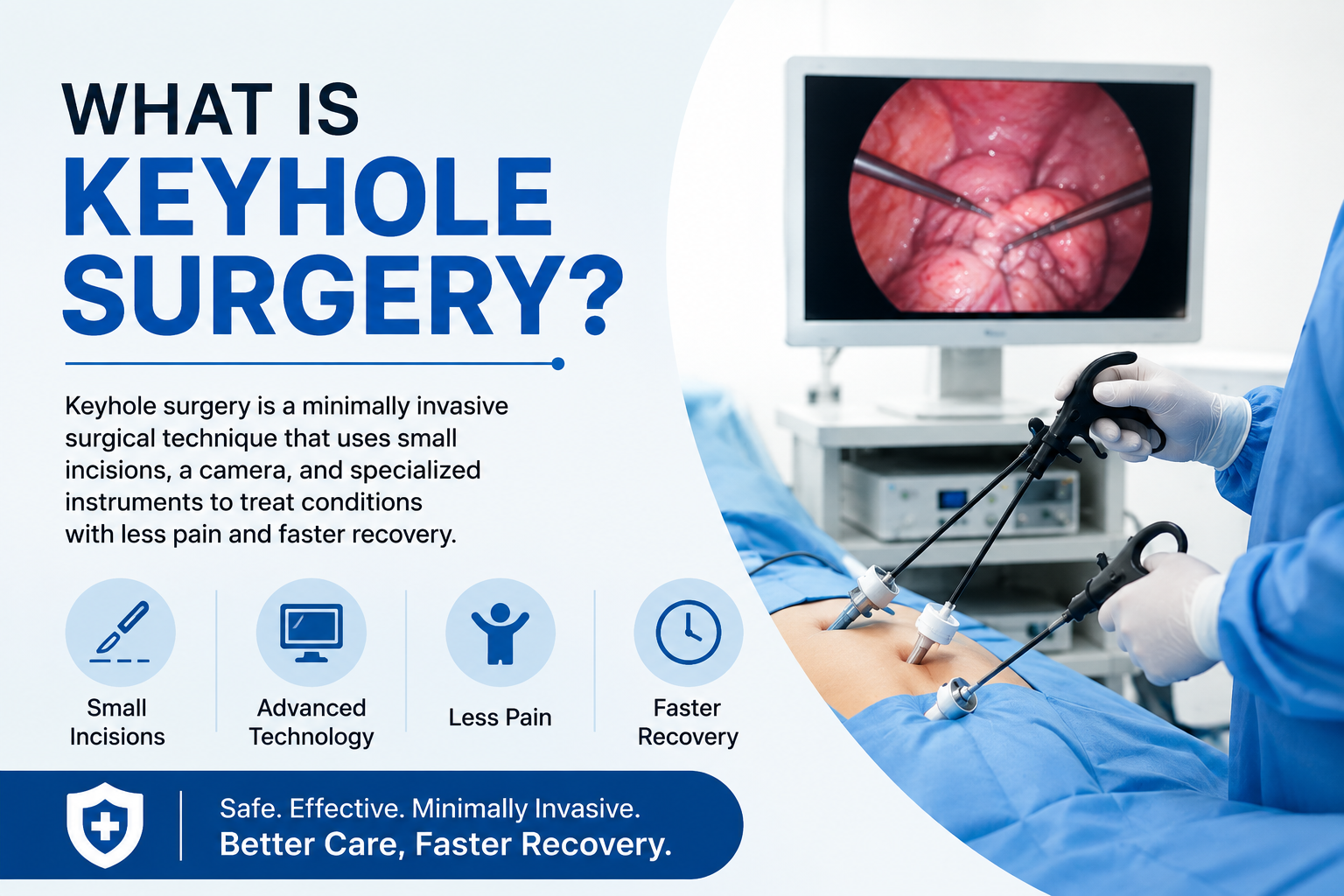
If your doctor has recommended surgery, you may have heard the term what is keyhole surgery. Many patients wonder what it means, how it differs from traditional surgery, and whether it offers a faster recovery. In simple terms, keyhole surgery is a minimally invasive technique that allows a surgeon to operate through small incisions using a camera and specialized instruments. In abdominal surgery, doctors commonly call it laparoscopic surgery.
What Is Keyhole Surgery?
Keyhole surgery involves making a few small incisions instead of one large surgical cut. The surgeon inserts a thin instrument called a laparoscope, which contains a camera and light.
The camera sends a magnified view of the internal organs to a monitor. The surgeon then operates using specialized instruments inserted through the other small incisions.
The term “keyhole” describes these small access points used during surgery.
Is Keyhole Surgery the Same as Laparoscopic Surgery?
For abdominal procedures, keyhole surgery and laparoscopic surgery generally refer to the same minimally invasive approach.
“Keyhole surgery” is a patient-friendly term, while “laparoscopic surgery” is the medical term commonly used for operations involving the abdomen or pelvis.
How Does Keyhole Surgery Work?
The exact procedure depends on the condition being treated, but the basic process usually involves:
- Giving appropriate anesthesia.
- Making small incisions in the surgical area.
- Inserting the laparoscopic camera.
- Viewing the internal organs on a monitor.
- Inserting specialized surgical instruments.
- Performing the required procedure.
- Removing the instruments and closing the incisions.
Which Surgeries Can Be Performed Using Keyhole Surgery?
Doctors use laparoscopic techniques to treat several abdominal and general surgical conditions. Common procedures include:
- Gallbladder removal
- Appendix removal
- Hernia repair
- Certain intestinal procedures
- Some colorectal procedures
- Selected gastrointestinal surgeries
- Diagnostic laparoscopy
However, keyhole surgery may not suit every patient. Your diagnosis, previous operations, overall health, anatomy, and complexity of the condition can influence the choice of surgical technique.
What Are the Benefits of Keyhole Surgery?
For appropriately selected patients, keyhole surgery may provide several advantages compared with traditional open surgery.
Smaller Incisions
Keyhole surgery generally uses several small incisions rather than one larger incision.
Smaller Scars
Because individual incisions are smaller, patients usually have smaller scars compared with similar procedures performed through open surgery.
Less Postoperative Discomfort
Some patients may experience less postoperative discomfort because laparoscopic surgery generally causes less disruption to surrounding tissues.
Shorter Hospital Stay
Depending on the procedure and individual recovery, some patients may leave the hospital sooner after laparoscopic surgery.
Faster Recovery
For certain operations, patients may return to light activities and their normal routine sooner than after comparable open surgery.
These benefits vary depending on the procedure and individual patient.
Is Keyhole Surgery Safe?
Keyhole surgery is commonly used for many surgical conditions. However, all surgeries carry potential risks.
Possible complications can include bleeding, infection, anesthesia-related problems, injury to surrounding structures, blood clots, or complications related to the specific procedure.
A surgeon should evaluate your condition and explain the expected benefits, possible risks, and alternative treatments before surgery.
Is Keyhole Surgery Better Than Open Surgery?
Not always.
Although minimally invasive surgery has several potential advantages, open surgery may be safer or more appropriate in certain situations.
Severe inflammation, complex disease, previous abdominal operations, extensive scar tissue, emergencies, or unexpected findings can influence the surgical approach.
Occasionally, a surgeon may begin an operation laparoscopically and convert to open surgery if necessary for patient safety.
Therefore, the best approach depends on your individual condition rather than incision size alone.
What Is Recovery Like After Keyhole Surgery?
Recovery depends on the type and complexity of the operation.
After surgery, your healthcare team may provide instructions regarding:
- Wound care
- Pain medication
- Diet
- Bathing
- Walking and physical activity
- Lifting restrictions
- Returning to work
- Follow-up appointments
Some patients return to light activities relatively quickly, while others need more time. Always follow the recovery timeline recommended by your surgeon.
Will Keyhole Surgery Leave Scars?
Yes. Keyhole surgery still requires incisions, so small scars will remain.
However, the scars are generally smaller than those associated with comparable open surgery. Their number and location depend on the procedure performed.
How Do I Know If Keyhole Surgery Is Right for Me?
Your surgeon needs to evaluate your condition before deciding whether keyhole surgery is appropriate.
The assessment may include your diagnosis, symptoms, medical history, previous operations, imaging results, current medications, overall health, and complexity of the required procedure.
Consult Dr. Hitesh Arora at Arora Elite Care
If you are considering keyhole surgery in Surat, you can consult Dr. Hitesh Arora at Arora Elite Care. A detailed evaluation can help determine whether laparoscopic surgery is suitable for your condition and what treatment approach may be appropriate.
Your consultation also allows you to understand the procedure, possible risks, expected hospital stay, and recovery process before making a treatment decision.
Conclusion
So, what is keyhole surgery? It is a minimally invasive surgical approach that uses small incisions, a camera, and specialized instruments to perform many types of operations.
It may offer smaller scars, less postoperative discomfort, shorter hospital stays, and faster recovery for appropriately selected patients. However, it is not suitable for every condition.
An experienced laparoscopic surgeon can assess your individual case and recommend whether keyhole or open surgery is the safer and more appropriate option.
Frequently Asked Questions
Is keyhole surgery a major surgery?
It can be. “Keyhole” describes the method used to access the surgical area, not necessarily how minor or major the operation is.
Is keyhole surgery painful?
Patients receive appropriate anesthesia during surgery. Some postoperative discomfort is expected, although smaller incisions may reduce pain for some procedures.
How many cuts are made during keyhole surgery?
The number of small incisions varies depending on the procedure and surgical technique.
Can gallbladder surgery be performed through keyhole surgery?
Yes. Laparoscopic gallbladder removal is a commonly performed minimally invasive procedure when clinically appropriate.
Can a keyhole operation become open surgery?
Yes. In some situations, the surgeon may need to convert from laparoscopic to open surgery if doing so is safer or necessary to complete the procedure.
1 Comment
Laparoscopic Surgery Recovery Time: A Day-by-Day Guide
September 22, 2026[…] If you want to understand how the procedure works, read What Keyhole Surgery Is?. […]