
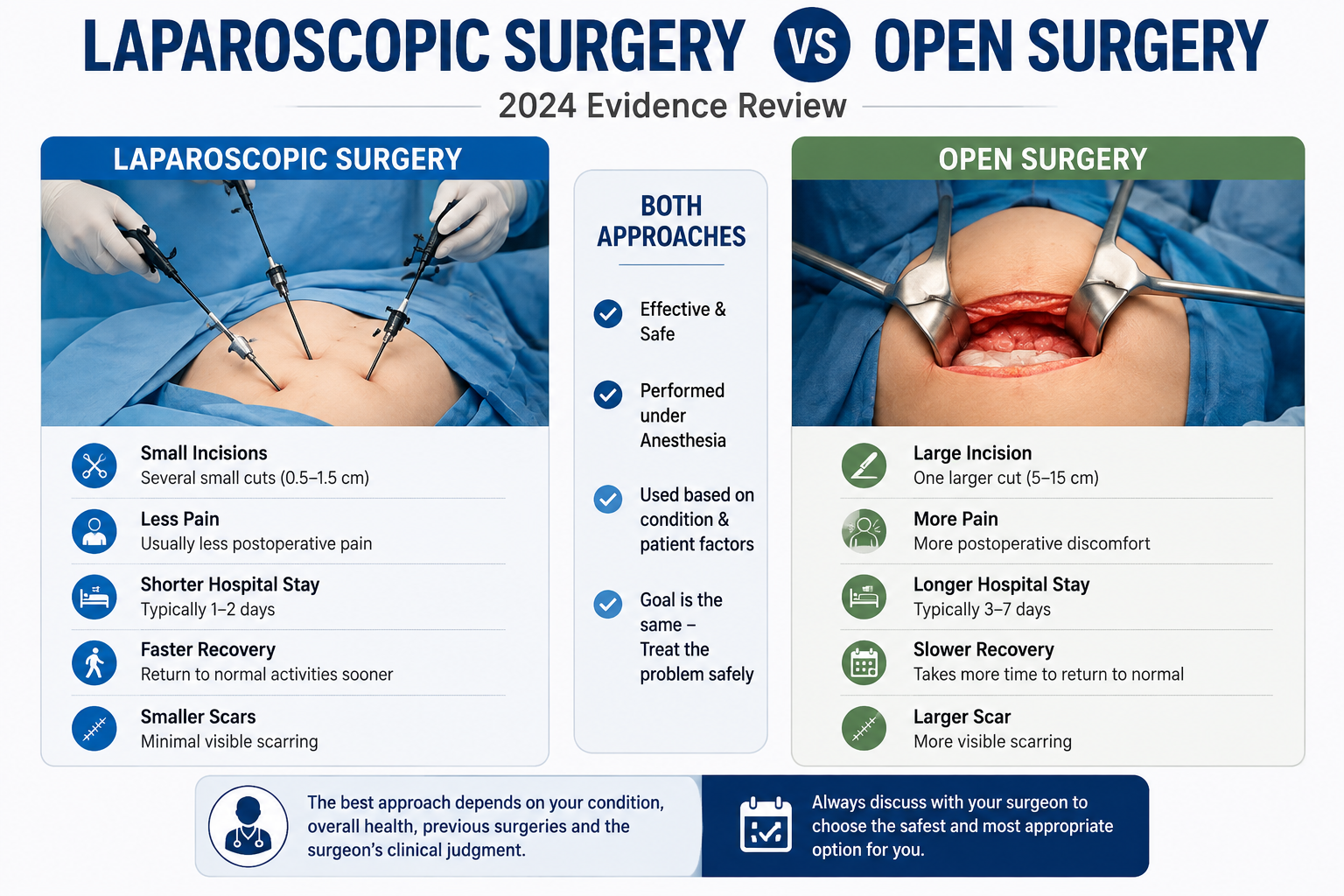
When surgery is recommended, patients often ask whether laparoscopic surgery or open surgery is better. Both are established surgical approaches, but they differ in incision size, recovery, hospital stay, and how surgeons access the treatment area. When considering laparoscopic vs open surgery evidence 2024, laparoscopic surgery offers several advantages for appropriately selected patients. However, open surgery remains important for complex conditions, emergencies, severe inflammation, and cases requiring wider surgical access.
What Is Laparoscopic Surgery?
Laparoscopic surgery, also called keyhole or minimally invasive surgery, uses several small incisions.
A surgeon inserts a thin camera called a laparoscope through one incision. The camera displays a magnified view of the internal organs on a monitor. Specialized surgical instruments enter through the other small openings to complete the procedure.
Doctors commonly use laparoscopic techniques for:
- Gallbladder removal
- Appendix surgery
- Hernia repair
- Certain intestinal procedures
- Selected gastrointestinal surgeries
Whether laparoscopy is appropriate depends on the patient’s diagnosis and overall condition.
What Is Open Surgery?
Open surgery involves making a larger incision so the surgeon can directly access the area requiring treatment.
Although minimally invasive techniques have advanced significantly, open surgery remains an important option. Surgeons may recommend it for complicated disease, severe infection, extensive scar tissue, emergencies, or situations requiring greater access to internal structures.
Laparoscopic vs Open Surgery: Key Differences
The main difference between the two approaches is how surgeons reach the treatment area.
Laparoscopic surgery generally offers:
- Smaller incisions
- Smaller scars
- Less postoperative discomfort in some patients
- Shorter hospital stays for certain procedures
- Earlier return to routine activities
Open surgery may provide:
- Wider access to the surgical area
- Direct visualization
- Greater flexibility in complicated cases
- An appropriate approach for certain emergencies
The best option depends on the condition rather than incision size alone.
Is Laparoscopic Surgery Less Painful?
For many comparable operations, patients may experience less postoperative discomfort after laparoscopic surgery because the abdominal incisions are smaller.
However, laparoscopic surgery is not painless. The amount of discomfort depends on the operation, its complexity, and individual pain sensitivity.
Which Surgery Has a Faster Recovery?
Laparoscopic surgery often allows earlier recovery for suitable patients.
Some patients may start walking sooner, leave the hospital earlier, and return to light activities more quickly than after comparable open surgery.
However, small external incisions do not mean the body has completely healed internally. Patients must still follow their surgeon’s recommendations regarding exercise, lifting, driving, and returning to work.
Is Laparoscopic Surgery Safer Than Open Surgery?
Neither technique is universally safer.
Both procedures can involve risks such as bleeding, infection, anesthesia-related complications, blood clots, or injury to nearby structures.
For an uncomplicated condition, laparoscopy may offer recovery-related advantages. For complex disease, open surgery may provide safer access and better surgical control.
The goal is therefore to choose the safest technique for the individual patient.
When Is Open Surgery Recommended?
A surgeon may recommend open surgery when there is:
- Severe inflammation or infection
- Extensive scar tissue
- Complex or advanced disease
- Difficult anatomy
- An emergency requiring wider access
- Unexpected findings during laparoscopic surgery
Which Approach Is Used for Common Surgeries?
Gallbladder Surgery
Laparoscopic gallbladder removal is commonly performed in suitable patients. Complicated gallbladder disease may occasionally require open surgery.
Appendix Surgery
Many appendix operations can be performed laparoscopically. The approach depends on the severity of appendicitis and whether complications are present.
Hernia Surgery
Both laparoscopic and open techniques are used for hernia repair. The surgeon considers the hernia’s type, location, size, previous surgery, and overall patient health before choosing an approach.
What Does the 2024 Evidence Mean for Patients?
The practical message from laparoscopic vs open surgery evidence 2024 is that minimally invasive surgery can provide meaningful benefits when it can safely achieve the required surgical result.
However, the smallest incision is not always the safest choice.
Modern surgical treatment focuses on selecting an approach according to the patient’s diagnosis, medical history, disease complexity, and overall health.
Consult Dr. Hitesh Arora in Surat
If you have been advised to undergo surgery, you can consult Dr. Hitesh Arora, an Advanced Laparoscopic and General Surgeon at Arora Elite Care Surat.
A detailed consultation can help determine whether laparoscopic or open surgery is appropriate after reviewing your symptoms, investigations, previous operations, and overall medical condition.
The goal is not simply to choose keyhole surgery whenever possible, but to select a surgical technique that provides safe and appropriate treatment.
Conclusion
The laparoscopic vs open surgery evidence 2024 comparison shows that both techniques have important roles.
Laparoscopic surgery may provide smaller incisions, smaller scars, less postoperative discomfort, shorter hospital stays, and faster recovery for suitable patients. Open surgery remains valuable for complicated conditions, emergencies, and cases requiring wider access.
Ultimately, the best surgical approach should be selected after an individualized evaluation by an experienced surgeon.
Frequently Asked Questions
Is laparoscopic surgery always better?
No. Open surgery may work better for certain complicated conditions or emergencies.
Which surgery has faster recovery?
Laparoscopic surgery often allows faster recovery for suitable procedures and patients.
Can laparoscopic surgery become open surgery?
Yes. A surgeon may convert to open surgery when it becomes necessary for safety or to complete the procedure effectively.
Does laparoscopic surgery leave scars?
Yes, but the scars are generally smaller than those associated with comparable open surgery.
How do I choose between laparoscopic and open surgery?
Your surgeon should recommend an approach after considering your diagnosis, health, previous surgeries, and complexity of the condition.