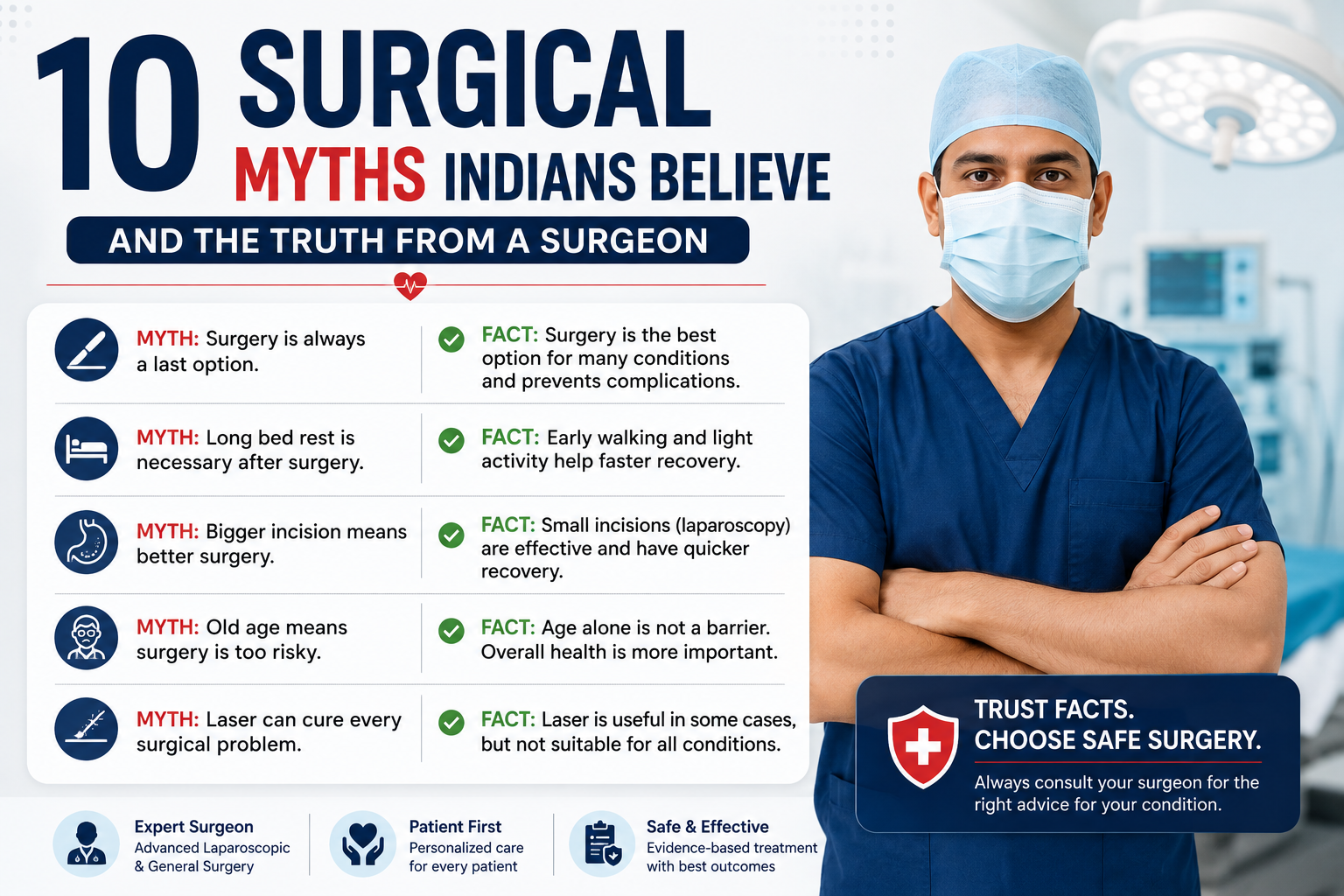
Surgery can make patients anxious, especially when advice from relatives, social media, or old beliefs conflicts with medical recommendations. Some commonly repeated ideas about surgery may have been based on older techniques but do not accurately represent modern surgical care. Understanding common Surgical Myths and facts in India can help patients ask better questions and make informed treatment decisions. Here are 10 myths worth clearing up before you undergo a surgical procedure.
Myth 1: Surgery Should Always Be the Last Option
Fact: Surgery is not automatically the last option. The right timing depends on the disease.
Some conditions can initially be managed with medicines, lifestyle changes, or observation. Others may require surgery to correct the underlying problem or prevent complications.
For example, symptomatic hernias and certain cases of appendicitis or gallbladder disease may require surgical management. Delaying necessary treatment simply because you want to avoid surgery can sometimes make the condition more complicated.
Myth 2: Bigger Incisions Mean Better Surgery
Fact: A larger incision does not necessarily mean better treatment.
Modern laparoscopic or keyhole surgery allows surgeons to perform many abdominal operations through several small incisions using a camera and specialized instruments.
For appropriately selected patients, minimally invasive surgery may offer smaller scars, less postoperative discomfort, and faster recovery.
However, open surgery remains important when wider access is necessary for safe treatment.
Myth 3: Laparoscopic Surgery Is Only for Minor Problems
Fact: Laparoscopic techniques are used for many established surgical procedures.
Surgeons commonly use minimally invasive approaches for selected:
- Gallbladder operations
- Appendix surgeries
- Hernia repairs
- Gastrointestinal procedures
- Colorectal procedures
Whether laparoscopy is appropriate depends on the condition, its complexity, previous surgeries, and the patient’s overall health.
Myth 4: You Should Stay Completely in Bed After Surgery
Fact: Complete bed rest is not routinely necessary after many operations.
Depending on the procedure, doctors may encourage patients to begin gentle movement relatively early. Appropriate mobility can form an important part of postoperative recovery.
However, this does not mean patients should immediately start exercising or lifting heavy objects. Activity should increase gradually according to the surgeon’s instructions.
Myth 5: Pain After Surgery Means Something Has Gone Wrong
Fact: Some postoperative discomfort is expected after surgery.
Its intensity depends on the operation, incision, individual pain tolerance, and recovery stage. Doctors can usually manage expected postoperative pain with appropriate medications.
However, sudden severe or worsening pain, particularly when associated with fever, vomiting, increasing swelling, bleeding, or other unusual symptoms, should be reported to your healthcare team.
Myth 6: Once You Have Surgery, You Cannot Live Normally Again
Fact: The purpose of many surgical procedures is to treat a health problem and help patients return to normal activities.
Recovery time varies significantly. Some minimally invasive procedures allow relatively early return to routine activities, while major or complicated operations require longer recovery.
Following instructions regarding diet, wound care, medicines, lifting, exercise, and follow-up can support safe recovery.
Myth 7: Older People Cannot Have Surgery
Fact: Age alone does not decide whether someone can safely undergo surgery.
Before recommending an operation, doctors consider factors such as:
- Heart and lung health
- Diabetes
- Kidney function
- Current medications
- Frailty
- Type of surgery
- Anesthesia risk
A medically fit older adult may sometimes be an appropriate surgical candidate. Individual assessment is more important than age alone.
Myth 8: Every Surgical Condition Can Be Treated With Laser
Fact: “Laser” is not a universal replacement for conventional or laparoscopic surgery.
Different diseases require different techniques. A treatment should be selected according to the diagnosis and clinical evidence rather than simply because it is advertised as laser-based or technologically advanced.
Ask your surgeon why a particular procedure is appropriate for your condition and what alternatives are available.
Myth 9: Small Incisions Mean No Surgical Risk
Fact: Smaller incisions do not make an operation risk-free.
Laparoscopic surgery can provide important benefits, but it remains a surgical procedure. Potential risks can include bleeding, infection, anesthesia-related complications, injury to nearby structures, and procedure-specific complications.
The surgeon should explain the relevant benefits and risks before treatment.
Myth 10: You Should Avoid Surgery as Long as You Can
Fact: Delaying surgery is not always safer.
Some conditions can be safely monitored, while others may become more difficult to treat if intervention is unnecessarily delayed.
The important question is not “How long can I avoid surgery?” but rather “What is the safest treatment and timing for my condition?”
A proper surgical consultation can help answer this.
How Can You Separate Surgical Myths and Facts?
When you hear a claim about surgery, avoid making treatment decisions based only on social media posts, relatives’ experiences, or another patient’s recovery.
Instead, ask your surgeon:
- Why do I need surgery?
- Are there non-surgical alternatives?
- What happens if I delay treatment?
- Can my procedure be performed laparoscopically?
- What are the possible risks?
- How long could recovery take?
- When can I return to work and exercise?
Every patient’s condition is different, so another person’s treatment experience may not apply to you.
Consult Dr. Hitesh Arora for Surgical Guidance
Patients who are unsure whether surgery is necessary can consult Dr. Hitesh Arora, an Advanced Laparoscopic and General Surgeon at Arora Elite Care Surat.
A detailed consultation can help clarify the diagnosis, whether an operation is necessary, which surgical approach may be suitable, and what to expect before and after treatment.
Rather than allowing Surgical Myths and Facts to influence an important healthcare decision, patients should rely on an individualized medical evaluation and clear discussion with their surgeon.
Conclusion
Understanding Surgical Myths and Facts is important because misinformation can create unnecessary fear or lead patients to delay appropriate treatment.
Modern surgery includes both open and minimally invasive techniques, and neither approach is automatically best for everyone. The appropriate treatment depends on your diagnosis, overall health, disease complexity, and individual surgical requirements.
If surgery has been recommended, discuss your concerns openly with your surgeon and make your decision based on your individual medical condition rather than common myths.
Frequently Asked Questions
Is laparoscopic surgery completely painless?
No. Some discomfort can occur after any surgery, although smaller incisions may reduce postoperative pain for certain procedures.
Is open surgery outdated?
No. Open surgery remains an important and sometimes safer approach for complex conditions and certain emergencies.
Can elderly patients undergo surgery?
Yes, depending on their overall health, surgical condition, and anesthesia assessment. Age alone does not determine suitability.
Is every modern surgery done with a laser?
No. Laser technology is useful for selected procedures but is not appropriate or necessary for every surgical condition.
Should I delay surgery until symptoms become severe?
Not necessarily. The appropriate timing depends on the condition. Delaying necessary surgery may increase the risk of complications in some cases.
1 Comment
Hydrocele Surgery in Surat: Procedure, Recovery and Cost
September 11, 2026[…] or interfering with walking, exercise, clothing, work, or other daily activities. Understanding whether surgery is actually necessary is therefore an important part of the surgical […]