
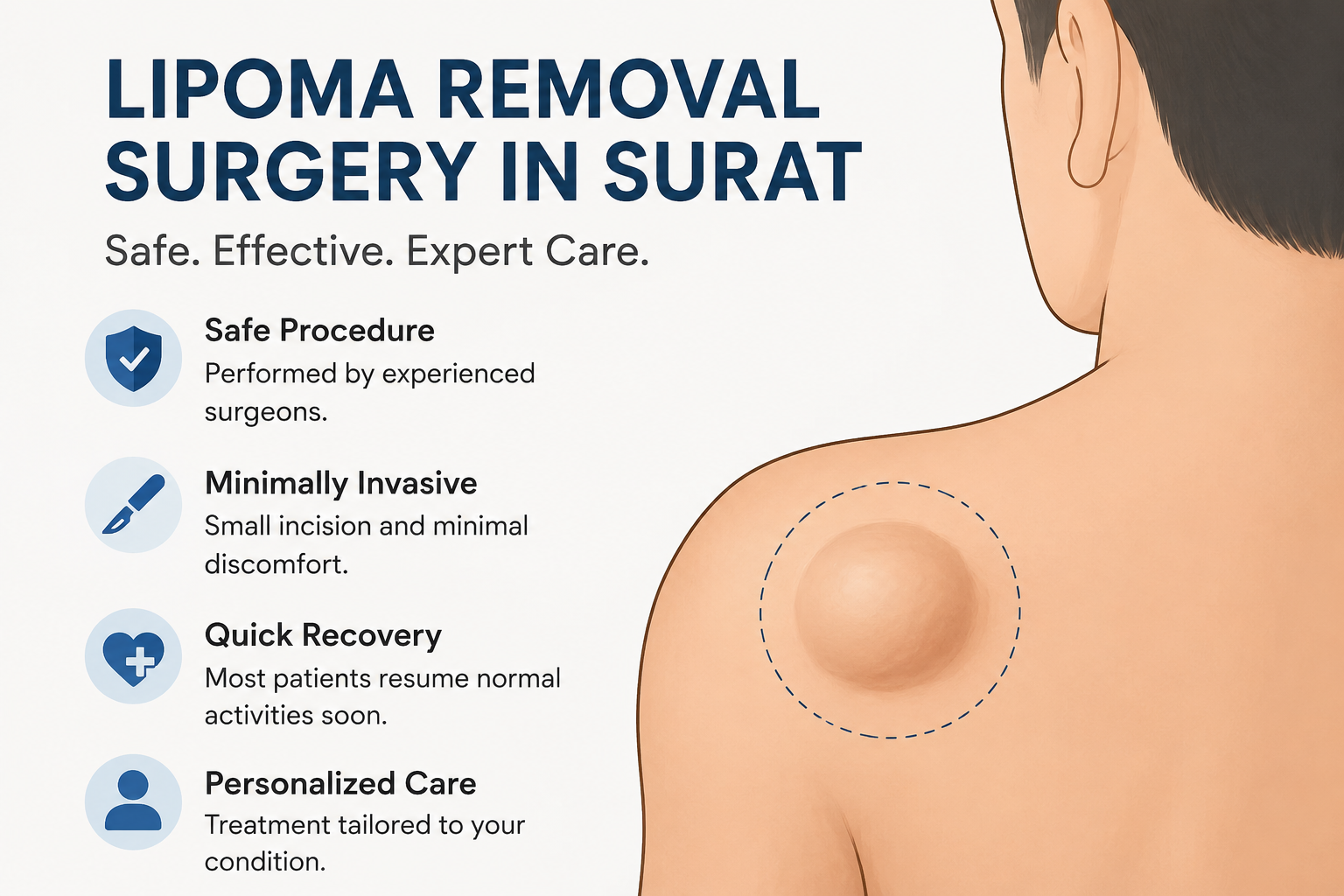
Lipoma removal surgery is a procedure used to remove a fatty lump beneath the skin, usually through a small incision. Many superficial lipomas can be removed under local anaesthesia as a day-care procedure. The surgery involves numbing the area, making an incision, removing the lump and closing the wound. The cost, scar size and recovery time depend on the lipoma’s size, depth, location and surgical complexity. Patients considering lipoma removal surgery in Surat can consult a qualified general surgeon for diagnosis and personalised treatment planning.
A lipoma is a usually harmless, slow-growing lump made of fatty tissue. It can develop on the arms, shoulders, back, neck, abdomen, or thighs.
Although most lipomas do not require treatment, some may cause discomfort, increase in size, or create cosmetic concerns.
At Arora Elite Care, Dr. Hitesh Arora provides surgical evaluation for patients with suitable superficial lumps and other general surgical concerns.
What Is a Lipoma?
A lipoma is a benign growth made mainly of fatty tissue that usually develops beneath the skin.
Most lipomas are soft or rubbery, move slightly when touched, and grow slowly.
Common locations include:
- Arms and shoulders
- Upper and lower back
- Neck
- Abdomen
- Thighs
- Chest wall
Lipomas are usually painless, although some may cause discomfort depending on their location or pressure on nearby tissues.
Importantly, not every lump beneath the skin is a lipoma.
A new, growing, or unusual lump should be examined before treatment is planned.
For additional medical information, read the Cleveland Clinic guide to lipomas.
When Is Lipoma Removal Surgery Necessary?
Doctors may recommend lipoma removal surgery when a lump causes pain, continues growing, interferes with movement, creates cosmetic concerns, or requires further diagnostic evaluation.
Not every lipoma needs surgical removal.
Doctors may monitor small, stable, and symptom-free lipomas after a proper medical assessment.
Your surgeon may recommend removal when the lump:
- Causes pain or tenderness
- Continues to increase in size
- Creates pressure or discomfort
- Interferes with movement
- Becomes irritated by clothing
- Causes a noticeable cosmetic concern
- Has an uncertain diagnosis
Lumps that are rapidly growing, deep, hard, fixed, or approximately 5 cm or larger need careful assessment. Depending on the findings, imaging or specialist referral may be necessary before attempting removal.
How Is a Lipoma Diagnosed Before Surgery?
A surgeon usually begins with a physical examination and may recommend imaging when the lump has unusual features or its diagnosis is uncertain.
During the examination, the doctor assesses the lump’s:
- Size and location
- Shape and consistency
- Mobility beneath the skin
- Tenderness
- Depth
- Growth history
An ultrasound may help evaluate some superficial lumps.
MRI or other investigations may be recommended for deeper, larger, or suspicious masses.
The purpose is to distinguish a typical lipoma from other soft-tissue conditions that may require a different treatment approach.
How Is Lipoma Removal Surgery Performed?
During lipoma removal surgery, the surgeon uses appropriate anaesthesia, makes a planned skin incision, removes the fatty lump, and closes the wound.
The procedure generally includes the following steps:
Step 1: Examination and Surgical Planning
The surgeon examines the lump and confirms the treatment plan.
The surgeon plans the incision according to the lipoma’s size, depth, and location.
Step 2: Anaesthesia
For suitable superficial lipomas, the surgeon may use local anaesthesia to numb the treatment area.
Larger, deeper, or more complex lumps may require a different anaesthesia approach.
Step 3: Incision and Removal
The surgeon makes an incision and carefully separates the lipoma from the surrounding tissue.
The surgeon then removes the fatty lump using a suitable surgical technique.
Step 4: Wound Closure
The surgeon closes the incision using sutures or another suitable closure method.
The surgical team applies a dressing to protect the wound.
Step 5: Tissue Examination and Follow-Up
The surgeon may send the removed tissue for histopathological examination to confirm the diagnosis.
The surgical team provides wound-care instructions and schedules follow-up appointments.
The surgeon adjusts the technique according to the lipoma’s characteristics.
Can a Lipoma Be Removed Under Local Anaesthesia?
Yes. Surgeons can remove many small, superficial lipomas under local anaesthesia without using general anaesthesia.
Local anaesthesia numbs the surgical area while the patient remains awake.
Patients may feel pressure or movement during the procedure, but the anaesthesia helps minimise pain.
If the patient experiences discomfort, the surgeon can assess the need for additional anaesthesia.
However, local anaesthesia does not suit every lipoma.
The surgeon selects the most appropriate anaesthesia based on the lipoma’s size, depth, location, complexity, and the patient’s medical condition.
What Is the Cost of Lipoma Removal Surgery in Surat?
The cost of lipoma removal surgery in Surat varies according to the lump’s size, depth, location, number of lipomas, anaesthesia requirements, and facility charges.
A small superficial lipoma removed under local anaesthesia may cost less than a large or deep lump requiring an operating theatre and more complex surgical care.
Lipoma Removal Cost Breakdown
| Cost Component | What Affects the Price |
|---|---|
| Consultation | Examination and treatment planning |
| Investigations | Ultrasound, MRI or other tests if required |
| Surgical procedure | Size, depth, location and number of lipomas |
| Anaesthesia | Local anaesthesia, sedation or general anaesthesia |
| Facility charges | Procedure room or operating theatre requirements |
| Histopathology | Laboratory examination of removed tissue |
| Follow-up care | Dressing changes and wound review |
Estimated Cost Range
A single fixed price cannot accurately represent every lipoma removal procedure.
Contact Arora Elite Care to confirm the current cost of lipoma removal surgery. The final price depends on the lipoma’s size, location, depth, and treatment requirements.
Patients can book a surgery consultation in Surat to discuss the procedure and receive a personalised cost estimate.
Will Lipoma Removal Leave a Scar?
Yes. Lipoma removal surgery generally leaves a scar because the surgeon makes an incision in the skin. The scar’s appearance depends on the incision size, healing process, and individual skin characteristics.
Factors affecting the scar include:
- Lipoma size and location
- Incision length
- Skin tension
- Surgical closure technique
- Wound infection or complications
- Individual scarring tendency
Some scars become less noticeable over time, but scar-free surgery cannot be guaranteed.
Patients with a history of thick or raised scars should inform their surgeon before the procedure.
How Long Does Recovery Take After Lipoma Removal?
Many patients recover relatively quickly after removal of a small superficial lipoma, although complete wound healing and return to strenuous activity may take longer.
Recovery depends on the procedure and individual healing.
| Recovery Stage | What Patients May Experience |
|---|---|
| First 24–48 hours | Mild soreness, swelling, or bruising |
| First few days | Gradual improvement in discomfort |
| Around 1–2 weeks | Wound review or removal of non-absorbable sutures when appropriate |
| Following weeks | Continued healing and gradual return to unrestricted activity as advised |
| Following months | Scar maturation and gradual changes in appearance |
These are general expectations, not guaranteed recovery timelines.
A larger or deeper lipoma may require a longer recovery period.
What Should You Do Before Lipoma Removal Surgery?
Before surgery, have the lump properly examined, discuss your medicines and medical history, and follow the surgeon’s preparation instructions.
A practical checklist includes:
- Confirm the diagnosis and treatment plan.
- Inform your surgeon about allergies.
- Share your complete medicine list.
- Discuss blood thinners and other prescribed medicines.
- Complete recommended investigations.
- Ask about anaesthesia and fasting instructions.
- Discuss expected scarring and recovery.
- Arrange transportation if sedation is planned.
Do not stop prescribed medicines without medical advice.
For additional guidance, read how to prepare for surgery.
How Should You Care for the Wound After Surgery?
After lipoma removal, follow the surgeon’s dressing, hygiene, medicine, and activity instructions to support wound healing.
| Recommended Care | Why It Matters |
|---|---|
| Keep the dressing clean and dry as instructed | Helps protect the surgical wound |
| Take prescribed medicines correctly | Supports appropriate pain and postoperative care |
| Avoid unnecessary pressure on the wound | May reduce discomfort and irritation |
| Limit strenuous activity when advised | Helps protect the incision |
| Attend follow-up appointments | Allows the surgeon to assess healing |
| Report concerning wound changes | Helps identify possible complications |
Do not apply unprescribed creams, oils, or home remedies directly to a fresh surgical wound.
Learn more about wound care after surgery.
Can a Lipoma Come Back After Removal?
A lipoma removed completely is unlikely to recur at the same site, but recurrence is possible. New lipomas can also develop elsewhere on the body.
The risk of recurrence depends on how completely the surgeon removes the original lump and the lipoma’s individual characteristics.
If another lump develops near the surgical site, consult your surgeon for a proper examination rather than assuming the lipoma has returned.
When Should You Get a Lump Checked Urgently?
A lump that grows rapidly, is deep or fixed, becomes unusually painful, or measures approximately 5 cm or more needs prompt medical evaluation.
Other concerning features include:
- Rapid increase in size
- Hard or irregular consistency
- Reduced mobility
- Numbness or pressure symptoms
- Interference with movement
- Unexplained changes in the overlying skin
These findings do not automatically mean cancer, but they require proper assessment.
A suspicious soft-tissue mass may need imaging and referral to an appropriate specialist before biopsy or removal.
Why Choose Arora Elite Care for Lipoma Removal Surgery in Surat?
Arora Elite Care provides general and laparoscopic surgical care in Surat.
Patients with suspected lipomas can consult Dr. Hitesh Arora for evaluation and treatment planning.
Dr. Hitesh Arora is an Advanced Laparoscopic and General Surgeon with more than 15 years of surgical experience. His professional profile reports an M.S. Gold Medal, FMAS qualification, and experience across more than 10,000 surgical procedures.
The consultation focuses on evaluating the lump, identifying whether further investigations are necessary, and discussing appropriate management.
Patients can explore general surgery services at Arora Elite Care or contact the clinic for an appointment.
Conclusion
Lipoma removal surgery in Surat may be appropriate when a fatty lump causes pain, discomfort, growth, cosmetic concerns, or diagnostic uncertainty.
Many superficial lipomas can be removed under local anaesthesia, but the procedure, scar, recovery time and cost depend on the individual case.
Not every lipoma requires surgery, and not every lump beneath the skin is a lipoma.
If you notice a growing, painful, or changing lump, consult a qualified surgeon for proper assessment.
For personalised guidance, book a consultation at Arora Elite Care.
Frequently Asked Questions
1. Is Lipoma Removal Surgery Painful?
Lipoma removal is performed using appropriate anaesthesia to minimise pain during the procedure. Many superficial lipomas can be removed under local anaesthesia. Mild soreness, swelling, or bruising may occur afterwards and generally improve during recovery.
2. How Much Does Lipoma Removal Surgery Cost in Surat?
The cost depends on the lipoma’s size, depth, location, anaesthesia, facility requirements, and investigations. A small superficial lipoma may cost less to remove than a large or deep lump. Contact the clinic for a procedure-specific quotation.
3. Can Lipoma Removal Be Done Under Local Anaesthesia?
Yes. Many small and superficial lipomas can be removed under local anaesthesia as a day-care procedure. Larger or deeper lipomas may require a different surgical setting or anaesthesia plan, depending on the surgeon’s assessment.
4. Will There Be a Scar After Lipoma Removal?
Yes. Surgical removal generally leaves a scar because an incision is required. The scar’s size and appearance depend on the lipoma, incision, wound healing, and individual skin characteristics. Scars may become less noticeable over time, but scar-free removal cannot be guaranteed.
5. How Many Days Does Recovery Take After Lipoma Surgery?
Many patients resume light daily activities within a few days after removal of a small superficial lipoma. Wound healing commonly takes longer, and non-absorbable sutures may need removal after approximately one to two weeks. Larger or deeper procedures may require additional recovery time.
6. Can a Lipoma Grow Back After Removal?
A completely removed lipoma is unlikely to return at the same site, but recurrence can occur. New lipomas may also develop elsewhere. Any new or changing lump should be medically examined to confirm its diagnosis.