
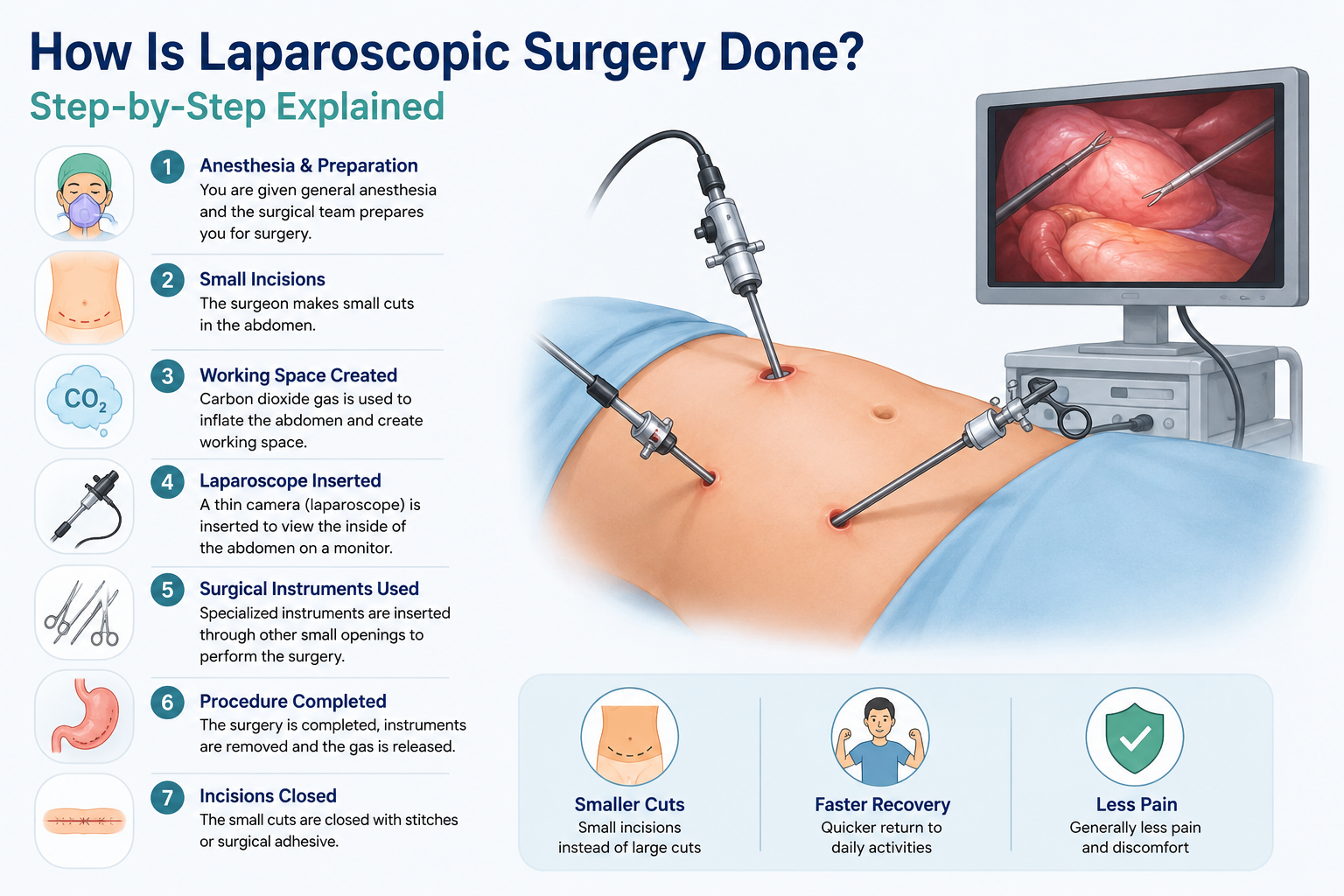
Laparoscopic surgery, commonly called keyhole surgery, allows surgeons to perform many abdominal operations through small incisions instead of one large incision. Surgeons commonly use this technique for gallbladder, appendix, hernia, and other abdominal procedures. If you are wondering how is laparoscopic surgery done, the surgeon makes small incisions, inserts a laparoscope with a camera, creates space inside the abdomen, uses specialized instruments to perform the procedure, and closes the incisions after completing the surgery.
What Is Laparoscopic Surgery?
Laparoscopic surgery is a minimally invasive surgical technique. Instead of directly viewing the abdominal organs through a large incision, the surgeon uses a laparoscope, a thin instrument equipped with a camera and light.
The camera sends a magnified view of the internal area to a monitor. The surgeon watches this screen while controlling specialized surgical instruments through other small incisions.
The exact technique varies depending on the condition and operation.
How Is Laparoscopic Surgery Done Step by Step?
Although every operation differs, most laparoscopic procedures follow several basic stages.
Step 1: Anesthesia and Preparation
The surgical and anesthesia teams first complete safety checks and prepare the patient for surgery.
Doctors commonly perform abdominal laparoscopic operations under general anesthesia, meaning the patient remains asleep during the procedure. The anesthesia team continuously monitors important parameters throughout surgery.
Step 2: Small Incisions Are Made
The surgeon makes small incisions in carefully selected areas of the abdomen.
The number and position of these incisions depend on the procedure. These openings allow the surgeon to introduce the camera and surgical instruments.
Step 3: Working Space Is Created
The surgeon usually introduces carbon dioxide gas into the abdominal cavity.
This gently expands the abdomen and creates working space between the abdominal wall and internal organs. It allows the surgeon to see and operate more clearly.
The surgical team removes the gas at the appropriate stage before completing the procedure.
Step 4: The Laparoscope Is Inserted
The surgeon introduces the laparoscope through one of the small openings.
Its camera provides a magnified view of the surgical area on a monitor. The surgeon carefully examines the relevant anatomy before proceeding.
This camera-guided approach forms the foundation of laparoscopic surgery.
Step 5: Surgical Instruments Are Introduced
The surgeon inserts specialized instruments through the other small openings.
The exact instruments and surgical steps depend on the operation.
For example, during laparoscopic gallbladder surgery, the surgeon carefully separates and removes the gallbladder. During laparoscopic appendix surgery, the surgeon identifies and removes the affected appendix.
The surgeon controls each instrument while viewing the operative field on the monitor.
Step 6: The Procedure Is Completed
After completing the planned operation, the surgeon checks the surgical area before removing the instruments.
The team then removes the laparoscope and releases the remaining gas as appropriate.
Step 7: Small Incisions Are Closed
Finally, the surgeon closes the incisions using an appropriate closure method and applies dressings when needed.
Because laparoscopic surgery generally uses smaller incisions than traditional open surgery, suitable patients may experience smaller scars, less incision-related discomfort, and earlier return to routine activities. However, recovery varies according to the operation and individual patient.
Is Laparoscopic Surgery Always Better Than Open Surgery?
No. Laparoscopic surgery is not automatically the best approach for every patient.
The surgeon considers the diagnosis, previous abdominal operations, disease severity, overall health, anatomy, and complexity of the procedure.
Sometimes a surgeon may need to convert a laparoscopic operation to an open procedure for safety or technical reasons. Conversion does not necessarily mean that something went wrong. It can be an appropriate surgical decision when circumstances require better access.
What Is Recovery Like After Laparoscopic Surgery?
Recovery depends heavily on the procedure performed.
Some patients can start walking relatively soon after surgery when their medical team considers it safe. The hospital team also provides instructions about food, medicines, wound care, bathing, physical activity, and follow-up.
Patients should avoid comparing their recovery directly with someone who underwent a different laparoscopic procedure.
Contact your surgical team if you develop concerning symptoms such as increasing abdominal pain, persistent vomiting, significant bleeding, breathing difficulty, increasing wound redness or swelling, or fever, particularly when your discharge instructions advise you to report these symptoms.
Why Choose an Experienced Laparoscopic Surgeon?
Laparoscopic surgery requires knowledge of anatomy, careful surgical judgment, and experience using camera-guided instruments.
At Arora Elite Care in Surat, Dr. Hitesh Arora practices as an Advanced Laparoscopic and General Surgeon. He has 15+ years of surgical experience, is an M.S. Gold Medalist, holds an FMAS (Fellowship in Minimal Access Surgery), and his professional profile reports experience across 10,000+ surgeries.
Patients considering laparoscopic surgery can discuss their diagnosis, available surgical approaches, expected benefits, possible risks, hospital stay, and recovery during consultation.
Conclusion
So, how is laparoscopic surgery done? The surgeon makes small incisions, creates working space inside the abdomen, inserts a camera and specialized instruments, performs the required operation while viewing a magnified monitor, and then closes the incisions.
The exact steps differ between gallbladder, appendix, hernia, and other operations. Your surgeon should determine whether a laparoscopic approach is suitable after evaluating your individual condition.
FAQs
Is laparoscopic surgery painful?
Patients receive anesthesia during surgery. Some discomfort can occur afterward, but its severity varies according to the procedure and individual patient. Your medical team will provide an appropriate pain-management plan.
How many cuts are made during laparoscopic surgery?
The number of incisions varies according to the operation and surgical technique. Your surgeon can explain the expected incision pattern for your specific procedure.
How long does laparoscopic surgery take?
There is no single duration. Surgery time depends on the procedure, complexity of the condition, anatomy, and findings during the operation.
Is laparoscopic surgery safe?
Laparoscopic surgery is widely used, but every operation has potential risks. Your surgeon should explain the benefits, alternatives, and procedure-specific risks before surgery.
When can I return to work?
Return-to-work timing depends on the type of operation, your occupation, and your recovery. Follow your surgeon’s individual activity recommendations.