
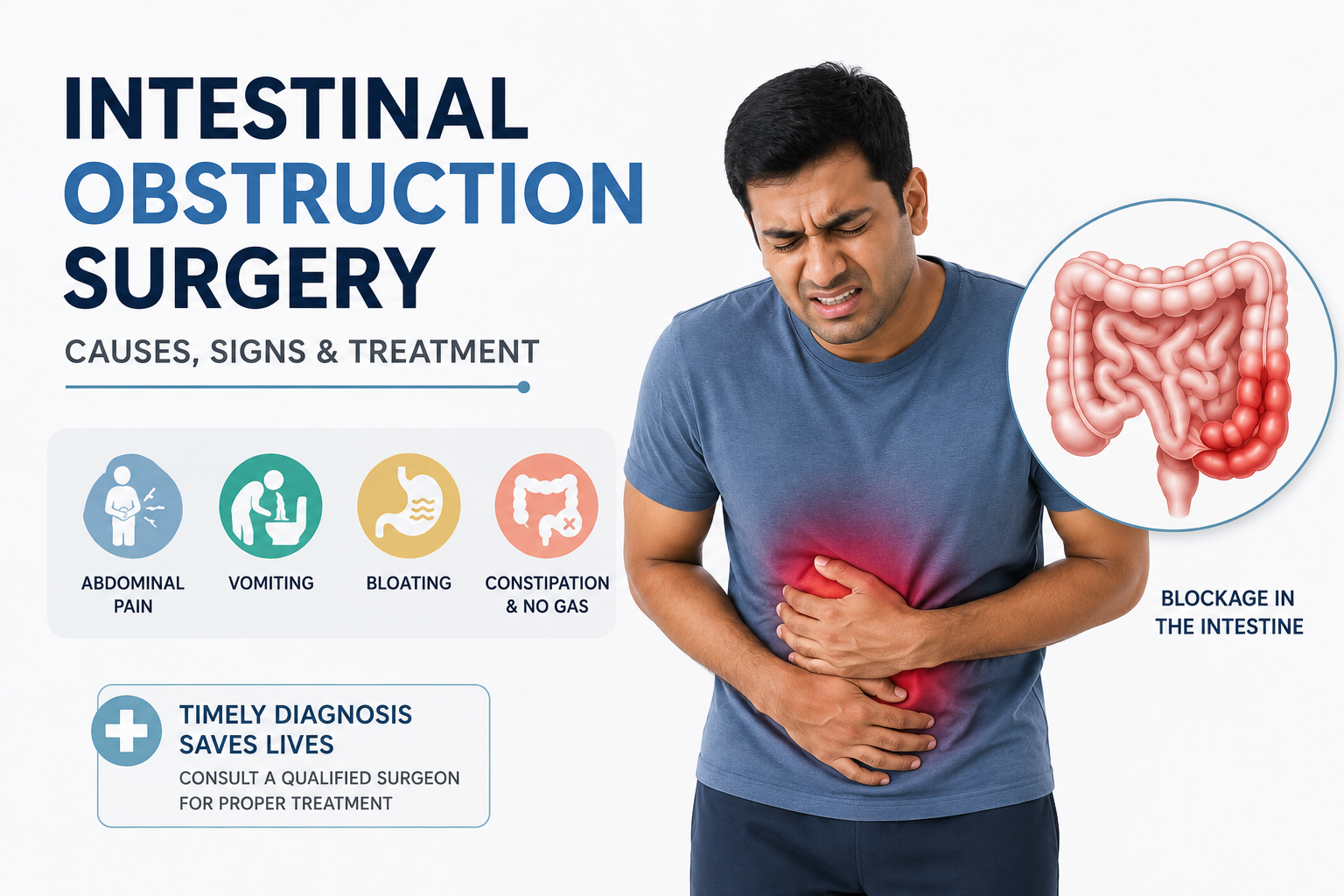
An intestinal obstruction happens when food, fluid, gas, and digestive contents cannot move normally through the intestine. The blockage may be partial or complete and can cause abdominal pain, swelling, vomiting, constipation, and inability to pass gas. Not every bowel obstruction requires an operation. However, intestinal obstruction surgery may become necessary when the blockage does not improve with appropriate non-surgical treatment, has a mechanical cause that needs correction, or threatens the blood supply and health of the bowel.
Some intestinal obstructions can become medical emergencies. Severe or rapidly worsening symptoms require prompt hospital evaluation.
What Is Intestinal Obstruction?
An intestinal obstruction is a blockage involving the small or large intestine. Doctors generally consider whether the blockage is partial or complete, where it is located, what caused it, and whether the bowel remains healthy.
A complete blockage can prevent stool and gas from passing. More serious cases may compromise the bowel’s blood supply, which can damage intestinal tissue and increase the risk of perforation and infection.
For this reason, doctors should assess suspected obstruction promptly.
What Causes Intestinal Obstruction?
Several conditions can block the intestine. Common causes include:
- Adhesions: Internal scar tissue can develop after previous abdominal surgery and may pull or trap part of the intestine.
- Hernia: A portion of the bowel can become trapped in a hernia.
- Tumors: A growth can narrow or block part of the intestine.
- Volvulus: Part of the intestine can twist and create an obstruction.
- Inflammatory narrowing: Certain inflammatory conditions can cause narrowing of the bowel.
- Intussusception: One part of the intestine can slide into another, although this occurs more commonly in children.
The cause matters because treatment for an adhesion-related obstruction can differ considerably from treatment for a hernia, tumor, or twisted bowel.
What Are the Warning Signs of Intestinal Obstruction?
Symptoms vary according to the location and severity of the blockage.
Common warning signs include:
- Cramping or severe abdominal pain
- Increasing abdominal swelling or bloating
- Repeated vomiting
- Constipation
- Inability to pass gas
- Loss of appetite
- Abdominal tenderness
Symptoms such as severe continuous pain, fever, marked weakness, fainting, persistent vomiting, or rapidly worsening abdominal swelling require urgent medical assessment.
Do not rely on home remedies when symptoms suggest a possible bowel obstruction.
Is Intestinal Obstruction an Emergency?
Intestinal obstruction can become a surgical emergency, particularly when the blockage is complete, or the bowel loses its blood supply.
A condition called strangulation can occur when an obstructed section of bowel develops compromised blood flow. Without timely treatment, the affected bowel can become damaged.
Doctors therefore consider not only whether a blockage exists but also whether there are signs of bowel compromise, perforation, infection, or other complications.
How Do Doctors Diagnose Intestinal Obstruction?
Diagnosis starts with the patient’s symptoms, medical history, and physical examination.
Tell your doctor about previous abdominal operations, hernias, bowel conditions, previous cancers, medicines, and when you last passed stool or gas.
Depending on the situation, doctors may use:
Blood tests: These can help identify dehydration, infection, electrolyte abnormalities, and other concerns.
Abdominal imaging: X-rays can provide useful information in selected situations.
CT scan: A CT scan can help identify the location, severity, and possible cause of an obstruction and look for complications.
The treating team chooses investigations according to the patient’s clinical condition.
Does Every Intestinal Obstruction Need Surgery?
No. Some intestinal obstructions can improve without surgery.
For selected patients, hospital treatment may involve bowel rest, intravenous fluids, correction of electrolyte problems, close observation, and a tube through the nose into the stomach when clinically appropriate.
However, conservative treatment is not appropriate for every patient.
Doctors may recommend intestinal obstruction surgery when:
- The obstruction is complete or persistent
- Non-surgical management does not resolve the problem
- A trapped hernia causes the blockage
- The bowel has twisted
- Blood supply to the bowel appears compromised
- Doctors suspect perforation or damaged bowel
- Another mechanical cause requires surgical correction
The decision depends on the cause and the patient’s condition rather than a fixed waiting period.
How Is Intestinal Obstruction Surgery Done?
The goal of surgery is to relieve the blockage and protect healthy bowel.
What the surgeon does depends on what they find. Surgery may involve releasing adhesions, repairing a hernia, untwisting the intestine, removing another source of obstruction, or removing a section of severely damaged bowel when necessary.
Surgeons may use an open or laparoscopic approach in selected situations. The safest approach depends on the cause of obstruction, bowel condition, previous operations, abdominal swelling, and overall clinical circumstances.
Patients and families should understand that the exact procedure may sometimes become clear only after the surgeon assesses the bowel directly.
What Is Recovery Like After Intestinal Obstruction Surgery?
Recovery varies considerably depending on the severity of the obstruction and the procedure performed.
After surgery, the healthcare team monitors bowel function, hydration, pain, wound healing, and signs of complications. Food and fluids are restarted according to the patient’s condition and the surgical team’s instructions.
Patients should follow individualized guidance about:
- Diet
- Medicines
- Walking and activity
- Wound care
- Heavy lifting
- Returning to work
- Follow-up appointments
A patient who only needs release of a simple obstruction may recover differently from someone who requires removal of damaged bowel.
When Should You Seek Urgent Medical Care?
Seek prompt medical attention for severe abdominal pain accompanied by repeated vomiting, significant abdominal swelling, or inability to pass stool or gas.
You should also seek urgent care if symptoms rapidly worsen or occur with fever, fainting, severe weakness, significant bleeding, or severe persistent pain.
Early evaluation is particularly important for people with a history of abdominal surgery or hernia.
Intestinal Obstruction Treatment With Dr. Hitesh Arora
Patients requiring assessment for acute abdominal and general surgical conditions can consult Dr. Hitesh Arora at Arora Elite Care.
Dr. Hitesh Arora is an Advanced Laparoscopic and General Surgeon with 15+ years of surgical experience. He is an M.S. Gold Medalist, holds an FMAS (Fellowship in Minimal Access Surgery), and his professional profile reports experience across 10,000+ surgeries.
With suspected intestinal obstruction, the priority is timely diagnosis. A surgeon can determine whether hospital observation, non-surgical management, or an operation is appropriate based on the cause and severity of the blockage.
Conclusion
An intestinal obstruction can range from a partial blockage that responds to hospital treatment to a serious surgical emergency.
Intestinal obstruction surgery may be necessary when a blockage persists, a mechanical problem requires correction, or the bowel shows signs of compromised blood supply or damage.
FAQs
Can intestinal obstruction clear without surgery?
Yes. Some partial obstructions can improve with appropriate hospital-based conservative management. Complete, persistent, or complicated obstructions may require surgery.
What are the main signs of intestinal obstruction?
Common symptoms include abdominal pain, swelling, vomiting, constipation, and difficulty or inability to pass gas.
How serious is intestinal obstruction?
It can become serious if the bowel loses its blood supply, becomes damaged, or perforates. Severe or worsening symptoms require prompt medical evaluation.
Is intestinal obstruction surgery laparoscopic?
Surgeons can use laparoscopic surgery in selected cases, but it is not suitable for every obstruction. The cause, bowel condition, previous surgery, and severity influence the approach.
How long does recovery take after intestinal obstruction surgery?
There is no single recovery period. Recovery depends on the cause of obstruction, procedure performed, whether bowel removal was necessary, complications, and the patient’s overall health.