
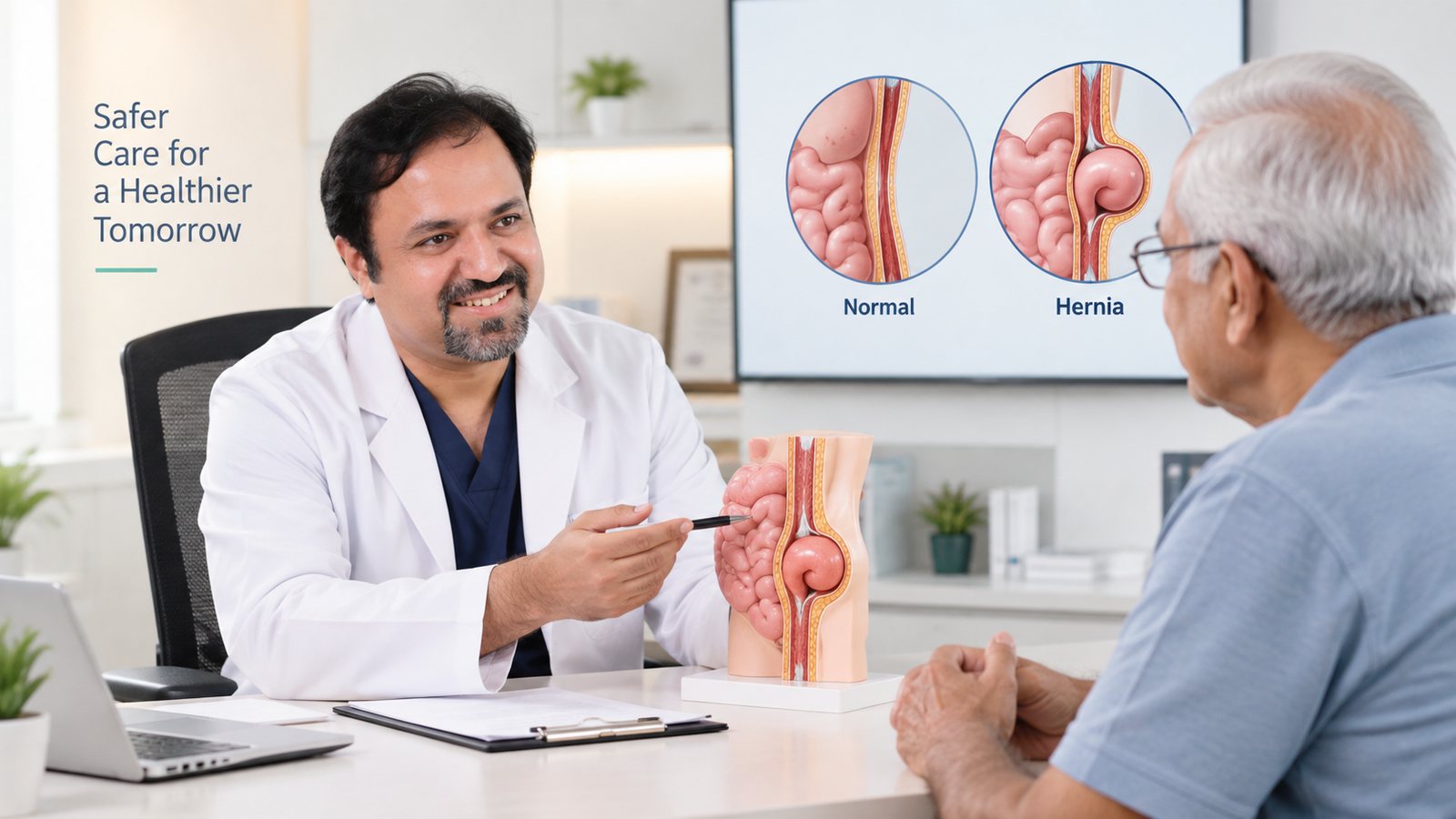
A hernia can occur at any age, but treating it in an older adult requires careful planning. Families often worry about anesthesia, existing medical conditions, medicines, recovery time, and whether surgery is safe at an advanced age. When considering hernia surgery elderly patients, age alone should not determine whether someone can have surgery. Doctors also evaluate overall health, frailty, heart and lung function, diabetes, medicines, the type of hernia, symptoms, and whether complications are developing.
Is Hernia Surgery Safe for Elderly Patients?
Hernia surgery can be performed safely in many appropriately selected older adults, but every patient needs an individual assessment.
A healthy 70-year-old may have a very different surgical risk from someone of the same age with significant heart, lung, kidney, or mobility problems.
Before recommending surgery, the surgical and anesthesia teams consider:
- Overall physical health and frailty
- Heart and lung conditions
- Diabetes and blood pressure
- Kidney function where relevant
- Current medicines
- Previous abdominal operations
- Type, size, and symptoms of the hernia
- Ability to recover and mobilize after surgery
The aim is to balance the risks of surgery against the risks of leaving the hernia untreated.
Why Can Hernias Be More Concerning in Senior Citizens?
Some hernias remain relatively stable, while others gradually enlarge or become increasingly uncomfortable.
An older adult may start experiencing pain while walking, coughing, standing, or performing routine activities. A growing hernia can also become more difficult to push back inside.
More importantly, bowel or other tissue can sometimes become trapped within a hernia. If its blood supply becomes compromised, the condition may require emergency treatment.
Therefore, families should not wait for an emergency before arranging an evaluation simply because the patient is elderly.
What Tests Are Needed Before Hernia Surgery?
Preoperative assessment helps the medical team understand whether the patient is fit for surgery and anesthesia.
Depending on the person’s health and procedure, doctors may recommend:
- Blood investigations
- ECG
- Chest or other investigations when clinically indicated
- Blood sugar assessment
- Kidney function tests
- Review of existing medical conditions
- Anesthesia evaluation
Doctors may request additional investigations or specialist opinions for patients with significant heart, lung, or other medical problems.
Not every elderly patient requires the same tests.
Open vs Laparoscopic Hernia Surgery in Elderly Patients
Surgeons can repair many hernias using either an open or laparoscopic approach.
During open surgery, the surgeon reaches the hernia through an incision over or near the affected area.
Laparoscopic surgery uses small incisions, a camera, and specialized instruments to perform the repair from inside the abdomen. For appropriately selected patients, minimally invasive surgery may offer advantages such as smaller incisions and earlier return to routine activities.
However, laparoscopic surgery is not automatically the best option for every senior citizen.
The surgeon considers the type and size of hernia, previous operations, overall health, anesthesia suitability, anatomy, and whether the operation is planned or urgent before recommending an approach.
What About Blood Thinners, Diabetes and Other Medicines?
Medication management deserves particular attention in older patients because many take several medicines every day.
Tell the surgical team about all:
- Prescription medicines
- Blood-thinning or antiplatelet medicines
- Diabetes medicines
- Blood pressure and heart medicines
- Vitamins and supplements
- Herbal products
Never stop blood thinners or other prescribed medicines yourself before surgery.
The surgeon, physician, or anesthesia team will tell you which medicines to continue, adjust, or temporarily stop. Diabetes also requires careful planning around fasting, medicines, and blood sugar monitoring.
What Is Recovery Like After Hernia Surgery in Senior Citizens?
Recovery depends on the patient’s health, hernia type, surgical technique, and complexity of the operation.
When medically appropriate, early movement may help reduce some complications associated with prolonged inactivity. The healthcare team will advise when the patient can start walking.
Families can also support recovery by helping the patient follow instructions regarding:
- Pain medicines
- Wound care
- Diet and hydration
- Constipation prevention
- Walking and gradual activity
- Lifting restrictions
- Follow-up appointments
Do not compare one patient’s recovery with another person’s. Older adults may need additional assistance at home during the early recovery period.
When Does a Hernia Need Urgent Attention?
A previously manageable hernia can occasionally become an emergency.
Seek prompt medical attention if an older adult develops:
- Sudden or severe hernia pain
- A swelling that becomes hard or cannot be pushed back
- Repeated vomiting
- Increasing abdominal swelling
- Inability to pass stool or gas
- Fever or significant weakness
- Red, dark, or otherwise concerning skin changes over the swelling
These symptoms can indicate incarceration, intestinal obstruction, or compromised blood supply and require urgent assessment.
Hernia Surgery With Dr. Hitesh Arora in Surat
At Arora Elite Care, patients and their families can consult Dr. Hitesh Arora for evaluation of hernias and other general or laparoscopic surgical conditions.
Dr. Hitesh Arora is an Advanced Laparoscopic and General Surgeon with 15+ years of surgical experience. He is an M.S. Gold Medalist, holds an FMAS (Fellowship in Minimal Access Surgery), and his professional profile reports experience across 10,000+ surgeries.
For an elderly patient, consultation is particularly important because treatment planning needs to consider both the hernia and the patient’s overall health.
Conclusion
When considering hernia surgery elderly patients, chronological age is only one part of the decision.
Doctors consider the patient’s overall fitness, medical conditions, medicines, frailty, hernia characteristics, anesthesia risk, and potential complications before recommending treatment.
A planned evaluation can also be preferable to waiting until a painful or trapped hernia becomes an emergency. Families should seek urgent medical attention for severe pain, vomiting, an irreducible swelling, abdominal distension, or concerning skin changes.
FAQs
Is 70 or 80 too old for hernia surgery?
Not necessarily. Doctors assess biological fitness, medical conditions, frailty, hernia characteristics, and anesthesia risk rather than using age alone to make the decision.
Can elderly patients have laparoscopic hernia surgery?
Some older adults may be suitable for laparoscopic repair. The surgeon determines suitability based on the hernia, previous operations, overall health, and anesthesia considerations.
Does every hernia in an elderly person require surgery?
No. Treatment depends on the type of hernia, symptoms, progression, overall health, and risk of complications. A surgical evaluation can help determine the appropriate approach.
How long does recovery take after hernia surgery?
Recovery varies according to the operation and individual patient. The surgeon provides personalized advice about walking, lifting, driving, work, and other activities.
What happens if an elderly patient delays hernia treatment?
Some hernias may remain stable, while others can enlarge or become symptomatic. Occasionally, a hernia can trap bowel or compromise its blood supply, which may require urgent treatment.