
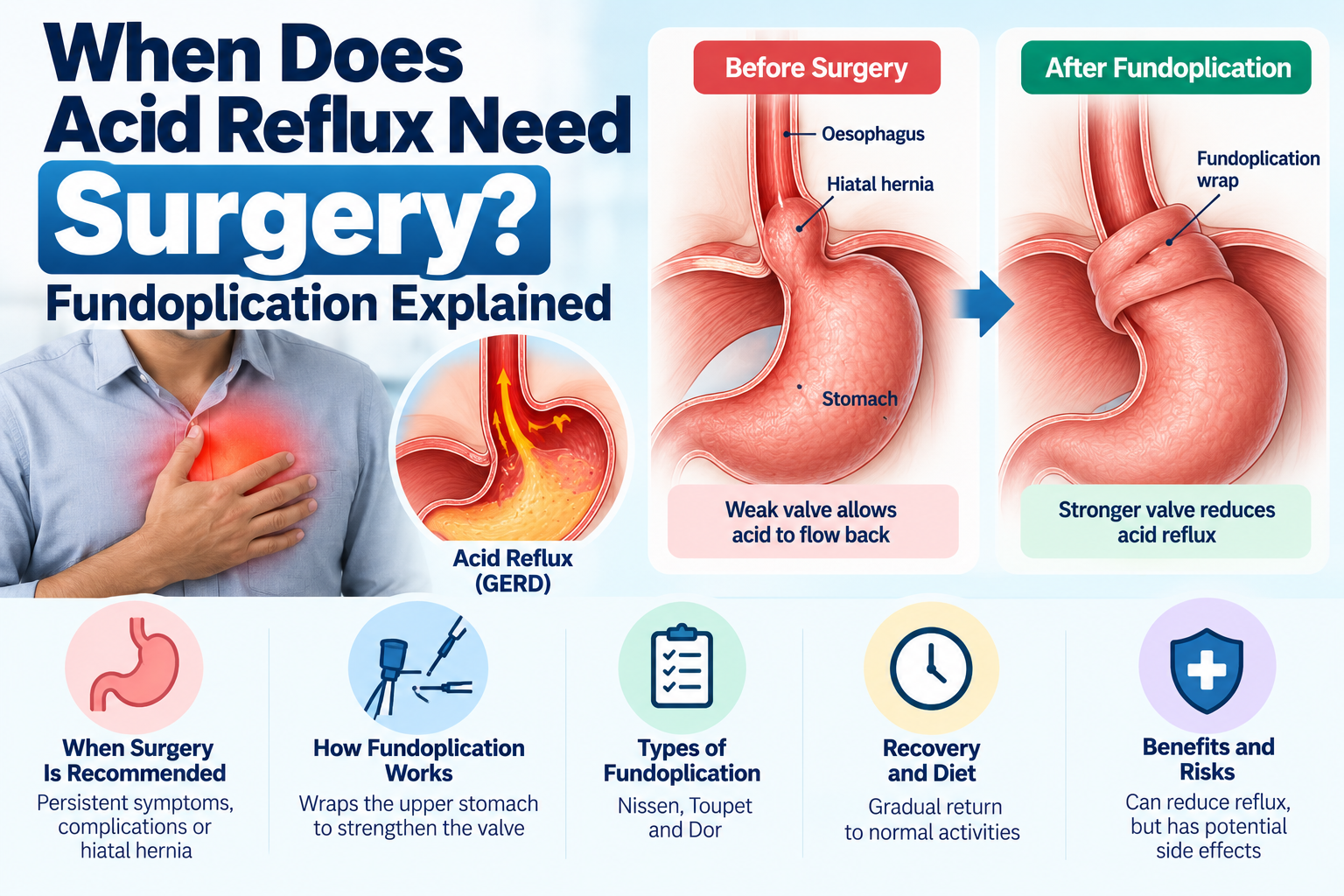
Acid reflux surgery may help patients who have confirmed gastroesophageal reflux disease (GERD), continue to experience troublesome symptoms despite appropriate treatment, or develop reflux-related complications. However, most people with occasional acidity or heartburn do not need surgery.
Doctors usually recommend lifestyle changes and medicines before considering an operation. When these treatments do not provide sufficient relief, or a patient has specific medical reasons to consider an alternative to long-term medication, a surgeon may discuss a procedure called fundoplication.
Fundoplication strengthens the barrier between the stomach and food pipe to reduce the backward flow of stomach contents.
At Arora Elite Care, Surat, Dr. Hitesh Arora, Advanced Laparoscopic and General Surgeon, can assess patients with persistent reflux symptoms and discuss whether surgical evaluation is appropriate.
What Is Acid Reflux and GERD?
Acid reflux occurs when stomach contents flow backward into the oesophagus, commonly called the food pipe.
A muscular valve called the lower oesophageal sphincter normally helps prevent this backward flow. When the valve does not function effectively, stomach acid and other contents may enter the oesophagus.
Common symptoms include:
- Burning sensation in the chest, especially after meals
- Sour or bitter taste in the mouth
- Regurgitation of food or liquid
- Discomfort when lying down
- Frequent heartburn
- Difficulty swallowing in some patients
Occasional reflux is common. However, frequent or troublesome symptoms may indicate GERD.
Learn more about the causes and warning signs in our guide to acid reflux symptoms.
When Does Acid Reflux Need Surgery?
Doctors may consider acid reflux surgery when a patient has objectively confirmed GERD and medicines or lifestyle measures do not adequately control symptoms, or when other clinical factors favour an operation.
Not every patient with reflux needs fundoplication.
A specialist may recommend surgical evaluation in the following situations.
1. Persistent Symptoms Despite Treatment
Some patients continue to experience troublesome regurgitation or heartburn despite appropriate medicines and lifestyle changes.
Before recommending surgery, doctors should confirm that reflux is responsible for the symptoms.
Other conditions can cause similar discomfort.
2. Severe Reflux-Related Complications
Long-standing GERD may cause inflammation or damage to the oesophagus.
Doctors may consider surgery in selected patients with complications such as severe erosive oesophagitis or reflux-related narrowing.
Treatment decisions depend on the specific findings.
3. Large Hiatal Hernia With GERD
A hiatal hernia develops when part of the stomach moves upward through an opening in the diaphragm.
Some hiatal hernias contribute to reflux by affecting the normal barrier between the stomach and oesophagus.
Patients with a significant hiatal hernia and confirmed GERD may benefit from surgical repair.
4. Preference for an Alternative to Long-Term Medication
Some patients with confirmed GERD prefer a surgical option rather than continuing long-term medication.
However, surgery has its own risks, and some patients still need acid-suppressing medicines afterward.
The doctor should explain both options before the patient makes a decision.
What Is Fundoplication Surgery?
Fundoplication is an anti-reflux operation in which the surgeon wraps the upper part of the stomach, called the fundus, around the lower oesophagus.
This wrap reinforces the barrier that helps prevent stomach contents from flowing backward.
Surgeons commonly perform the procedure laparoscopically through small abdominal incisions.
The main goal is to reduce troublesome reflux and improve symptoms in appropriately selected patients.
Fundoplication does not treat every cause of chest discomfort, indigestion or upper abdominal pain.
A careful diagnosis is essential before surgery.
Types of Fundoplication Surgery
Surgeons may use different techniques depending on the patient’s anatomy, oesophageal function and clinical findings.
Nissen Fundoplication
Nissen fundoplication involves a complete, 360-degree wrap of the upper stomach around the lower oesophagus.
It creates a stronger anti-reflux barrier but may increase the likelihood of postoperative swallowing difficulty or gas-related symptoms in some patients.
Toupet Fundoplication
Toupet fundoplication uses a partial wrap, typically around 270 degrees.
Surgeons may consider this technique when they want to balance reflux control with a lower risk of certain swallowing-related side effects.
Dor Fundoplication
Dor fundoplication creates an anterior partial wrap, commonly around 180 degrees.
Doctors use this approach in selected clinical situations, including alongside certain oesophageal procedures.
The appropriate technique depends on individual test results and the surgeon’s assessment. No single fundoplication method suits every patient.
Which Tests Are Necessary Before GERD Surgery?
Doctors usually recommend investigations to confirm reflux and evaluate oesophageal function before planning anti-reflux surgery.
Upper GI Endoscopy
An upper gastrointestinal endoscopy allows the doctor to examine the oesophagus, stomach and upper digestive tract.
It can identify inflammation, narrowing, a hiatal hernia or other abnormalities.
Ambulatory Reflux Monitoring
A reflux monitoring test measures acid exposure in the oesophagus over a specified period.
Doctors may recommend this test when endoscopy does not provide conclusive evidence of GERD.
Oesophageal Manometry
Manometry evaluates how the oesophageal muscles contract and how the lower oesophageal sphincter functions.
It also helps identify major motility disorders that could affect the safety or suitability of fundoplication.
Additional Imaging
In selected cases, the doctor may request a barium swallow study or other imaging to assess anatomy and swallowing.
These tests help the surgical team select an appropriate treatment.
How Does Laparoscopic Fundoplication Work?
Surgeons generally perform laparoscopic fundoplication under general anaesthesia.
The operation usually involves the following steps.
Step 1: Small abdominal incisions
The surgeon makes small incisions and introduces a camera and specialised surgical instruments.
Step 2: Examination of the upper stomach
The surgeon identifies the junction between the stomach and oesophagus.
Step 3: Hiatal hernia repair, when necessary
If the patient has a hiatal hernia, the surgeon may reposition the stomach and repair the enlarged opening in the diaphragm.
Step 4: Creation of the fundoplication wrap
The surgeon brings the upper portion of the stomach around part or all of the lower oesophagus, depending on the selected technique.
Step 5: Final assessment and closure
The surgeon checks the repair and closes the incisions.
The operation aims to improve the anti-reflux barrier without creating excessive resistance to swallowing.
What Is the Recovery Time After Fundoplication?
Many patients return to light daily activities within approximately one to two weeks after uncomplicated laparoscopic fundoplication, but complete recovery varies.
Some patients need a longer period before resuming strenuous work or heavy lifting.
The hospital stay may range from an overnight admission to a few days, depending on the procedure and the patient’s condition.
Diet After Fundoplication
Patients usually follow a gradual dietary progression.
The surgical team may recommend:
- Liquids during the initial recovery period
- Soft or pureed foods as tolerated
- Small, frequent meals
- Slow eating and thorough chewing
- Avoiding foods that cause discomfort
- Gradual return to normal meals according to medical advice
Temporary swallowing difficulty can occur because of swelling around the surgical area.
Patients should follow the specific diet plan their surgeon provides.
What Are the Risks of Fundoplication?
Fundoplication can improve reflux symptoms in appropriately selected patients, but it also carries potential risks.
Possible complications and side effects include:
- Temporary or persistent difficulty swallowing
- Bloating and increased gas
- Difficulty belching or vomiting
- Infection or bleeding
- Injury to nearby organs
- Anaesthesia-related complications
- Recurrent reflux symptoms
- Need for further treatment or repeat surgery
Some patients develop gas-bloat syndrome, which can cause abdominal fullness and discomfort.
The likelihood of complications depends on individual health, anatomy, surgical technique and other factors.
Patients should discuss expected benefits and possible limitations before agreeing to surgery.
Can a Hiatal Hernia Cause Acid Reflux?
Yes. Certain hiatal hernias can weaken the normal anti-reflux mechanism and contribute to GERD.
However, not every hiatal hernia causes symptoms or requires surgery.
Doctors consider the size and type of hernia, the patient’s symptoms, test results and overall health.
If a patient has both a significant hiatal hernia and confirmed GERD, the surgeon may repair the hernia and perform fundoplication during the same operation.
Dietary adjustments can also help some patients manage symptoms.
Read our guide to hiatal hernia diet and foods to avoid.
Is Fundoplication Better Than Taking Acid Reflux Medicines?
Neither option is automatically better for every patient.
Proton pump inhibitors and other prescribed treatments help many people control GERD effectively.
Fundoplication may provide an alternative for selected patients with confirmed reflux, particularly those with persistent regurgitation, severe reflux-related disease or a suitable surgical indication.
However, surgery cannot guarantee permanent relief.
Some patients experience recurrent symptoms or need medication again in the future.
A gastroenterologist and surgeon can help patients compare the benefits, risks, and long-term implications of each option.
When Should You Seek Medical Attention for Reflux?
Consult a doctor if you experience frequent heartburn, persistent regurgitation, or symptoms that interfere with eating and sleeping.
Seek prompt medical evaluation if you develop:
- Progressive difficulty swallowing
- Pain while swallowing
- Unexplained weight loss
- Repeated vomiting
- Vomiting blood
- Black, tar-like stools
New, severe, or unexplained chest pain requires urgent medical assessment, particularly when it occurs with sweating, breathlessness, dizziness, or pain spreading to the arm or jaw.
Do not assume that chest pain always comes from acidity.
Acid Reflux Surgery Consultation in Surat
Patients with persistent GERD symptoms or a suspected hiatal hernia can consult Dr. Hitesh Arora, Advanced Laparoscopic and General Surgeon, at Arora Elite Care, Surat.
During a consultation, the doctor can review symptoms, medical history, previous treatment, and investigation reports.
The medical team can then discuss whether continued medical treatment, additional testing, or surgical evaluation is appropriate.
Clinic: Arora Elite Care
Location: Solaris Kode 202–203, VIP Road, Surat, Gujarat 395007
Patients can contact the clinic to arrange a consultation and discuss available treatment options.
Frequently Asked Questions
1. When Is Acid Reflux Surgery Necessary?
Doctors may recommend acid reflux surgery for selected patients with confirmed GERD, persistent symptoms despite appropriate treatment, severe reflux-related complications or certain hiatal hernias. Most patients do not need surgery.
2. What Is the Success Rate of Fundoplication?
Many appropriately selected patients experience meaningful improvement in reflux symptoms after fundoplication. However, results vary, and some patients develop recurrent symptoms or need medication later. Your surgeon can explain expected outcomes for your situation.
3. Is Fundoplication a Major Surgery?
Fundoplication is an abdominal operation that requires general anaesthesia. Surgeons commonly perform it laparoscopically, but it still carries surgical risks and requires a structured recovery period.
4. Can Acid Reflux Return After Fundoplication?
Yes. Some patients experience recurrent reflux after surgery because the repair loosens, the anatomy changes or other factors affect reflux control. Further evaluation may be necessary if symptoms return.
5. How Long Does It Take to Recover From GERD Surgery?
Many patients resume light activities within one to two weeks after uncomplicated laparoscopic surgery. Diet progression, strenuous activity and complete recovery may require several additional weeks.
6. Is Hiatal Hernia Surgery the Same as Fundoplication?
No. Hiatal hernia repair corrects the abnormal position of the stomach and the opening in the diaphragm. Fundoplication strengthens the anti-reflux barrier. Surgeons may perform both procedures together when medically appropriate.
Conclusion
Acid reflux surgery is an option for selected patients with confirmed GERD, particularly when symptoms remain troublesome despite appropriate treatment or when reflux causes significant complications.
Laparoscopic fundoplication can strengthen the barrier between the stomach and oesophagus, but patients need proper testing and careful assessment before surgery.
If you experience persistent reflux symptoms or have a hiatal hernia, consult a qualified specialist to understand whether medicines, lifestyle changes or surgery offer the most appropriate approach.