
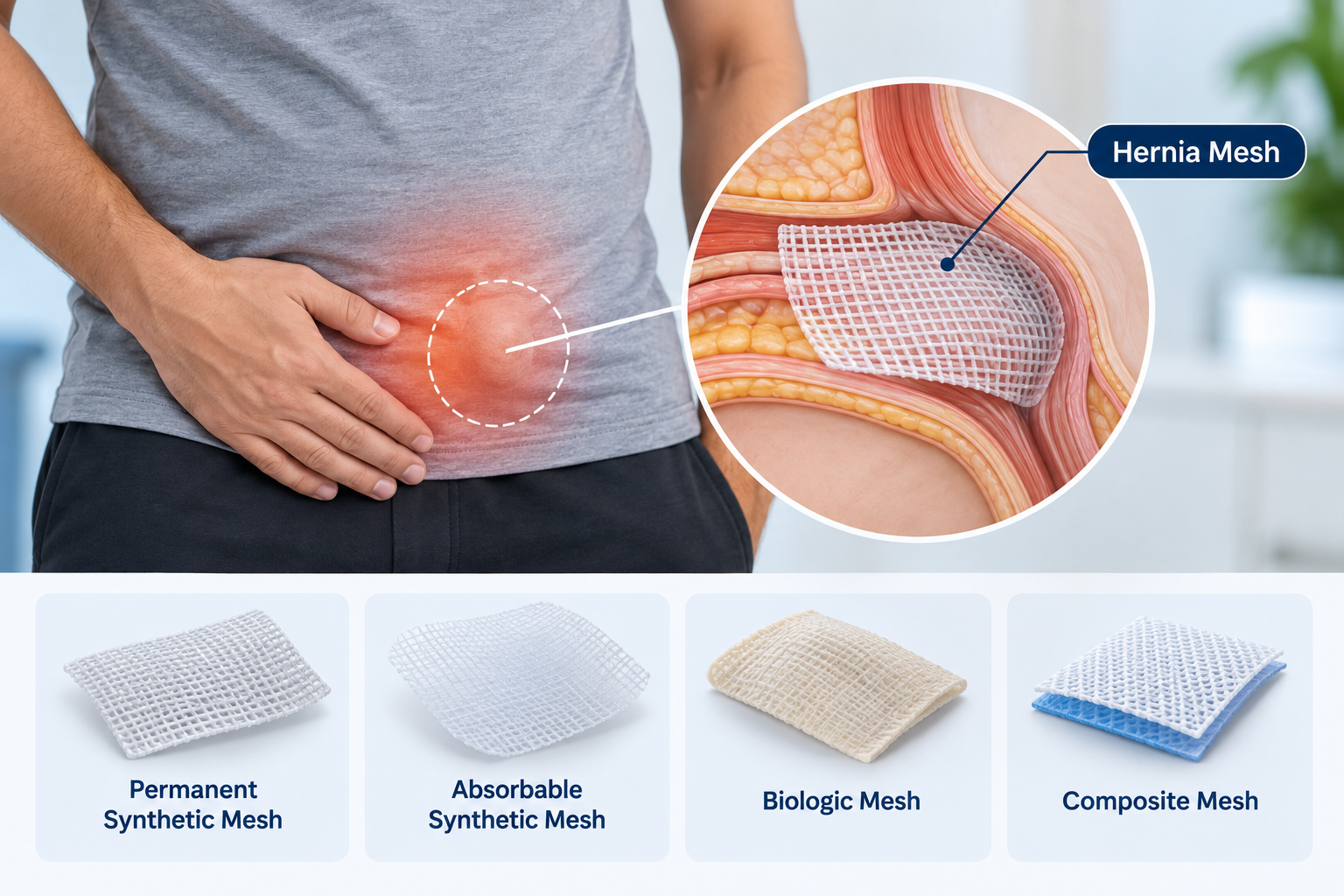
Medically reviewed by: Dr. Hitesh Arora, Advanced Laparoscopic and General Surgeon, Arora Elite Care, Surat (doctor review pending before publication). Hernia mesh is a medical implant that surgeons use to strengthen weakened tissue during hernia repair. It helps reduce the risk of recurrence in many types of hernias. Most patients tolerate modern surgical mesh well, but complications such as infection, persistent pain, fluid collection, or mesh-related problems can occur. The safest approach depends on the hernia type, mesh material, surgical technique, and individual patient factors.
If your surgeon recommends mesh during hernia surgery, you may wonder whether it is safe, whether it stays in your body permanently, and whether you can choose surgery without mesh.
These questions are common, especially when patients encounter conflicting information online.
Understanding how hernia mesh works, its different types, and possible complications can help you make an informed treatment decision.
What Is Hernia Mesh and Why Do Surgeons Use It?
Hernia mesh is a surgical implant that reinforces the weakened abdominal wall or other tissue where a hernia has developed.
A hernia occurs when tissue or an internal organ pushes through a weak area in the surrounding muscle or connective tissue.
During hernia repair, surgeons return the protruding tissue to its proper position and repair the weakness.
They may place mesh over or beneath the weakened area to provide reinforcement.
Mesh helps distribute tension across the repair rather than relying entirely on stitches to hold the tissue together.
Surgeons commonly use mesh for:
-
Inguinal hernias
-
Umbilical hernias
-
Incisional hernias
-
Ventral hernias
-
Selected recurrent hernias
However, not every hernia requires mesh. The surgeon considers the defect size, location, patient health, and available repair techniques.
What Are the Different Types of Hernia Mesh?
The main types of hernia mesh include permanent synthetic mesh, absorbable synthetic mesh, biologic mesh, and composite mesh. Each material has different properties and clinical applications.
1. Permanent Synthetic Mesh
Surgeons commonly use permanent synthetic mesh for many hernia repairs.
Manufacturers produce these implants using materials such as polypropylene or polyester.
Permanent mesh provides long-term reinforcement and generally remains in the body.
Over time, the surrounding tissue grows into or around the mesh, helping incorporate it into the repair.
2. Absorbable Synthetic Mesh
Absorbable mesh gradually breaks down after implantation.
Different products provide support for different lengths of time.
As the material absorbs, the patient’s own healing tissue must provide the remaining strength.
Absorbable mesh is not automatically better or safer than permanent mesh. Its suitability depends on the clinical situation.
3. Biologic Mesh
Biologic mesh comes from specially processed human or animal tissue.
Surgeons may consider it in selected complex abdominal wall reconstructions.
However, biologic mesh can be expensive, and research does not show that it consistently produces better outcomes than synthetic mesh.
4. Composite Mesh
Composite mesh combines different materials or surface properties.
Some products include a barrier designed to reduce direct contact between the mesh and internal organs when surgeons place it inside the abdominal cavity.
The surgeon selects the material according to the intended position and repair technique.
| Mesh Type | Main Feature | Typical Consideration |
|---|---|---|
| Permanent synthetic | Long-term reinforcement | Commonly used in hernia repair |
| Absorbable synthetic | Gradually breaks down | Selected repairs requiring temporary reinforcement |
| Biologic | Processed biological tissue | Certain complex reconstructions |
| Composite | Multiple material layers or surfaces | Selected placements near internal organs |
Is Hernia Mesh Safe?
Hernia mesh is generally considered safe and effective when surgeons use an appropriate implant and technique for a suitable patient. However, no surgical implant is completely free from risk.
Research supports mesh-based repair for many adult inguinal and ventral hernias because it can reduce recurrence compared with certain non-mesh repairs.
International groin hernia guidelines recommend mesh-based repair for most patients with inguinal hernias, while recognizing that non-mesh repair remains an option in selected circumstances.
The safety of a repair depends on several factors:
-
Mesh material and design
-
Hernia type and size
-
Mesh placement
-
Surgical technique
-
Surgeon experience
-
Infection risk
-
Smoking and diabetes status
-
Previous abdominal operations
-
Individual healing response
Patients should discuss their concerns with their surgeon instead of assuming that all mesh products have identical risks.
What Are the Possible Hernia Mesh Side Effects?
Possible hernia mesh side effects include pain, infection, swelling, fluid collection, and, less commonly, mesh migration, erosion, or complications that require another procedure.
Not every complication following hernia surgery results directly from the mesh. Some problems can also occur after repairs without mesh.
Common Early Problems
Patients may experience:
-
Temporary pain or discomfort
-
Swelling around the surgical site
-
Bruising
-
Seroma, or fluid collection
-
Haematoma, or blood collection
-
Wound infection
Many early postoperative symptoms improve during recovery.
Less Common or Long-Term Problems
Some patients develop:
-
Persistent groin or abdominal pain
-
Mesh infection
-
Hernia recurrence
-
Mesh displacement or migration
-
Mesh contraction or folding
-
Adhesions
-
Rare erosion into nearby structures
Severe mesh complications are less common, but they deserve appropriate medical evaluation.
Persistent pain after surgery does not automatically mean that the mesh has failed.
Doctors may need to investigate nerve irritation, scar tissue, recurrence, or other causes.
Hernia Mesh vs No Mesh: Which Is Better?
Mesh repair generally lowers recurrence risk for many adult hernias, while non-mesh repair may suit selected patients depending on the hernia and surgical circumstances.
The choice depends on the type of hernia rather than a universal preference.
| Factor | Mesh Repair | No-Mesh Repair |
|---|---|---|
| Repair method | Reinforces tissue with an implant | Uses the patient’s own tissue and sutures |
| Implant required | Yes | No |
| Recurrence risk | Often lower for many hernia types | Depends on technique and patient selection |
| Mesh-related complications | Possible | Not applicable |
| Suitable for every hernia | No | No |
| Surgeon expertise matters | Yes | Yes |
For example, the Shouldice technique is an established non-mesh approach for selected inguinal hernias.
However, its outcomes depend strongly on surgical expertise and patient selection.
For larger ventral or incisional hernias, mesh reinforcement often provides an important advantage in reducing recurrence.
Neither approach guarantees permanent success.
Can Hernia Mesh Move, Shrink or Cause Problems?
Yes, mesh-related complications such as migration, folding, contraction, or erosion can occur, although they are not expected outcomes of a properly performed repair.
Mesh movement is not the same as ordinary postoperative discomfort.
In some cases, mesh can change position or become involved in scar-related complications.
The likelihood depends on mesh characteristics, placement, fixation, healing, and other surgical factors.
Doctors may investigate persistent symptoms using physical examination and appropriate imaging.
Not every patient with pain requires mesh removal. Treatment depends on the identified cause.
Does Hernia Mesh Stay in the Body Forever?
Permanent synthetic hernia mesh is designed to remain in the body indefinitely, while absorbable mesh gradually breaks down over a period determined by its material.
Permanent mesh does not normally require routine replacement.
The body develops tissue around the implant during healing.
Patients should not assume that permanent mesh needs removal after a fixed number of years.
Surgeons generally consider mesh removal only when a specific complication makes further intervention necessary.
Is Hernia Mesh Used in Laparoscopic Hernia Surgery?
Yes. Surgeons commonly use mesh during laparoscopic repair of inguinal, ventral, and certain other hernias.
Laparoscopic surgery uses small incisions and a camera to access the surgical area.
During many laparoscopic hernia repairs, the surgeon places mesh to reinforce the weakened tissue.
For example, in a laparoscopic inguinal hernia repair, the surgeon may position mesh in the preperitoneal space to cover the weakened area.
Two commonly used laparoscopic inguinal hernia techniques are:
-
TAPP: Transabdominal Preperitoneal Repair
-
TEP: Totally Extraperitoneal Repair
TAPP involves entering the abdominal cavity and accessing the preperitoneal space to position the mesh.
TEP reaches the preperitoneal space without entering the abdominal cavity.
You can learn more about TAPP hernia surgery and how surgeons perform this procedure.
For a broader explanation of available procedures, explore laparoscopic hernia surgery in Surat.
What Are the Most Common Myths About Hernia Mesh?
Misinformation about surgical implants can create unnecessary fear. Understanding the difference between myths and medical evidence helps patients make informed decisions.
Myth 1: Hernia Mesh Always Causes Complications
Fact: Most patients do not develop serious mesh-related complications. However, complications are possible, and individual risks vary.
Myth 2: Mesh Guarantees That a Hernia Will Never Return
Fact: Mesh can reduce recurrence risk, but a hernia can still return after repair.
Factors such as tissue quality, obesity, smoking, wound complications, and the surgical technique can influence recurrence.
Read more about hernia recurrence after surgery.
Myth 3: Every Hernia Requires Mesh
Fact: Some hernias can be repaired without mesh. The decision depends on hernia characteristics, patient factors, and the surgeon’s expertise.
Myth 4: All Hernia Mesh Products Are the Same
Fact: Mesh products differ in material, weight, pore size, structure, absorbability, and intended placement.
Myth 5: Hernia Mesh Must Be Replaced Regularly
Fact: Permanent mesh is generally designed for long-term implantation and does not require scheduled replacement.
Myth 6: Mesh Surgery Is Completely Painless
Fact: Patients can experience postoperative discomfort after mesh repair. Some develop persistent pain, although many recover without significant long-term symptoms.
How Do Surgeons Choose the Right Hernia Mesh?
Surgeons select mesh according to the hernia’s location, size, complexity, repair technique, and the patient’s clinical condition.
Important considerations include:
-
Hernia location: Groin, umbilical, ventral, or incisional hernias may require different approaches.
-
Defect size: Larger defects may need broader reinforcement.
-
Previous operations: Scar tissue or earlier mesh placement may affect planning.
-
Infection risk: Contamination and active infection can influence material selection and timing.
-
Patient health: Diabetes, smoking, obesity, and other factors may affect wound healing.
-
Surgical approach: Open and laparoscopic techniques may require different mesh designs or placements.
The surgeon should explain why a particular mesh or non-mesh technique suits the patient’s condition.
What Is Recovery Like After Hernia Mesh Surgery?
Recovery after hernia mesh repair depends on the hernia type, surgical technique, size of the repair and individual healing response.
Patients commonly experience temporary soreness, swelling, or bruising.
Doctors often encourage early gentle walking to support recovery.
However, instructions about lifting, exercise, work and other activities vary.
Patients undergoing a straightforward laparoscopic inguinal hernia repair may recover differently from someone having a large incisional hernia reconstruction.
Follow your surgeon’s individual recovery instructions rather than assuming that every mesh operation has the same timeline.
When Should You Contact Your Surgeon After Mesh Repair?
Contact your surgical team if pain worsens instead of improving, the wound develops concerning changes, or new symptoms appear after hernia repair.
Warning signs include:
-
Increasing redness or swelling
-
Fever
-
Pus or discharge from the wound
-
Persistent or worsening pain
-
A new or enlarging bulge
-
Vomiting or significant abdominal distension
-
Problems with wound healing
Seek urgent medical care for severe abdominal pain, persistent vomiting, inability to pass stool or gas with abdominal swelling, or other signs of serious illness.
Early assessment helps identify complications and determine appropriate treatment.
Hernia Mesh Surgery at Arora Elite Care, Surat
At Arora Elite Care, Dr. Hitesh Arora, Advanced Laparoscopic and General Surgeon, evaluates patients with inguinal, umbilical, ventral, and other hernia conditions.
The consultation focuses on understanding the type of hernia and selecting an appropriate repair technique.
Depending on the patient’s condition, treatment planning may include:
-
Clinical examination
-
Imaging when necessary
-
Assessment of hernia size and location
-
Discussion of mesh and non-mesh options
-
Selection of an open or laparoscopic approach
-
Evaluation of recurrence risk
-
Postoperative recovery guidance
The aim is to recommend a repair based on the patient’s condition rather than assuming that one mesh or surgical technique suits everyone.
Frequently Asked Questions
1. Is Hernia Mesh Safe for Long-Term Use?
Hernia mesh is generally safe for long-term use when an appropriate product and surgical technique are selected. Permanent synthetic mesh is designed to remain inside the body. However, complications such as infection, chronic pain, or mesh-related problems can occur. Patients should discuss their individual risks with their surgeon.
2. What Are the Most Common Hernia Mesh Side Effects?
Possible side effects include temporary pain, swelling, bruising, fluid collection, and wound infection. Less commonly, patients may experience chronic pain, mesh infection, migration, or erosion. Some complications can also occur after hernia surgery without mesh, so persistent symptoms require medical evaluation to identify the actual cause.
3. Can a Hernia Return After Mesh Repair?
Yes. Mesh reinforcement reduces recurrence risk in many hernia repairs but does not eliminate it. Recurrence can depend on the hernia type, tissue strength, surgical technique, wound healing, and patient factors such as smoking or obesity. A new bulge after surgery should be evaluated by a surgeon.
4. Is Hernia Surgery Possible Without Mesh?
Yes. Surgeons can repair selected hernias using tissue-based techniques without placing mesh. However, mesh repair is preferred for many adult hernias because it often reduces recurrence risk. The most appropriate option depends on the hernia’s location, size, patient characteristics, and surgeon experience.
5. Does Hernia Mesh Dissolve Over Time?
It depends on the material. Permanent synthetic mesh is designed to remain in the body, while absorbable synthetic mesh gradually breaks down. Biologic mesh also undergoes tissue remodeling. Your surgeon can explain the properties of the specific implant and why it suits your repair.
6. Can Hernia Mesh Cause Pain Years After Surgery?
Persistent or delayed pain can occur after hernia repair, but it does not always result directly from the mesh. Possible causes include nerve irritation, scar tissue, recurrence, or mesh-related complications. A surgeon may recommend examination and imaging to identify the cause before deciding on treatment.
Conclusion
Hernia mesh plays an important role in modern hernia repair because it strengthens weakened tissue and reduces recurrence risk in many patients.
Permanent synthetic, absorbable, biologic, and composite meshes have different properties and clinical uses.
Although mesh repair is generally safe and effective, complications remain possible. Likewise, non-mesh surgery may suit selected patients but is not automatically safer or more effective.
The most important decision is not simply mesh vs. no mesh. It is choosing the appropriate repair for the specific hernia and patient.
At Arora Elite Care, Dr. Hitesh Arora provides surgical evaluation and individualized treatment planning for patients with hernias.
Patients considering hernia surgery should discuss the proposed technique, mesh material, potential complications, and recovery expectations before treatment.