If you have noticed a bulge in your abdomen or groin, discomfort while lifting, or pain that becomes worse during coughing or straining, you may be dealing with a hernia. While some hernias cause only mild symptoms initially, they usually do not disappear on their own and may gradually become larger or more uncomfortable. If you are searching for hernia surgery near Navsari & Valsad, you may also consider travelling to Surat for specialized surgical evaluation and access to advanced laparoscopic treatment. At Arora Elite Care, Surat, patients can receive evaluation and treatment for different types of hernias, with the surgical approach selected according to the type, size, location, symptoms, and individual medical condition.
What Is a Hernia?
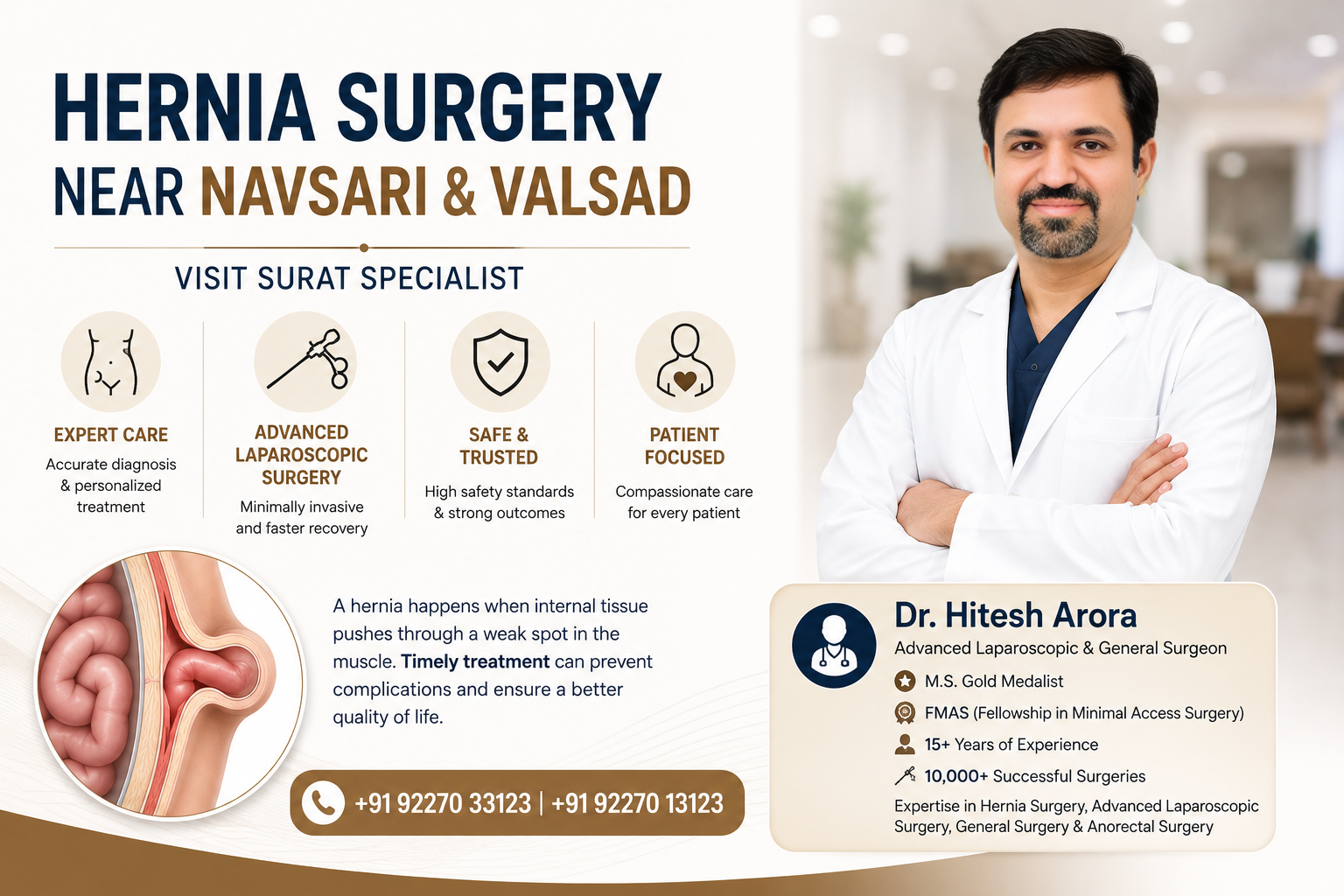
A hernia occurs when an internal tissue or organ pushes through a weak area in the surrounding muscle or abdominal wall.
It often appears as a visible or noticeable lump. The swelling may become more prominent when you stand, cough, lift something heavy, exercise, or strain during bowel movements.
Some hernias cause little discomfort at first, while others can become painful and interfere with everyday activities.
What Are the Common Types of Hernia?
Hernias can occur in different areas of the body. Some common types include:
Inguinal Hernia
An inguinal hernia develops in the groin and is particularly common in men. You may notice a bulge on one side of the groin that becomes more noticeable while standing, coughing, or lifting.
Umbilical Hernia
An umbilical hernia occurs around the belly button. It can affect both children and adults.
Incisional Hernia
An incisional hernia can develop through a weakened area associated with a previous abdominal surgical incision.
Ventral Hernia
A ventral hernia occurs through a weak point in the abdominal wall and can develop at different locations.
Because different hernias require different treatment approaches, an examination by a surgeon is important before deciding on treatment.
What Symptoms Can a Hernia Cause?
A hernia does not cause the same symptoms in every patient. Common signs can include:
- A visible or noticeable lump in the abdomen or groin
- Swelling that becomes more obvious while standing
- Pain or discomfort during lifting
- A dragging or heavy sensation
- Discomfort while coughing or sneezing
- Burning or aching around the swelling
- Pressure in the abdomen or groin
- A bulge that reduces when lying down
Some people have a hernia without significant pain. The absence of severe pain, however, does not necessarily mean the condition should be ignored.
Can a Hernia Heal Without Surgery?
A true hernia generally does not repair itself naturally because the weakness or opening in the abdominal wall remains present.
Lifestyle changes may reduce pressure on the area and help control discomfort. For example, avoiding excessive straining, managing constipation, and maintaining an appropriate body weight may help.
However, these measures do not close the underlying defect.
Whether you need surgery immediately depends on the type of hernia, symptoms, size, risk of complications, overall health, and the surgeon’s assessment.
When Does a Hernia Need Surgery?
Surgery may be recommended when a hernia:
- Causes persistent or increasing pain
- Becomes progressively larger
- Interferes with work or daily activities
- Causes repeated discomfort during physical activity
- Cannot easily be reduced
- Has features that increase concern for complications
Your surgeon will determine whether planned repair is appropriate after examining the hernia and reviewing your overall health.
When Is a Hernia an Emergency?
Most hernia operations can be planned, but certain symptoms require urgent medical attention.
Seek immediate medical care if a hernia suddenly becomes extremely painful, firm, very tender, or cannot be pushed back when it previously could. Severe abdominal pain, vomiting, abdominal swelling, fever, or inability to pass stool or gas can also indicate a potentially serious complication.
Do not wait for a routine appointment when these symptoms occur.
How Is Hernia Surgery Performed?
The purpose of hernia surgery is to return the protruding tissue to its appropriate position and repair the weakened area.
Two commonly used approaches are open hernia repair and laparoscopic hernia repair.
Open Hernia Surgery
In open surgery, the surgeon makes an incision near the hernia and repairs the weakened area directly.
Open repair remains an appropriate and effective option for many patients.
Laparoscopic Hernia Surgery
Laparoscopic surgery is a minimally invasive approach in which the surgeon works through several small incisions using a camera and specialized instruments.
For appropriately selected patients, potential advantages can include:
- Smaller incisions
- Smaller scars
- Less postoperative discomfort in some cases
- Earlier mobility
- Faster return to routine activities for some patients
However, laparoscopic surgery is not automatically better for every hernia. The surgeon chooses the technique according to the individual case.
Is Mesh Used During Hernia Surgery?
Mesh may be used in many adult hernia repairs to reinforce the weakened abdominal wall and provide additional support to the repair.
However, the need for mesh and the technique used depend on factors such as the type and size of the hernia, location, previous surgery, contamination risk, and individual patient considerations.
Your surgeon should explain the planned repair before surgery.
Why Do Patients From Navsari and Valsad Consider Surat for Hernia Surgery?
Patients searching for hernia surgery near Navsari & Valsad may consider travelling to Surat when they want specialized surgical evaluation or access to laparoscopic treatment options.
For a planned operation, choosing a surgical centre should involve more than distance alone. Patients should consider:
- The surgeon’s experience with hernia repair
- Availability of laparoscopic surgery
- Proper preoperative evaluation
- Surgical and anesthesia facilities
- Personalized selection of the surgical technique
- Clear recovery instructions
- Availability of postoperative follow-up
Because Navsari and Valsad are connected with Surat, patients can discuss whether travelling for consultation and planned surgery is practical for their individual situation.
Why Consider Arora Elite Care, Surat?
At Arora Elite Care, Surat, patients with suspected or diagnosed hernias can undergo a detailed surgical evaluation before treatment.
The consultation helps determine:
- What type of hernia you have
- How large the hernia is
- Whether surgery is currently necessary
- open or laparoscopic repair may be appropriate
- Whether mesh may be required
- What preparation is needed before surgery
- What recovery may involve
The aim is to select treatment according to the patient’s actual condition rather than recommending the same procedure for every hernia.
What Happens Before Hernia Surgery?
Before surgery, your surgeon may review your symptoms, medical history, previous operations, medications, and existing health conditions.
Depending on your age and health, preoperative assessment may include:
- Blood investigations
- Imaging when clinically required
- ECG or other tests when indicated
- Anesthesia fitness assessment
- Review of medicines and allergies
If you are travelling from Navsari or Valsad, carry your previous reports, scans, prescriptions, and details of earlier operations to your consultation.
How Long Does Recovery Take After Hernia Surgery?
Recovery varies depending on the type of hernia, surgical approach, complexity of the repair, occupation, and individual healing.
Patients are generally encouraged to begin gentle movement according to their surgeon’s advice. You will receive instructions about wound care, bathing, medication, diet, driving, lifting, exercise, and returning to work.
Avoid restarting heavy lifting simply because your pain has improved. Follow your surgeon’s instructions regarding when strenuous activity can safely resume.
Can a Hernia Come Back After Surgery?
Hernia recurrence is possible, although many repairs provide long-term correction.
Several factors can influence recurrence, including the type and complexity of the hernia, tissue quality, surgical technique, smoking, obesity, persistent coughing, constipation, and returning to strenuous activity too early.
Following postoperative instructions and addressing factors that increase abdominal pressure can support recovery.
Consult for Hernia Surgery Near Navsari & Valsad
If you are looking for hernia surgery near Navsari & Valsad, you can consider a specialist surgical consultation with Dr. Hitesh Arora.
A proper examination can determine whether your swelling is actually a hernia, identify its type and severity, and establish whether observation, open repair, or laparoscopic hernia surgery is appropriate. An Advanced Laparoscopic and General Surgeon in Surat, he has over 15 years of experience and has successfully performed more than 10,000 surgeries. He is an M.S. Gold Medalist and holds an FMAS (Fellowship in Minimal Access Surgery) qualification. His surgical expertise includes hernia surgery, advanced laparoscopic surgery, general surgery, and anorectal surgery, with minimally invasive techniques used for suitable hernia cases.
Conclusion
A hernia may begin as a small bulge or occasional discomfort, but it should not simply be ignored. Since the underlying abdominal-wall weakness generally does not repair itself, medical evaluation can help determine whether and when surgery is needed.
For patients searching for hernia surgery near Navsari & Valsad, travelling to Arora Elite Care, Surat can provide access to surgical assessment and both conventional and minimally invasive hernia treatment options.
The right treatment depends on the type of hernia, its size and symptoms, your overall health, and the surgeon’s evaluation.
Frequently Asked Questions
Can a hernia heal on its own?
A true hernia generally does not close on its own. A surgeon can assess whether monitoring or surgical repair is appropriate.
Is laparoscopic surgery possible for a hernia?
Yes, many hernias can be treated laparoscopically. However, suitability depends on the type of hernia, previous surgeries, overall health, and other individual factors.
Is every hernia an emergency?
No. Many hernias can be treated with planned surgery. Sudden severe pain, vomiting, a firm or irreducible swelling, or abdominal distension requires urgent medical evaluation.
Can I travel from Navsari or Valsad to Surat for hernia surgery?
For planned treatment, patients can travel to Surat for surgical consultation and treatment. Your surgeon should advise when it is safe to travel home after surgery.