
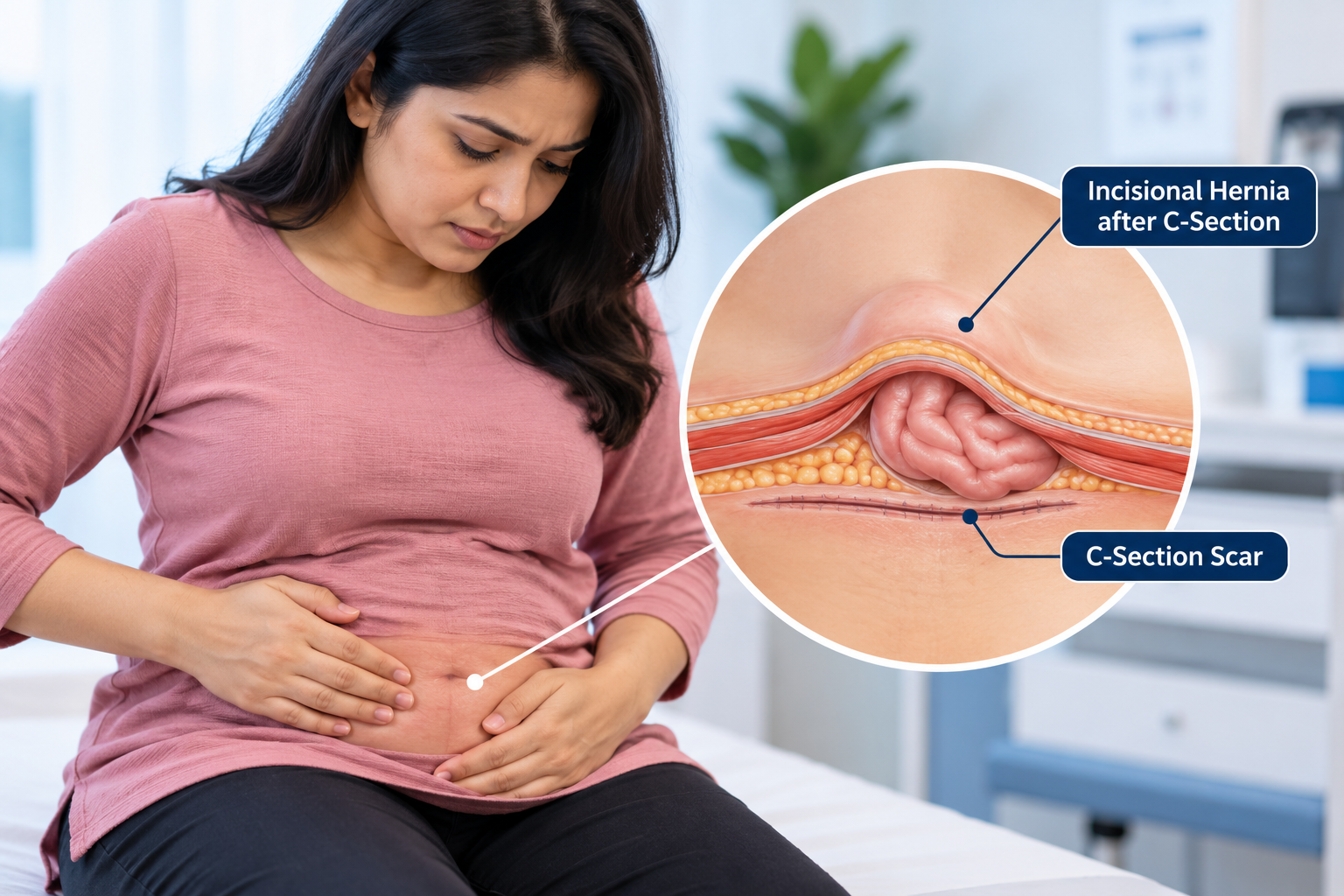
An incisional hernia after C section develops when tissue pushes through a weakened area of the abdominal wall near a previous Caesarean delivery incision. It may cause a visible bulge near the C-section scar, discomfort when coughing or lifting, or a pulling sensation in the lower abdomen. Not every swelling after delivery is a hernia. A surgeon can confirm the diagnosis and recommend monitoring, open repair, or laparoscopic surgery depending on the condition.
A C-section involves an incision through the abdominal wall to deliver a baby. Although most incisions heal without major complications, a small number of women develop weakness in the abdominal wall near the surgical site.
This weakness may eventually allow fat or part of the intestine to protrude, creating an incisional hernia.
Some women notice a lump shortly after delivery, while others discover it months or years later.
Understanding the symptoms of a hernia after delivery can help women recognise when a surgical evaluation is necessary.
What Is an Incisional Hernia After C-Section?
An incisional hernia after C section is a defect in the abdominal wall that develops at or near a previous surgical incision.
During a Caesarean delivery, the surgeon makes an incision through several tissue layers to reach the uterus.
These tissues normally heal and regain strength over time. However, the abdominal wall’s deeper supporting layer, called the fascia, may remain weak or develop a defect.
Fat or abdominal contents can then push through this area.
The resulting bulge may become more noticeable when a woman stands, coughs, strains, or lifts something.
An incisional hernia is different from ordinary postoperative swelling because it involves a structural weakness in the abdominal wall.
Although incisional hernias can occur after C-section delivery, they are relatively uncommon, particularly after a low-transverse incision.
What Causes a Hernia After C-Section Delivery?
A hernia after C-section develops when the abdominal wall does not maintain adequate strength at the previous incision site.
Several factors can increase the likelihood of incisional hernia formation.
1. Poor Wound Healing
If the surgical wound heals slowly or develops complications, the deeper abdominal tissues may not regain their expected strength.
2. Surgical Site Infection
A wound infection can interfere with normal healing and increase the risk of an incisional hernia.
3. Obesity
Excess abdominal weight can increase pressure on the abdominal wall and place additional stress on a healing incision.
4. Multiple Abdominal Operations
Previous C-sections or other abdominal surgeries may affect tissue strength and create scar tissue.
However, having more than one C-section does not automatically mean a woman will develop a hernia.
5. Increased Abdominal Pressure
Persistent coughing, chronic constipation, and repeated heavy straining can increase pressure inside the abdomen.
6. Diabetes and Smoking
Poorly controlled diabetes and smoking can impair wound healing and may increase postoperative complication risks.
A surgeon considers these factors when evaluating a suspected incisional hernia.
What Are the Signs of a Hernia Near a C-Section Scar?
The most recognisable sign is a bulge near the C-section scar that becomes more prominent when standing, coughing, or straining.
Symptoms may include:
-
A visible or palpable lump near the surgical scar
-
Swelling that increases when standing
-
A bulge that becomes smaller when lying down
-
Mild discomfort or a pulling sensation
-
Pain when coughing, lifting, or bending
-
Pressure or heaviness in the lower abdomen
Some incisional hernias cause little or no pain.
Others gradually enlarge and interfere with daily activities.
A bulge does not need to be painful to require medical assessment.
If you notice a persistent or growing lump near your C-section incision, consult a surgeon for an examination.
Is Every Bulge After C-Section a Hernia?
No. Several conditions can cause swelling or a change in abdominal shape after Caesarean delivery.
A surgeon must distinguish an incisional hernia from other postpartum conditions.
| Condition | Typical Features | Main Difference |
|---|---|---|
| Incisional hernia | Localised bulge near the surgical incision | Defect in the abdominal wall fascia |
| Diastasis recti | Broad bulging or doming along the midline | Separation of abdominal muscles without a true fascial hole |
| Seroma | Localised fluid collection | Fluid accumulation rather than herniation |
| Scar tissue | Firmness or thickening around the incision | Healing-related tissue changes |
| Haematoma | Swelling, sometimes with bruising | Collection of blood |
Diastasis recti is particularly important to recognise after pregnancy.
It occurs when the two rectus abdominis muscles move farther apart as the connective tissue between them stretches.
Unlike a true hernia, diastasis recti does not involve an opening through which abdominal contents protrude.
Both conditions can sometimes occur together.
How Is an Incisional Hernia Diagnosed?
Doctors diagnose an incisional hernia using a medical history, physical examination, and imaging when necessary.
The surgeon asks about previous C-sections, wound complications, symptoms, and when the swelling first appeared.
During the examination, the surgeon may assess the abdomen while the patient stands, lies down, or gently coughs.
This helps identify a bulge that changes with abdominal pressure.
Ultrasound
Ultrasound can help identify a defect in the abdominal wall and distinguish a hernia from some other causes of swelling.
CT Scan
A CT scan may be useful when the hernia is difficult to examine, the anatomy is complex, or the surgeon needs more detailed information before repair.
Not every patient requires a CT scan.
The surgeon selects imaging according to the examination findings and treatment plan.
Can an Incisional Hernia After C-Section Heal Without Surgery?
A true incisional hernia generally does not close permanently on its own because the abdominal wall has developed a structural defect.
However, not every patient requires immediate surgery.
For a small, reducible hernia that causes minimal symptoms, the surgeon may recommend observation after discussing the risks and benefits.
Monitoring can include watching for increasing size, discomfort, or changes in the bulge.
Weight management, constipation prevention, and avoiding unnecessary straining may help reduce symptoms, but these measures do not repair the defect.
Abdominal binders may provide temporary support for some patients. They do not cure an incisional hernia.
Women should avoid attempting forceful massage or pushing a painful, stuck bulge back into the abdomen.
What Are the Treatment Options for Hernia After C-Section?
Treatment options include careful monitoring, open hernia repair, and minimally invasive repair, depending on the hernia’s characteristics and the patient’s circumstances.
1. Observation
A surgeon may recommend watchful waiting for a small, reducible hernia with few symptoms.
Regular assessment helps identify changes that may require treatment.
2. Open Incisional Hernia Repair
During open surgery, the surgeon makes an incision to access the weakened abdominal wall.
The surgeon returns protruding tissue to its proper position and repairs the defect.
Mesh reinforcement may be recommended to reduce recurrence risk, depending on the defect and clinical situation.
3. Laparoscopic Hernia Repair
Laparoscopic surgery uses a camera and specialised instruments through small incisions.
The surgeon repairs the defect and may reinforce the abdominal wall with mesh.
This approach may be suitable for selected patients, but previous operations, adhesions, hernia size, and anatomy influence the decision.
For detailed information, explore incisional hernia treatment in Surat.
Open vs Laparoscopic Hernia Repair After C-Section
Both open and laparoscopic techniques can treat incisional hernias, but neither approach is automatically better for every patient.
| Factor | Open Hernia Repair | Laparoscopic Hernia Repair |
|---|---|---|
| Surgical access | Incision over or near the repair area | Several small incisions |
| Technique | Direct repair of the abdominal wall | Camera-assisted repair |
| Mesh | May be used | Commonly used |
| Recovery | Depends on repair size and complexity | May support earlier recovery in selected cases |
| Previous scar | May involve the existing scar | Often uses separate incision sites |
| Suitability | Can address a wide range of defects | Depends on anatomy and surgical history |
The surgeon considers hernia size, location, previous operations, symptoms, and future pregnancy plans.
Learn more about laparoscopic hernia surgery in Surat and how surgeons select the appropriate approach.
When Is the Right Time for Hernia Repair After Delivery?
The ideal timing depends on the patient’s recovery from childbirth, hernia symptoms, risk of complications, and plans for another pregnancy.
After a C-section, the body needs time to heal.
For a small, uncomplicated hernia, a surgeon may recommend delaying elective repair until postpartum recovery is more complete.
However, there is no single waiting period that suits every woman.
A painful, enlarging or complicated hernia may require earlier assessment or treatment.
Women who are breastfeeding should also discuss medications, anaesthesia and postoperative support with their healthcare team.
The surgeon and obstetrician can coordinate care when necessary.
Can You Get Pregnant Again After Incisional Hernia Repair?
Yes, pregnancy may be possible after incisional hernia repair, but a future pregnancy can place additional strain on the repaired abdominal wall.
As the uterus grows, abdominal pressure increases and the surrounding tissues stretch.
This can increase the risk of recurrence after repair.
For women planning another pregnancy, surgeons may consider delaying elective repair of a small, uncomplicated hernia until after the planned pregnancy.
However, this decision depends on symptoms, defect size, and complication risk.
Women with a symptomatic or high-risk hernia may need treatment sooner.
Discuss pregnancy plans with your surgeon before choosing the timing and technique of repair.
When Is a Hernia After C-Section an Emergency?
A hernia becomes an emergency when abdominal contents become trapped, or their blood supply is compromised.
Seek urgent medical care if you experience:
-
Sudden, severe abdominal pain
-
A painful bulge that cannot be reduced
-
Persistent vomiting
-
Increasing abdominal swelling
-
Redness or darkening of skin over the bulge
-
Inability to pass stool or gas, particularly with abdominal pain and vomiting
These symptoms can indicate incarceration, bowel obstruction or strangulation.
Strangulated hernias require urgent treatment because reduced blood supply can damage the trapped tissue.
Do not wait for a routine appointment if these symptoms occur.
Incisional Hernia Treatment at Arora Elite Care, Surat
At Arora Elite Care, Dr. Hitesh Arora, Advanced Laparoscopic and General Surgeon, evaluates patients with abdominal wall and incisional hernias.
A consultation may include examination of the previous C-section scar, assessment of the hernia defect, and discussion of appropriate treatment options.
Treatment planning considers symptoms, hernia size, previous surgery, overall health, and future pregnancy plans.
Depending on the findings, the surgeon may discuss observation, open repair or laparoscopic surgery.
For an individual assessment, book a surgery consultation in Surat.
Conclusion
An incisional hernia after C section is an uncommon but important cause of a persistent bulge near a Caesarean delivery scar.
Although some hernias cause little discomfort, others enlarge or become painful over time.
Not every postpartum abdominal bulge is a hernia. Diastasis recti, seroma, and scar-related changes can produce similar concerns.
A proper surgical examination helps establish the diagnosis and identify the most appropriate treatment.
Women who notice a new or enlarging bulge near their C-section scar should seek medical advice, especially if they experience pain or changes in the swelling.
Frequently Asked Questions
1. How Do I Know If I Have a Hernia After a C-Section?
A hernia after C-section may cause a bulge near the surgical scar that becomes more noticeable when standing, coughing, or lifting. Some women experience discomfort or a pulling sensation. However, other conditions can cause similar swelling. A surgeon can confirm the diagnosis through examination and imaging when necessary.
2. How Soon After a C-Section Can an Incisional Hernia Appear?
An incisional hernia may become noticeable during the months after delivery or develop years later. The timing varies according to wound healing, abdominal wall strength, and other factors. A new bulge near the C-section scar should be examined rather than assumed to be a normal postoperative change.
3. Can an Incisional Hernia After C-Section Go Away on Its Own?
A true incisional hernia generally does not heal permanently without surgery because it involves a defect in the abdominal wall. However, small hernias with minimal symptoms may not require immediate repair. A surgeon can recommend observation or treatment according to the hernia’s size, symptoms, and risks.
4. Is Laparoscopic Surgery Possible for a Hernia After C-Section?
Yes, laparoscopic repair may be possible for selected incisional hernias after C-section. Suitability depends on the hernia’s size and location, previous operations, scar tissue, and overall health. Some patients benefit more from open surgery. The surgeon recommends the approach after examining the abdominal wall.
5. Can I Have Another Pregnancy After Incisional Hernia Repair?
Pregnancy may be possible after incisional hernia repair, but it can increase pressure on the repaired abdominal wall and potentially raise recurrence risk. Women planning another pregnancy should discuss timing and treatment options with their surgeon. Elective repair may sometimes be delayed when the hernia is uncomplicated.
6. When Should I Worry About a Bulge Near My C-Section Scar?
Arrange a medical evaluation for a persistent, growing, or painful bulge near your C-section scar. Seek urgent care if the bulge becomes severely painful, cannot be reduced, or occurs with vomiting, abdominal swelling, or skin discolouration. These symptoms may indicate a trapped or strangulated hernia.