
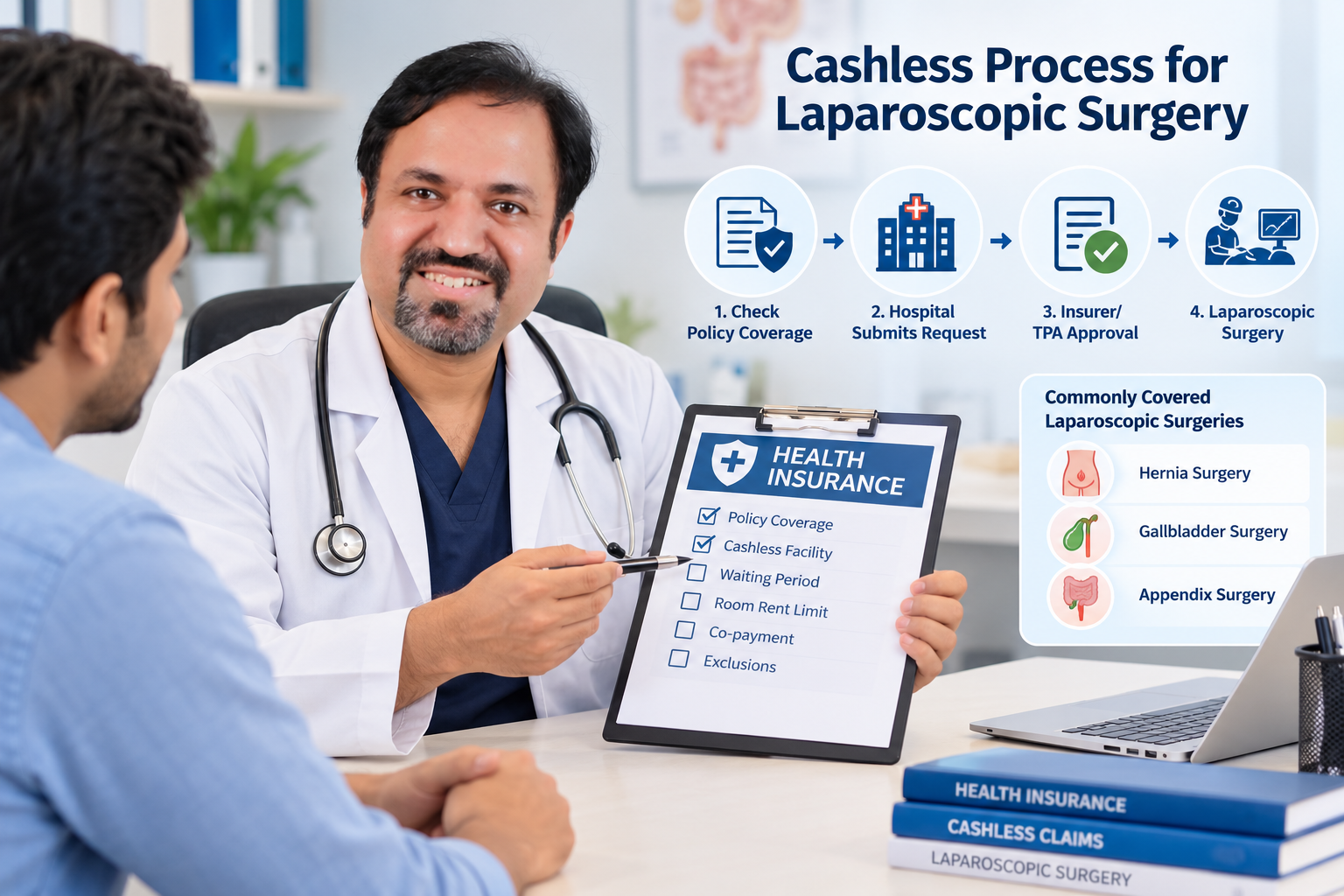
Laparoscopic surgery insurance may cover medically necessary procedures such as hernia repair, appendix removal, and gallbladder surgery, depending on your health insurance policy. To receive cashless treatment, patients must meet the policy’s coverage requirements and obtain the necessary insurer or TPA approval. Waiting periods, exclusions, co-payments, room-rent limits, and non-payable expenses can affect the final amount a patient must pay.
Planning surgery involves more than choosing a surgeon and understanding the procedure. Many patients also want to know whether their mediclaim policy will cover the treatment and whether they can receive cashless hospitalisation.
For patients in Surat, understanding the laparoscopic surgery insurance process can help reduce financial uncertainty before a planned operation.
However, cashless treatment does not mean that every surgery receives automatic approval or that the insurer will pay the entire hospital bill.
This guide explains how mediclaim works for laparoscopic procedures, which expenses insurers may cover, what documents patients need, and how to prepare for a cashless claim.
What Is Laparoscopic Surgery Insurance?
Laparoscopic surgery insurance refers to health insurance coverage for eligible surgical procedures that doctors perform using minimally invasive techniques.
Laparoscopic surgery involves small incisions through which the surgeon introduces a camera and specialised instruments.
Doctors commonly use this approach for:
-
Hernia repair
-
Gallbladder removal
-
Appendix removal
-
Selected colorectal procedures
-
Certain gynaecological operations
-
Other medically necessary abdominal procedures
Insurance companies generally evaluate the medical necessity of the procedure and the terms of the policy rather than approving treatment simply because the surgeon uses laparoscopy.
A patient may have coverage for one operation but face restrictions or exclusions for another.
Does Mediclaim Cover Laparoscopic Surgery in India?
Yes, many Indian health insurance policies cover medically necessary laparoscopic surgery, subject to their terms, exclusions, waiting periods, and available sum insured.
Coverage depends on several factors:
-
Whether the policy includes hospitalisation and surgical benefits
-
the condition falls under a waiting period
-
The insurer considers the procedure medically necessary
-
The policy has a specific exclusion
-
The hospital qualifies for cashless treatment
-
The available sum insured covers the eligible expenses
-
Whether co-payment or sub-limit conditions apply
For example, a patient with symptomatic gallstones may require laparoscopic gallbladder removal.
The insurer may cover the procedure if the policy includes the treatment and the patient meets all relevant conditions.
However, the insurer must still review the claim and confirm eligibility.
Which Laparoscopic Surgeries May Be Covered by Mediclaim?
Mediclaim policies may cover several common laparoscopic procedures when patients meet the insurer’s medical and policy requirements.
| Procedure | Potential Insurance Coverage | Important Consideration |
|---|---|---|
| Laparoscopic hernia repair | Often covered | Waiting periods and exclusions may apply |
| Laparoscopic gallbladder removal | Often covered | Medical necessity and policy conditions matter |
| Laparoscopic appendectomy | Often covered | Emergency and policy eligibility rules apply |
| Laparoscopic colorectal surgery | May be covered | Diagnosis and treatment details affect eligibility |
| Gynaecological laparoscopy | May be covered | Procedure-specific exclusions may apply |
| Diagnostic laparoscopy | Depends on the policy | Indication and hospitalisation criteria matter |
Patients should check their individual policy before assuming coverage.
For more information about the procedures themselves, explore laparoscopic hernia treatment in Surat, gallbladder surgery, and appendix surgery.
How Does the Cashless Surgery Process Work in Surat?
Cashless surgery allows an eligible insurer to settle approved hospital expenses directly with the hospital, reducing the amount the patient needs to pay upfront.
The process generally follows these steps.
Step 1: Consult the Surgeon
The surgeon examines the patient, reviews medical reports, and determines whether surgery is necessary.
The patient receives information about the diagnosis, recommended procedure, and expected hospitalisation.
Step 2: Check Your Insurance Policy
Contact your insurance company or TPA to confirm:
-
Policy validity
-
Available sum insured
-
Relevant waiting periods
-
Network hospital eligibility
-
Procedure coverage
-
Co-payment requirements
-
Room-rent restrictions
Do not assume that every hospital has a cashless arrangement with every insurance company.
Step 3: Request a Hospital Estimate
The hospital prepares an estimate based on the proposed procedure, expected hospital stay, and other anticipated charges.
The estimate may include surgeon fees, operating theatre charges, anaesthesia, room charges, and other treatment-related expenses.
Step 4: Submit Pre-Authorisation
For planned surgery, the hospital’s insurance desk or another authorised party generally submits the required pre-authorisation documents.
The insurer or TPA reviews the diagnosis, treatment recommendation, policy eligibility, and estimated expenses.
Step 5: Receive the Insurer’s Decision
The insurer may approve the request, seek additional documents, issue a partial approval, or decline cashless authorisation.
Pre-authorisation does not necessarily guarantee payment of every charge on the final bill.
Step 6: Complete Treatment and Final Claim Processing
After surgery, the hospital prepares the final bill and supporting documents.
The insurer reviews the final claim and confirms the approved amount.
The patient pays any applicable non-covered expenses, deductibles, co-payments, or other outstanding charges.
What Documents Are Required for Cashless Mediclaim?
Patients generally need their health insurance details, identification, medical records, and the surgeon’s treatment recommendation for a cashless claim.
Commonly requested documents include:
-
Health insurance card or policy details
-
Government-issued identification
-
Doctor’s consultation notes
-
Diagnosis and treatment recommendation
-
Blood test reports
-
Ultrasound, CT, or other relevant imaging reports
-
Hospital cost estimate
-
Pre-authorisation form
-
Previous medical records when relevant
The insurer may request additional documents.
Keeping these records organised can help avoid unnecessary claim-processing delays.
What Is the Waiting Period for Laparoscopic Surgery?
A mediclaim waiting period is the period during which an insurer may restrict coverage for certain medical conditions or treatments after the policy begins.
Different waiting periods may apply.
Initial Waiting Period
Many health insurance policies have an initial waiting period, commonly 30 days, during which coverage for non-accidental illnesses may be restricted.
Specific Disease or Procedure Waiting Period
Some policies apply a specific waiting period to listed conditions or procedures, which may include certain hernias.
Under the current Indian regulatory framework, specified disease or procedure waiting periods generally cannot exceed 36 months, although individual policies may have shorter periods.
Pre-Existing Disease Waiting Period
A condition that qualifies as pre-existing under the applicable policy and regulatory definition may attract a separate waiting period.
Current IRDAI rules generally cap the pre-existing disease waiting period at 36 months for applicable health insurance policies.
Older policies, renewals, and particular products may have different contractual details.
Always check the actual policy wording and continuity benefits rather than relying only on general waiting-period information.
Is Hernia Surgery Covered by Insurance?
Yes, many health insurance policies cover medically necessary hernia surgery, including laparoscopic hernia repair, but waiting periods and policy conditions can affect eligibility.
Some insurers classify hernia treatment under a specific disease or procedure waiting period.
For example, if your policy includes a waiting period for hernia surgery, you may not receive coverage until that period ends, unless a relevant exception or continuity benefit applies.
Before scheduling surgery, ask your insurer to confirm whether your policy covers the diagnosis, proposed operation, surgical mesh, and hospital expenses.
You can also review hernia surgery cost in Surat to understand the factors that influence treatment expenses.
What Expenses May Not Be Covered by Mediclaim?
Cashless mediclaim does not always cover the entire hospital bill. Patients may need to pay excluded expenses, co-payments, deductibles, or charges above policy limits.
Depending on the policy, these may include non-medical consumables, room upgrades, charges above procedure sub-limits, or other excluded items.
For example, a patient may have an approved cashless claim but still need to pay the difference between the hospital’s final bill and the amount the insurer accepts.
The insurer’s approval letter and policy wording help identify these differences.
Cashless vs Reimbursement: What Is the Difference?
Cashless insurance involves direct settlement of approved expenses between the insurer and hospital. Reimbursement requires the patient to pay the bill first and then claim eligible expenses from the insurer.
| Factor | Cashless Mediclaim | Reimbursement |
|---|---|---|
| Initial payment | Insurer settles approved charges directly | Patient generally pays first |
| Hospital eligibility | Network or specially approved arrangement | Subject to policy conditions |
| Pre-authorisation | Generally required | Requirements vary |
| Claim documents | Hospital and patient submit required records | Patient submits bills and medical records |
| Patient expenses | Non-covered charges remain payable | Non-reimbursed charges remain payable |
Some insurers also offer Cashless Everywhere arrangements at eligible non-network hospitals, subject to advance intimation, hospital participation and insurer approval. Availability is not automatic.
What Happens If Cashless Pre-Authorisation Is Rejected?
A rejected cashless request does not necessarily mean the insurer has rejected all possible coverage for the treatment.
The insurer may decline pre-authorisation because of missing documents, policy restrictions, network issues, or other eligibility concerns.
Ask the insurer for the written reason and check whether additional information could resolve the issue.
If cashless treatment remains unavailable, you may be able to submit a reimbursement claim after treatment, subject to your policy.
For urgent surgical conditions, do not delay necessary medical care while waiting for insurance approval.
How Can You Avoid Mediclaim Claim Delays?
You can reduce avoidable claim delays by checking your policy before planned surgery and submitting complete, accurate documents.
Confirm the procedure’s coverage, waiting periods, available sum insured, and hospital eligibility.
Share your complete medical history with the insurer and hospital. Keep your policy details, test reports, and treatment recommendation ready.
IRDAI’s published health insurance guidance specifies a decision timeline of one hour for cashless pre-authorisation and three hours for final discharge authorisation after the insurer receives the relevant request. These are regulatory service standards, not guarantees that every claim will receive approval.
How Can Arora Elite Care Help You Plan a Surgery Consultation?
At Arora Elite Care, Surat, Dr. Hitesh Arora provides surgical evaluation and treatment planning for conditions that may require laparoscopic or general surgery.
During a consultation, patients can discuss the diagnosis, recommended procedure, expected hospitalisation, and treatment estimate.
Patients should separately confirm insurer eligibility, cashless availability, and documentation requirements with their insurance company and the hospital’s authorised administrative team.
To discuss your surgical condition and treatment options, book a surgery consultation in Surat.
Conclusion
Laparoscopic surgery insurance can help patients manage the cost of medically necessary surgical treatment, but coverage depends on the individual policy.
Understanding waiting periods, exclusions, pre-authorisation, and non-payable expenses helps patients prepare for planned surgery.
Cashless mediclaim can reduce upfront payments, but it does not guarantee full bill coverage.
Before scheduling treatment, confirm the procedure, expected charges, insurance eligibility, and hospital arrangement.
Frequently Asked Questions
1. Is Laparoscopic Surgery Covered by Health Insurance in India?
Many Indian health insurance policies cover medically necessary laparoscopic procedures, including selected hernia, appendix, and gallbladder operations. However, eligibility depends on the policy’s benefits, waiting periods, exclusions, and available sum insured. Contact your insurer to confirm coverage for your specific diagnosis and recommended procedure.
2. Is Hernia Surgery Covered by Mediclaim?
Hernia surgery is covered under many mediclaim policies, including laparoscopic repair when medically necessary. However, insurers may apply a specific waiting period, co-payment, procedure sub-limit, or other policy restriction. Check your policy wording and request confirmation of eligibility before scheduling planned surgery.
3. Can I Get Cashless Laparoscopic Surgery in Surat?
Cashless laparoscopic surgery may be available in Surat when your insurer supports the hospital, your policy covers the treatment, and the insurer approves the claim. Some non-network arrangements may also be available. Confirm the hospital’s current cashless arrangements directly before admission.
4. What Is the Waiting Period for Hernia or Gallbladder Surgery?
The waiting period depends on the insurance policy and medical condition. Some policies include an initial waiting period, a specific disease waiting period, or a pre-existing disease waiting period. Current IRDAI rules generally limit applicable waiting periods to 36 months, but individual policy conditions and continuity benefits matter.
5. What Happens If My Cashless Claim Is Rejected?
Ask your insurer for the written reason. You may need to provide additional medical records or clarify the treatment details. If cashless approval remains unavailable, reimbursement may still be possible under your policy. Do not postpone emergency medical treatment solely because authorisation is pending.
6. Does Cashless Mediclaim Cover the Entire Surgery Bill?
Not necessarily. The insurer pays approved eligible expenses according to your policy. You may still need to pay co-payments, deductibles, non-medical expenses, charges above sub-limits, or excluded items. Review the approval letter and final bill to understand your financial responsibility.