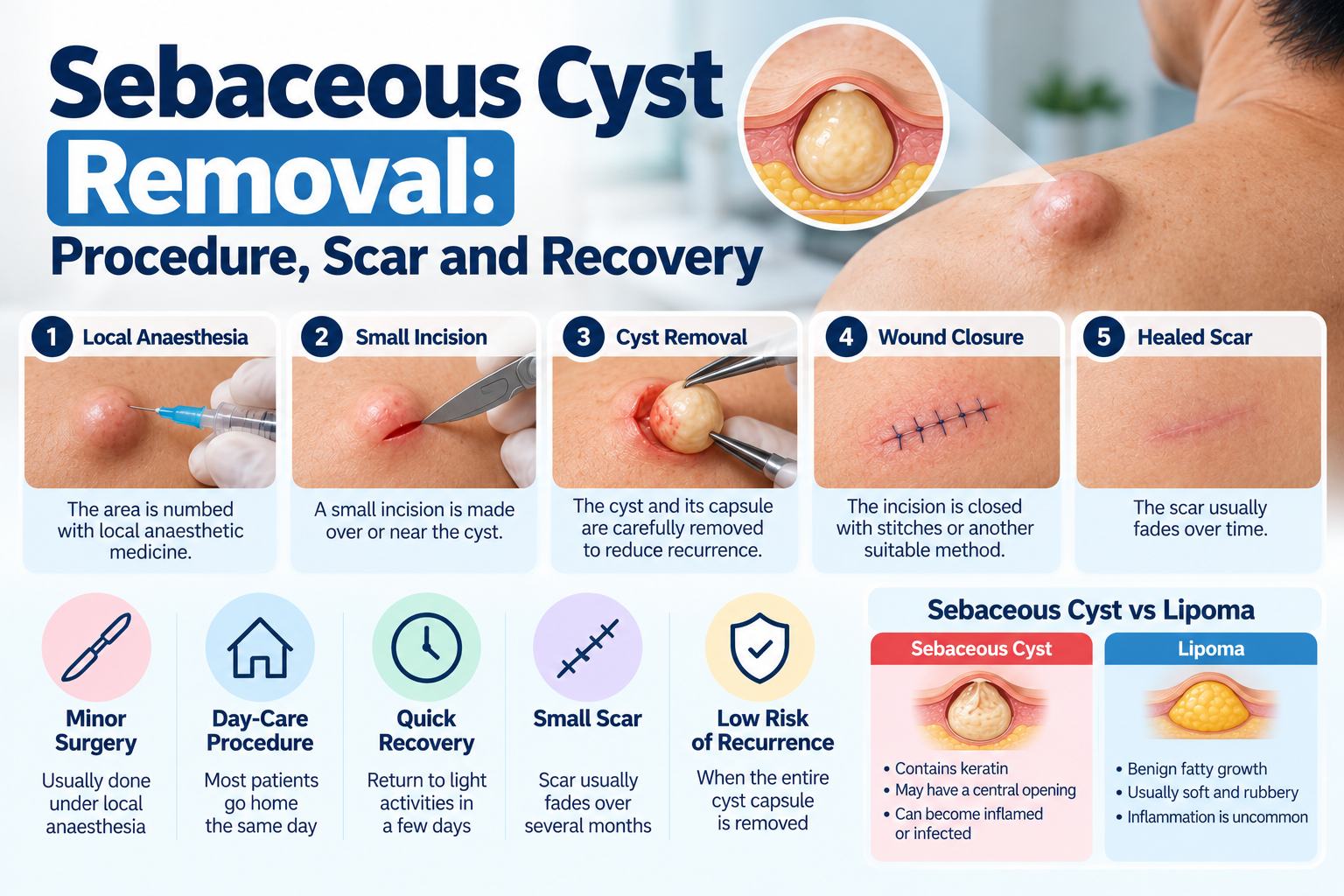
Sebaceous cyst removal is a minor surgical procedure in which a doctor removes a cyst and its surrounding capsule to reduce the chance of recurrence. Doctors commonly perform the procedure under local anaesthesia, and many patients return home the same day.
A sebaceous cyst usually appears as a slow-growing lump beneath the skin. It may remain painless for years, but some cysts become inflamed, infected or uncomfortable.
Although people commonly use the term sebaceous cyst, many of these lumps are actually epidermoid cysts, which contain keratin rather than oil from a sebaceous gland.
Not every cyst needs surgery. However, doctors may recommend removal when a cyst causes pain, grows, repeatedly becomes inflamed or creates cosmetic concerns.
At Arora Elite Care, Surat, Dr. Hitesh Arora, Advanced Laparoscopic and General Surgeon, evaluates skin lumps and discusses suitable treatment options.
What Is a Sebaceous Cyst?
A sebaceous cyst is a term people commonly use for a round lump that develops beneath the skin.
Most lumps described this way are epidermoid cysts.
These cysts form when skin cells accumulate inside a sac beneath the skin and produce keratin, a protein normally present in the outer layer of the skin.
Common features include:
- A round or dome-shaped lump beneath the skin
- Slow growth over months or years
- A smooth surface
- A central opening or small dark spot in some cases
- A soft or firm texture
- Occasional discharge of thick, unpleasant-smelling material
Cysts commonly develop on the face, neck, back, chest and scalp.
However, not every skin lump is a cyst. A medical examination helps determine the likely cause.
When Is Sebaceous Cyst Removal Necessary?
Doctors may recommend sebaceous cyst removal when the lump causes discomfort, grows, repeatedly becomes inflamed or interferes with daily activities.
Small, painless cysts may not require immediate treatment.
A doctor may recommend surgery in the following situations.
1. The Cyst Causes Pain
A cyst may become painful when inflammation develops or surrounding tissues experience pressure.
2. The Cyst Keeps Growing
A growing lump may cause discomfort or become more noticeable.
Doctors should assess enlarging lumps to confirm the diagnosis.
3. Repeated Inflammation or Infection
Some cysts repeatedly become red, swollen or tender.
A doctor may recommend removal after the inflammation settles.
4. Cosmetic Concerns
Cysts on the face, neck or other visible areas may affect appearance.
Patients may choose removal after discussing the expected scar.
5. Uncertain Diagnosis
A lump that grows rapidly, feels unusually firm, becomes fixed to deeper tissues or has other concerning features needs medical assessment.
The doctor may recommend imaging, biopsy or further investigation when necessary.
How Do Doctors Perform Sebaceous Cyst Removal?
Sebaceous cyst removal usually involves a small incision, careful removal of the cyst capsule and closure of the wound.
The exact technique depends on the cyst’s size, location and condition.
Step 1: Examination
The doctor examines the lump and checks for pain, redness, discharge or other symptoms.
The surgeon may recommend additional tests if the diagnosis remains uncertain.
Step 2: Local Anaesthesia
For many uncomplicated cysts, the doctor injects local anaesthetic medicine around the treatment area.
This numbs the skin and helps reduce pain during the procedure.
Patients may still feel pressure or movement.
Step 3: Small Incision
The surgeon makes an incision over or near the cyst.
The incision size depends on the cyst’s location, size and removal technique.
Step 4: Removal of the Cyst
The surgeon carefully separates the cyst from surrounding tissues and attempts to remove the entire capsule.
Removing the capsule reduces the likelihood that the cyst will return.
Step 5: Wound Closure
The surgeon may close the incision with stitches or use another suitable wound-management technique.
The healthcare team then applies a dressing and provides recovery instructions.
Some doctors send the removed tissue for laboratory examination, particularly when the diagnosis is uncertain.
Can Doctors Remove an Infected Sebaceous Cyst?
An inflamed or infected cyst may require a different treatment approach.
When a cyst develops an abscess, the doctor may need to drain the collected pus.
If the surrounding tissues have significant inflammation, complete capsule removal can become more difficult.
The doctor may therefore recommend treating the acute problem first and scheduling definitive cyst removal after the inflammation improves.
Antibiotics may help when a bacterial infection requires treatment, but they do not remove the cyst capsule.
Do not squeeze, puncture or attempt to remove a cyst at home.
Doing so can increase inflammation, cause infection and damage surrounding skin.
Does Sebaceous Cyst Removal Leave a Scar?
Yes. Sebaceous cyst removal usually leaves a scar because the surgeon makes an incision in the skin.
However, the scar’s appearance depends on several factors:
- Size of the cyst
- Location on the body
- Incision length
- Skin type
- Wound tension
- Previous inflammation or infection
- Individual healing response
The surgeon may use techniques that help limit unnecessary tissue damage.
Initially, the scar may appear pink or slightly raised. It often becomes less noticeable over several months.
Some patients develop thick or raised scars, including hypertrophic scars or keloids.
Patients with a history of abnormal scarring should inform their surgeon before the procedure.
What Is the Recovery Time After Sebaceous Cyst Removal?
Most patients can resume light daily activities shortly after uncomplicated sebaceous cyst removal, but complete wound healing usually takes longer.
Recovery depends on the cyst’s size, location and whether the wound requires stitches.
First 24–48 Hours
Patients may notice:
- Mild pain or tenderness
- Minor swelling
- Slight bruising
- A dressing over the wound
Follow the surgeon’s instructions for wound care and pain relief.
Days 3–7
Discomfort often decreases as the wound begins to heal.
Patients should keep the area clean and follow dressing instructions.
Avoid activities that stretch or irritate the incision.
Days 7–14
The healthcare team may remove non-absorbable stitches during this period, depending on the wound location and healing progress.
Some wounds need more time.
Following Weeks
The wound continues to strengthen, while the scar gradually matures.
Scar appearance may continue changing for several months.
How Should You Care for the Wound After Cyst Removal?
Proper wound care helps support healing and reduces avoidable complications.
Follow these precautions:
- Keep the dressing clean and follow the surgeon’s instructions about changing it.
- Wash your hands before touching the wound.
- Avoid scratching or picking at the incision.
- Take prescribed medicines as directed.
- Avoid heavy stretching or friction around the surgical site.
- Attend follow-up appointments when necessary.
Ask your surgeon when you can shower, exercise, and return to strenuous activities.
Contact the healthcare team if you notice increasing redness, worsening pain, pus, fever, or persistent bleeding.
Sebaceous Cyst vs Lipoma: What Is the Difference?
Sebaceous cysts and lipomas can both appear as lumps beneath the skin, but they have different structures.
| Feature | Sebaceous Cyst | Lipoma |
|---|---|---|
| Origin | Usually a sac containing keratin | Benign growth of fatty tissue |
| Texture | Often firm or smooth | Usually soft and rubbery |
| Skin opening | May have a central punctum | Usually no central punctum |
| Inflammation | Can become inflamed or infected | Inflammation is less common |
| Treatment | Observation or cyst removal | Observation or surgical removal |
| Recurrence | More likely if the capsule remains | Uncommon after complete removal |
A physical examination can help distinguish the two conditions, but some lumps require imaging or tissue examination.
For more information, read our guide to lipoma removal surgery in Surat.
Can a Sebaceous Cyst Return After Removal?
Yes. A cyst can return after treatment, particularly if part of its capsule remains beneath the skin.
Simply draining the cyst contents does not necessarily prevent recurrence because the capsule can continue producing keratin.
Complete removal generally lowers the chance of recurrence, but it cannot guarantee that the cyst will never return.
New cysts can also develop in other areas.
Sebaceous Cyst Removal in Surat at Arora Elite Care
Patients with a painful, growing, or repeatedly inflamed skin lump can consult Dr. Hitesh Arora, Advanced Laparoscopic and General Surgeon, at Arora Elite Care, Surat.
During the consultation, the doctor can examine the lump, discuss the likely diagnosis, and explain whether observation, additional testing, or surgical removal is appropriate.
The surgeon can also explain the expected incision, scar, and recovery requirements.
Clinic: Arora Elite Care
Address: Solaris Kode 202–203, VIP Road, Surat, Gujarat 395007
Contact Arora Elite Care to arrange a consultation.
Frequently Asked Questions
1. Is Sebaceous Cyst Removal Painful?
Doctors commonly use local anaesthesia to numb the area before removing an uncomplicated cyst. Patients may feel pressure during the procedure and mild discomfort afterward.
2. How Long Does Sebaceous Cyst Removal Take?
Many uncomplicated cyst removals take approximately 20–45 minutes. Larger, inflamed or difficult-to-access cysts may require more time.
3. Can a Sebaceous Cyst Go Away Without Surgery?
Some cysts remain small and painless for years, and occasional inflamed cysts may temporarily shrink. However, a persistent cyst capsule usually does not disappear completely on its own.
4. Will Sebaceous Cyst Removal Leave a Permanent Scar?
Surgical removal usually leaves a scar. Its visibility often decreases over time, but the final appearance depends on the incision, wound healing and individual skin characteristics.
5. Can a Sebaceous Cyst Come Back After Surgery?
Yes. Recurrence is possible, especially when part of the cyst capsule remains. Complete removal reduces the likelihood of recurrence.
6. Is a Sebaceous Cyst the Same as a Lipoma?
No. A sebaceous or epidermoid cyst contains material within a sac, while a lipoma consists of fatty tissue. A doctor can assess the lump and recommend further testing when necessary.
Conclusion
Sebaceous cyst removal is a common minor surgical procedure that can treat painful, enlarging, or repeatedly inflamed cysts.
Doctors usually perform uncomplicated removal under local anaesthesia and aim to remove the cyst capsule to reduce recurrence.
Most patients resume light activities relatively quickly, although wound healing and scar maturation take longer.
If you notice a new or changing skin lump, consult a qualified doctor for an accurate diagnosis and suitable treatment.