
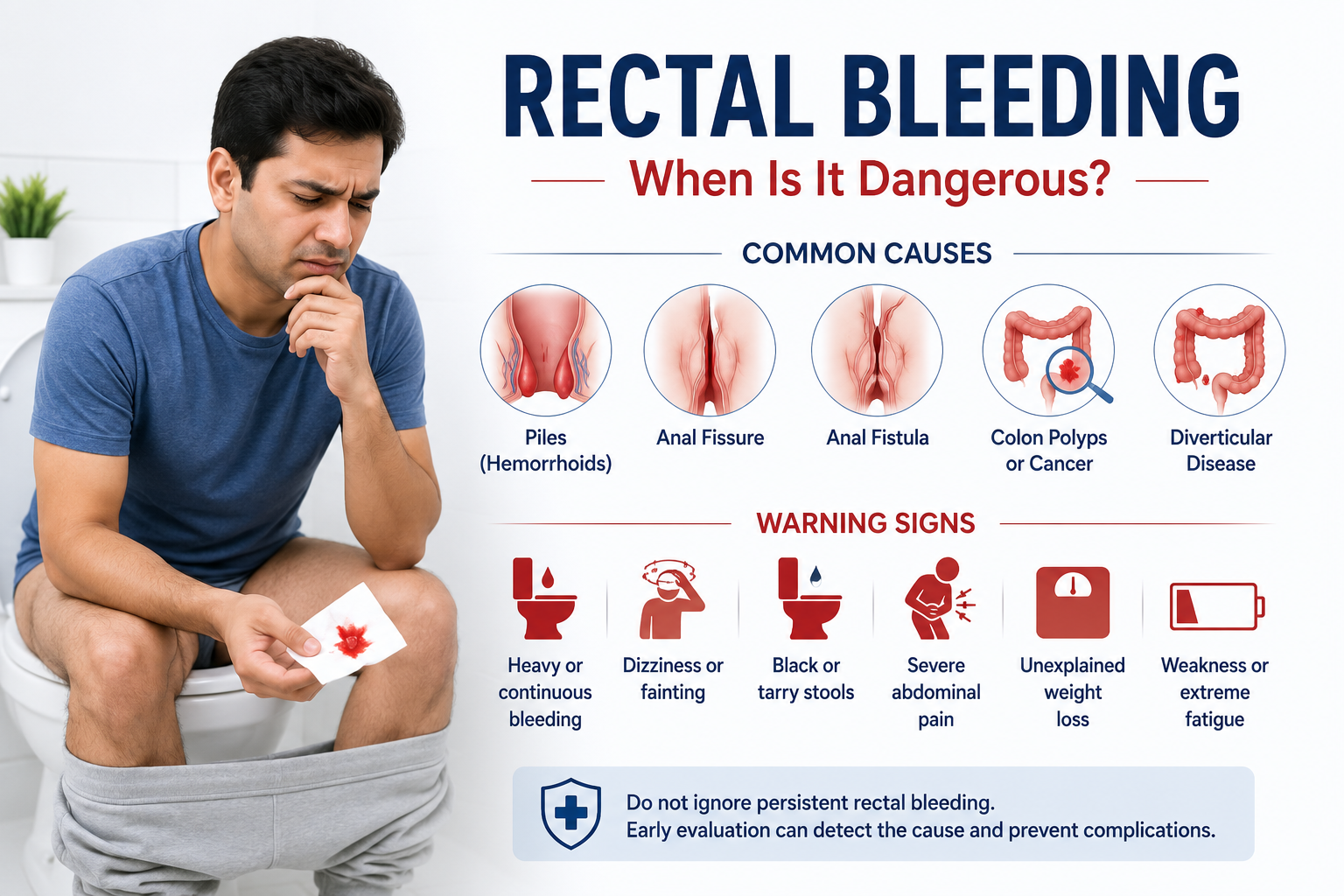
Bleeding from the anus without pain often occurs because of internal piles (haemorrhoids), but diverticular bleeding, colorectal polyps, inflammation, and other bowel conditions can also cause it. The absence of pain does not guarantee that the bleeding is harmless. New, unexplained, or repeated rectal bleeding requires medical evaluation. If you searched for “bleeding from anus no pain” after noticing blood on toilet paper or in the toilet, it is important to understand that several conditions can produce similar symptoms.
The amount, colour and frequency of bleeding may provide clues, but only an appropriate medical assessment can identify the cause.
Bleeding From Anus No Pain: What Could Be the Cause?
Painless rectal bleeding may originate from the anal canal, rectum, or colon.
Internal piles commonly cause bright red bleeding during bowel movements. However, conditions affecting the large intestine can also produce painless bleeding, sometimes in significant amounts.
Common Causes of Rectal Bleeding
| Possible Cause | Typical Bleeding Pattern | Is Pain Common? |
|---|---|---|
| Internal piles | Bright red blood during or after bowel movements | Often painless |
| Anal fissure | Small amounts of bright red blood | Usually painful |
| Diverticular bleeding | Sudden bleeding that may be substantial | Often painless |
| Colorectal polyps | Intermittent bleeding or no visible symptoms | Often painless |
| Colorectal cancer | Visible or hidden bleeding, sometimes with bowel changes | May be painless |
| Proctitis or colitis | Blood, sometimes with mucus or diarrhoea | Variable |
| Angiodysplasia | Intermittent or recurrent intestinal bleeding | Often painless |
Important: Blood colour and the presence or absence of pain cannot reliably confirm the diagnosis.
What Are the Common Causes of Painless Rectal Bleeding?
1. Internal Piles or Haemorrhoids
Internal piles are enlarged or symptomatic vascular cushions inside the anal canal.
They may cause bright red blood on toilet paper, in the toilet bowl, or on the surface of stool.
Other symptoms can include itching, mucus discharge, or tissue protruding from the anus.
Internal piles are often painless because of their location. However, finding piles does not rule out another source of bleeding.
Learn more about piles treatment in Surat.
2. Diverticular Bleeding
Diverticula are small pouches that can develop in the wall of the large intestine.
Sometimes, a blood vessel associated with a diverticulum bleeds.
Diverticular bleeding may begin suddenly and cause bright red or maroon blood without abdominal pain.
Although some episodes stop spontaneously, significant bleeding can cause weakness, dizziness, or dangerous blood loss.
3. Colorectal Polyps
Colorectal polyps are growths on the lining of the colon or rectum.
Many cause no symptoms. Others produce intermittent bleeding.
Certain types can develop into colorectal cancer over time, making appropriate investigation and screening important.
4. Colorectal Cancer
Colorectal cancer may cause rectal bleeding without pain.
Other possible symptoms include persistent changes in bowel habits, unexplained weight loss, fatigue, iron-deficiency anaemia, and blood mixed with stool.
These symptoms do not necessarily mean cancer is present, but they warrant medical evaluation.
5. Angiodysplasia
Angiodysplasia involves abnormal, fragile blood vessels in the digestive tract.
These vessels can bleed intermittently, sometimes causing visible blood or gradual blood loss leading to anaemia.
6. Proctitis and Colitis
Inflammation affecting the rectum or colon can cause bleeding.
Patients may also experience diarrhoea, mucus discharge, abdominal discomfort, or an urgent need to pass stool.
Possible causes include inflammatory bowel disease, infection, and other inflammatory conditions.
Can an Anal Fissure Cause Bleeding Without Pain?
Anal fissures usually cause sharp pain during or after bowel movements, along with small amounts of bright red blood.
However, symptoms can vary.
An anal fissure is a small tear in the lining of the anal canal, often associated with hard stools or constipation.
Read more about anal fissure treatment in Surat.
What Does the Colour of Rectal Bleeding Mean?
The appearance of blood may help doctors investigate its source.
| Blood Appearance | What It May Suggest |
|---|---|
| Bright red blood | Bleeding from the anus, rectum or lower colon |
| Dark red or maroon blood | Bleeding from the colon or another digestive tract location |
| Black, tar-like stool | Possible bleeding from the upper digestive tract |
| Blood mixed with stool | Colorectal inflammation, polyps or other bowel conditions |
These patterns can overlap.
Certain medicines, supplements and foods can also change stool colour. However, suspected gastrointestinal bleeding requires appropriate assessment.
Is Painless Rectal Bleeding Always Piles?
No. Painless rectal bleeding is not always caused by piles.
Internal haemorrhoids commonly cause bright red bleeding, but colorectal polyps, diverticular bleeding, inflammation and colorectal cancer can produce similar symptoms.
A person may also have piles alongside another bowel condition.
Doctors consider age, family history, symptoms, medication use and examination findings when deciding whether further investigations are necessary.
Learn more about the difference between piles, fissure and fistula.
Is Diverticular Bleeding Dangerous?
Diverticular bleeding can become dangerous when it causes substantial blood loss, even without pain.
Some episodes stop naturally, but others require hospital treatment.
Doctors may recommend monitoring, blood tests, colonoscopy, imaging, or procedures to control bleeding.
Seek emergency care if you experience large amounts of blood, repeated significant bleeding, fainting, severe dizziness, rapid heartbeat, or marked weakness.
When Is Rectal Bleeding Dangerous?
Rectal bleeding requires urgent attention when it is heavy, persistent, or accompanied by symptoms suggesting significant blood loss or another serious condition.
Warning Signs That Need Emergency Care
Seek immediate medical attention for:
- Heavy or continuous bleeding
- Fainting or severe dizziness
- Marked weakness
- Black, tar-like stools
- Severe abdominal pain
- Vomiting blood
- Rapidly worsening symptoms
Arrange a medical appointment for unexplained or recurrent bleeding, particularly if you also experience persistent bowel-habit changes, unexplained weight loss, increasing fatigue or symptoms of anaemia.
Do not delay evaluation simply because the bleeding stops temporarily.
How Do Doctors Diagnose Painless Rectal Bleeding?
Doctors investigate rectal bleeding according to the symptoms, medical history, examination findings, and severity.
Medical History
The doctor may ask about blood colour, quantity, frequency, bowel habits, constipation, pain, previous episodes, and family history.
Medicines such as anticoagulants and antiplatelet drugs are also relevant because they can affect bleeding.
Physical Examination
An abdominal and anorectal examination may help identify piles, fissures, or other abnormalities.
Anoscopy or Proctoscopy
These examinations allow the doctor to inspect the anal canal or lower rectum.
They may help identify internal piles or another local source of bleeding.
Blood Tests
A complete blood count may help assess haemoglobin levels and identify anaemia.
Doctors may recommend additional tests according to the clinical situation.
Colonoscopy
Colonoscopy allows doctors to examine the lining of the colon and rectum.
It may help identify polyps, inflammation, suspicious growths and certain bleeding sources.
Not every patient needs colonoscopy, but it may be important when symptoms or risk factors warrant further investigation.
Imaging
Patients with substantial or ongoing bleeding may need hospital-based investigations such as CT angiography.
The treating team selects the appropriate tests according to the patient’s condition.
How Can You Stop Rectal Bleeding Safely?
The safest way to stop rectal bleeding is to identify and treat its underlying cause.
If you notice bleeding from the anus without pain, avoid assuming that piles cream or a home remedy will solve the problem.
Treatment for Piles
Depending on the severity, doctors may recommend dietary changes, improved bowel habits, medicines, or office-based procedures.
Some patients with persistent or advanced haemorrhoids require surgery.
Treatment for Anal Fissures
It may include measures to soften stools, prescription ointments and additional procedures for persistent fissures.
Treatment for Bleeding From the Colon
It depends on the diagnosis.
Patients with polyps, diverticular bleeding, inflammation or other bowel conditions may require medicines, endoscopic treatment or surgery in selected cases.
Do not attempt to manage heavy rectal bleeding at home. Seek emergency care if bleeding is substantial or accompanied by dizziness, fainting or severe weakness.
Can You Prevent Rectal Bleeding?
Not every cause of rectal bleeding is preventable.
However, healthy bowel habits may reduce bleeding associated with constipation, piles and fissures.
Helpful habits include eating adequate fibre when medically appropriate, drinking sufficient fluids, staying physically active, avoiding excessive straining, and limiting prolonged toilet sitting.
Follow recommended colorectal cancer screening guidance based on your age and individual risk.
Persistent bleeding still requires evaluation, even if you maintain healthy bowel habits.
Rectal Bleeding Evaluation at Arora Elite Care, Surat
Patients experiencing rectal bleeding or other anorectal symptoms can consult Dr. Hitesh Arora at Arora Elite Care, Surat.
Dr. Hitesh Arora is an Advanced Laparoscopic and General Surgeon with over 15 years of surgical experience. He is an M.S. Gold Medalist and holds an FMAS qualification.
During a consultation, the doctor may review your symptoms, assess bowel habits, examine the anorectal area, and recommend further investigations when necessary.
The goal is to identify the cause and recommend appropriate treatment. A surgical consultation does not automatically mean that you need surgery.
Clinic: Arora Elite Care
Address: Solaris Kode 202–203, VIP Road, Surat, Gujarat 395007
Book a Surgery Consultation in Surat
Conclusion
Bleeding from anus no pain is a common search concern, but painless rectal bleeding has several possible causes.
Internal piles frequently cause bright red bleeding, while diverticular disease, colorectal polyps, inflammation, and other conditions may produce similar symptoms.
The absence of pain does not confirm that the bleeding is harmless.
Seek medical evaluation for new, unexplained, or recurrent bleeding. Heavy bleeding, fainting, severe dizziness, black stools, or marked weakness require urgent attention.
An accurate diagnosis helps ensure that treatment addresses the actual cause.
Frequently Asked Questions
1. What Causes Bleeding From the Rectum Without Pain?
Internal piles, diverticular bleeding, colorectal polyps, angiodysplasia and other bowel conditions may cause painless rectal bleeding. A doctor can assess the symptoms and recommend appropriate investigations.
2. Is Painless Bright Red Bleeding Always Piles?
No. Internal piles commonly cause painless bright red bleeding, but other colorectal conditions can produce similar symptoms. Medical evaluation helps determine the source.
3. Is Diverticular Bleeding Dangerous?
Yes, it can be. Diverticular bleeding may cause sudden and substantial blood loss without pain. Heavy bleeding, fainting, dizziness or marked weakness requires emergency care.
4. How Can You Stop Rectal Bleeding?
Treatment depends on the underlying cause. Piles or fissures may respond to bowel-care measures and medical treatment, while other conditions may require endoscopy, medicines or surgery. Seek urgent care for heavy bleeding.
5. Can Rectal Bleeding Be a Sign of Colorectal Cancer?
Yes. Colorectal cancer can cause visible or hidden bleeding, sometimes without pain. Persistent bleeding, unexplained weight loss, anaemia or bowel-habit changes warrant medical evaluation.
6. When Should You See a Doctor for Rectal Bleeding?
Arrange a medical assessment for new, unexplained or recurrent bleeding. Seek emergency care for heavy bleeding, fainting, severe dizziness, black stools or severe abdominal pain.