Groin pain after exercise, running, twisting, or lifting may make you wonder whether you have a hernia. However, a sports hernia and a regular hernia are not the same condition. A sports hernia usually involves an injury or weakness of soft tissues in the lower abdomen or groin, while a regular hernia occurs when tissue pushes through a weak area in the abdominal wall. Understanding sports hernia symptoms treatment, and how the condition differs from a regular hernia can help you seek the right medical evaluation.
What Is a Sports Hernia?
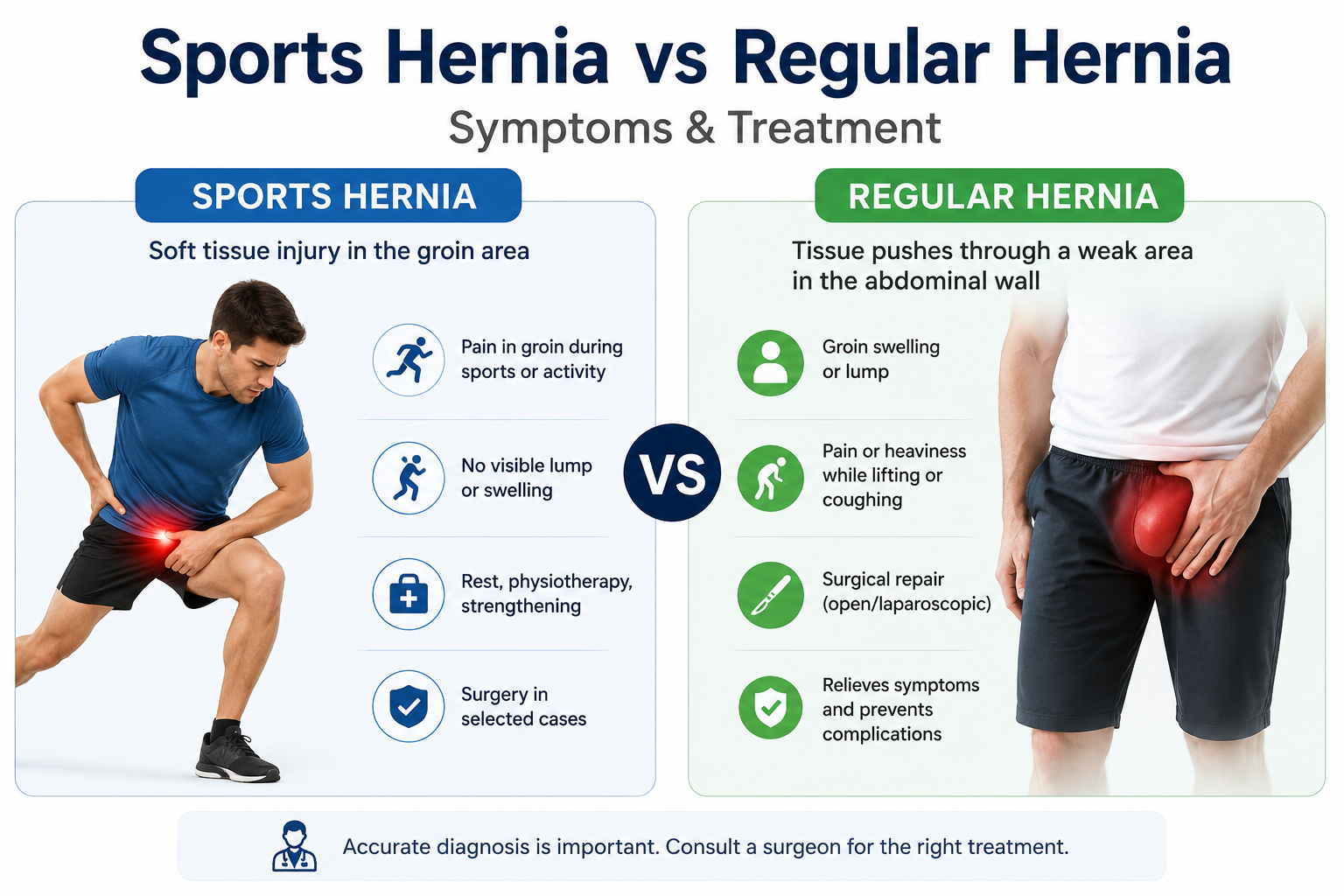
A sports hernia, often called athletic pubalgia, is a soft-tissue injury involving the lower abdomen or groin region. Despite its name, it usually does not create the typical opening and visible bulge associated with a conventional hernia.
Activities that involve sudden twisting, kicking, rapid changes in direction, or intense abdominal movements can contribute to the injury.
Athletes who participate in football, cricket, running, hockey, or other high-intensity sports may develop this type of groin pain.
What Is a Regular Hernia?
A regular abdominal-wall hernia develops when tissue or an internal structure pushes through a weak area in the surrounding muscle or connective tissue.
An inguinal hernia, which occurs in the groin, can sometimes produce symptoms similar to a sports hernia.
Typical signs may include:
- A visible or noticeable groin bulge
- Groin discomfort or heaviness
- Pain during coughing or straining
- Discomfort while lifting
- A swelling that becomes more noticeable while standing
Not every hernia causes significant pain, so a medical examination remains important.
Sports Hernia vs Regular Hernia: What Is the Difference?
| Feature | Sports Hernia | Regular Hernia |
|---|---|---|
| Main problem | Soft-tissue injury | Abdominal-wall defect |
| Visible bulge | Usually absent | May be present |
| Common trigger | Twisting or athletic activity | Lifting, straining or abdominal pressure |
| Pain | Often activity-related | May worsen with coughing, lifting or straining |
| Treatment | Rest, rehabilitation or selected surgery | Observation or surgical repair depending on the case |
Because symptoms can overlap, you should not rely on the presence or absence of a bulge alone to diagnose the problem.
What Are Sports Hernia Symptoms?
Sports hernia symptoms often begin with groin or lower abdominal pain during physical activity.
You may notice pain when:
- Sprinting or running
- Kicking
- Twisting the body
- Changing direction quickly
- Performing abdominal exercises
- Returning to sport after resting
The discomfort may improve with rest and return when physical activity resumes.
Persistent groin pain can have several other causes, so proper diagnosis matters before beginning treatment.
How Do Doctors Diagnose a Sports Hernia?
A doctor starts by discussing how the pain began, which activities trigger it, and whether you have noticed swelling.
The examination may involve checking the abdomen and groin and asking you to perform movements that reproduce your symptoms.
Imaging such as ultrasound or MRI may help in selected cases, particularly when the diagnosis remains uncertain, or the doctor needs to evaluate other causes of groin pain.
What Is the Treatment for a Sports Hernia?
Initial sports hernia symptoms treatment often focuses on reducing pain and allowing injured tissues to recover.
Depending on the injury, treatment may include:
- Temporary rest from painful activities
- Appropriate pain management
- Physiotherapy
- Core-strengthening exercises
- Gradual return to sport
Patients should avoid repeatedly exercising through significant pain because this may delay recovery.
When symptoms remain persistent despite appropriate rehabilitation, a specialist may consider further treatment, including surgery in selected cases.
How Is a Regular Hernia Treated?
Treatment for a regular hernia depends on its type, size, symptoms, and risk of complications.
A surgeon may monitor some minimally symptomatic hernias when clinically appropriate. Symptomatic or problematic hernias may require surgical repair.
Depending on the individual case, surgeons can perform hernia repair through an open or laparoscopic approach. The surgeon chooses the technique after considering the hernia and the patient’s health.
What Is Recovery Like?
Recovery from a sports hernia depends on the severity of the injury and treatment required. Patients receiving conservative treatment generally follow a gradual rehabilitation program before returning to demanding sports.
After regular hernia surgery, recovery also varies according to the type of repair, surgical approach, occupation, and overall health.
Do not return to strenuous exercise simply because the pain has disappeared. Follow your doctor or physiotherapist’s advice regarding lifting, running, gym activity, and sports.
When Should You Consult a Surgeon?
Seek medical evaluation if groin pain persists, repeatedly returns during exercise, interferes with sports, or occurs with noticeable swelling.
Sudden severe pain, vomiting, increasing abdominal or groin swelling, or a painful bulge that does not reduce requires urgent medical attention.
Hernia Evaluation With Dr. Hitesh Arora in Surat
Patients experiencing persistent groin pain or suspected hernia can consult Dr. Hitesh Arora at Arora Elite Care. Dr. Hitesh Arora is an Advanced Laparoscopic and General Surgeon with 15+ years of surgical experience, an M.S. Gold Medalist, and holds an FMAS (Fellowship in Minimal Access Surgery).
An evaluation can help distinguish a conventional hernia from other causes of groin pain and determine whether conservative care, further investigations, rehabilitation, or surgical treatment may be appropriate.
Conclusion
A sports hernia typically involves a soft-tissue injury without the characteristic abdominal-wall bulge, while a regular hernia involves tissue pushing through a weak area.
Although their symptoms can overlap, their treatment can differ significantly. Proper diagnosis is therefore an important part of sports hernia symptoms treatment.
If persistent groin pain or swelling affects exercise or everyday activities, seek medical evaluation rather than attempting to diagnose the condition yourself.
FAQs
Does a sports hernia cause a visible lump?
Usually not. Unlike many regular groin hernias, a sports hernia generally does not cause a typical visible bulge.
Can a sports hernia heal without surgery?
Some patients improve with rest, physiotherapy, and gradual rehabilitation. Persistent cases may require further specialist evaluation.
How can I tell if I have a sports hernia or inguinal hernia?
Symptoms alone may not reliably distinguish them. A physical examination and, when appropriate, imaging can help identify the cause.
Can I exercise with a sports hernia?
Continuing activities that trigger significant pain may worsen symptoms. Follow a clinician-guided rehabilitation and return-to-sport plan.
Who should I consult for a suspected inguinal hernia?
A general or laparoscopic surgeon can assess a suspected abdominal-wall or inguinal hernia and discuss appropriate treatment.