
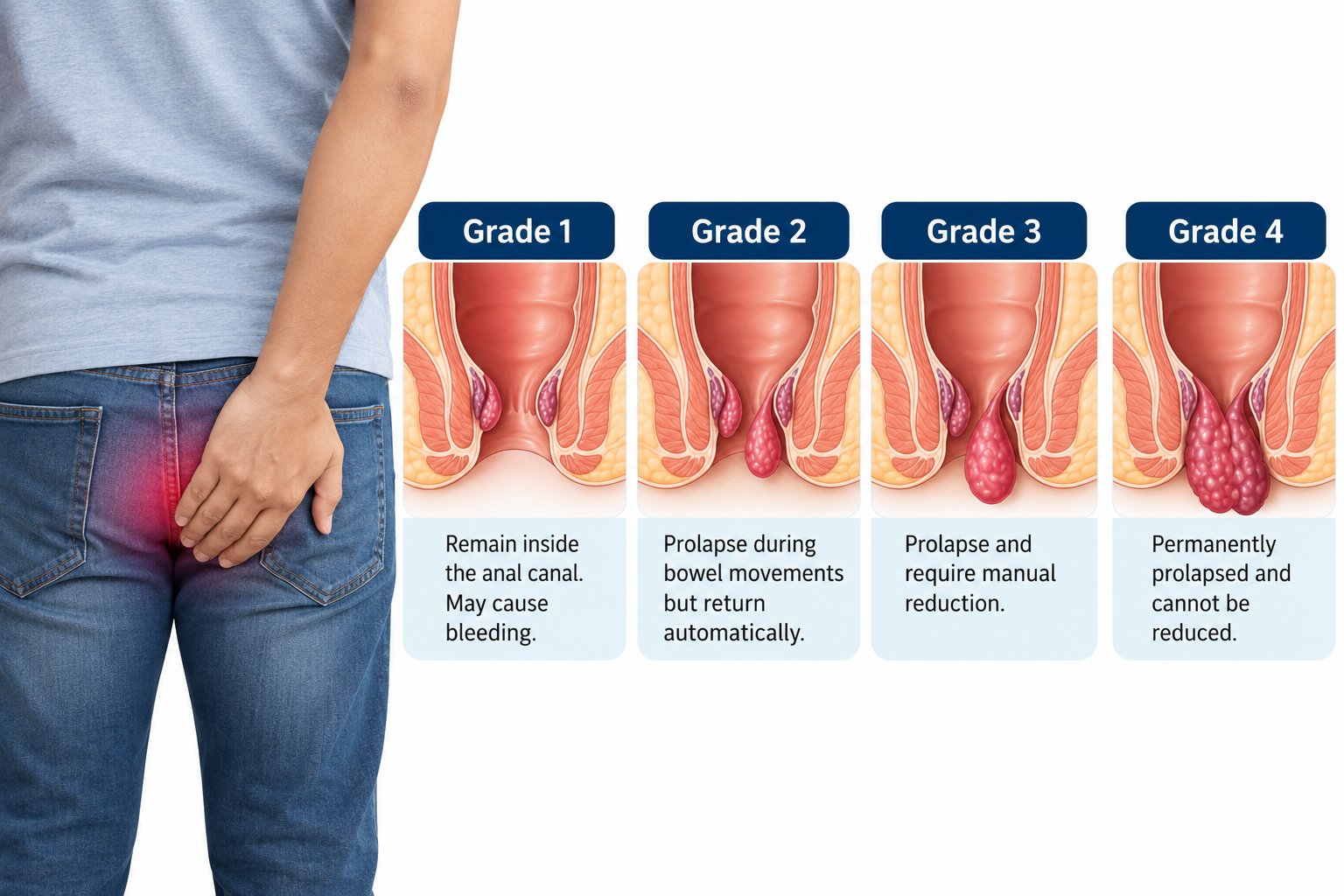
Piles grades describe the severity of internal haemorrhoid prolapse. Grade 1 piles remain inside the anal canal; 2 piles protrude but return automatically; 3 piles require manual reduction; and Grade 4 piles remain prolapsed and cannot be pushed back. Grade 1 and 2 piles usually do not require surgery, while Grade 3 and 4 piles may need procedures or surgical treatment. However, doctors select treatment based on symptoms, examination findings, and patient health, not the grade alone.
Piles, also called haemorrhoids, are swollen or enlarged vascular cushions in and around the anal canal. They can cause bleeding, itching, discomfort, and tissue protrusion during bowel movements.
Many patients worry that a diagnosis of piles automatically means surgery. In reality, several treatment options exist, and many patients improve without an operation.
Understanding piles grades helps patients recognise the different stages and learn when medical or surgical treatment may be necessary.
What Are Piles and How Are They Graded?
Doctors classify internal piles into four grades according to how much the haemorrhoidal tissue protrudes through the anus.
Internal haemorrhoids develop inside the anal canal, above the dentate line.
External haemorrhoids develop below this line and are assessed differently.
The four-grade classification applies specifically to internal haemorrhoids.
Doctors consider additional factors, including bleeding, pain, external components, and the impact on daily activities.
A higher grade often indicates more advanced prolapse, but it does not automatically determine the best treatment.
What Are the Four Grades of Piles?
The four piles stages range from internal haemorrhoids without prolapse to permanently prolapsed haemorrhoids that cannot be reduced.
Grade 1 Piles: No Prolapse
Grade 1 piles remain inside the anal canal.
They may cause painless, bright-red bleeding during bowel movements but do not protrude outside the anus.
Grade 2 Piles: Prolapse That Returns Automatically
Grade 2 piles protrude during bowel movements or straining.
However, they return inside the anal canal without manual assistance.
Grade 3 Piles: Prolapse Requiring Manual Reduction
Grade 3 piles protrude during bowel movements or other activities.
Patients may need to gently push the tissue back inside.
Grade 4 Piles: Permanently Prolapsed
Grade 4 piles remain outside the anus and cannot be manually reduced.
They may cause irritation, hygiene difficulties, swelling, or discomfort.
Complications such as strangulation or thrombosis can sometimes occur.
Grade 1 Piles: Do You Need Surgery?
Grade 1 piles usually do not require surgery because lifestyle changes and non-surgical treatments often control symptoms.
Doctors commonly recommend:
-
Increasing dietary fibre
-
Drinking adequate fluids
-
Avoiding excessive straining
-
Reducing prolonged toilet sitting
-
Treating constipation
-
Maintaining regular bowel habits
Short-term medicines may help relieve specific symptoms, but they do not necessarily eliminate the underlying haemorrhoids.
If bleeding continues despite conservative treatment, a doctor may recommend an office-based procedure.
Rubber band ligation or other treatments may be suitable depending on the examination findings.
Grade 2 Piles: Can They Improve Without Surgery?
Grade 2 piles can often improve without surgery through bowel-habit changes, symptom management, and office-based procedures.
Because the prolapsed tissue returns automatically, many patients do not need an operation.
However, persistent bleeding or recurrent prolapse may require further treatment.
Rubber band ligation is an established procedure for many symptomatic Grade 2 internal haemorrhoids.
During this procedure, the clinician places a small band around the base of the haemorrhoidal tissue, reducing its blood supply.
The treated tissue eventually shrinks and separates.
The doctor selects treatment according to symptoms, medical history, and examination findings.
Grade 3 Piles: What Are the Treatment Options?
Grade 3 piles treatment may involve rubber band ligation, selected minimally invasive procedures, or surgery, depending on the extent of prolapse and symptoms.
3 haemorrhoids require manual reduction after prolapse.
Patients may experience repeated bleeding, mucus discharge, irritation or difficulty maintaining hygiene.
Treatment options include:
Rubber Band Ligation
Banding may work for selected Grade 3 internal haemorrhoids.
However, more extensive prolapse may respond less effectively and require additional treatment.
Surgical Procedures
Surgeons may recommend an operation when Grade 3 piles cause persistent symptoms, recur after office treatment, or have a significant external component.
Excisional haemorrhoidectomy is an established option for suitable patients.
Other procedures may be considered according to the clinical findings.
Laser-Based Treatment
Some centres offer laser haemorrhoid procedures for selected cases.
However, laser treatment is not automatically superior to established techniques, and evidence about long-term outcomes varies by procedure.
The surgeon should explain expected benefits, possible complications, and recurrence risk before treatment.
Grade 4 Piles: Is Surgery Necessary?
Grade 4 piles often require surgical treatment because the haemorrhoidal tissue remains prolapsed and cannot be reduced.
Patients may experience persistent swelling, irritation, bleeding, discomfort, and hygiene problems.
Conservative measures can help manage constipation and reduce straining, but they generally do not correct significant permanent prolapse.
Excisional haemorrhoidectomy is commonly recommended for symptomatic Grade 4 haemorrhoids, particularly when there is a substantial external component.
However, the surgeon must assess the patient’s condition before recommending an operation.
Severe pain, rapidly increasing swelling, or heavy bleeding requires prompt medical evaluation.
Piles Grades 1 to 4: Comparison Table
| Piles Grade | Prolapse | Typical Symptoms | Common Treatment |
|---|---|---|---|
| Grade 1 | No prolapse | Bleeding, mild irritation | Fibre, bowel-habit changes, selected office procedures |
| Grade 2 | Returns automatically | Bleeding, temporary protrusion | Conservative treatment, rubber band ligation |
| Grade 3 | Requires manual reduction | Recurrent prolapse, bleeding, discomfort | Banding in selected cases or surgery |
| Grade 4 | Cannot be reduced | Persistent prolapse, irritation, discomfort | Surgery often recommended |
The table provides general guidance. The best treatment depends on the individual patient’s symptoms and examination findings.
Can Piles Progress From Grade 1 to Grade 4?
Internal haemorrhoids can become more severe over time, but not every patient with Grade 1 piles progresses to Grade 4.
Factors that may contribute to worsening symptoms include:
-
Chronic constipation
-
Repeated straining
-
Prolonged toilet sitting
-
Persistent diarrhoea
-
Increased abdominal pressure
-
Pregnancy-related changes
-
Age-related changes in supporting tissues
Early treatment of bowel-habit problems may help control symptoms and reduce irritation.
However, lifestyle changes cannot guarantee that haemorrhoids will never progress.
How Do Doctors Diagnose Piles Grades?
Doctors determine piles grades through symptom assessment, physical examination and, when appropriate, anoscopy or proctoscopy.
The consultation begins with questions about bleeding, pain, prolapse, constipation and bowel habits.
The doctor may perform an external examination and a digital rectal examination when appropriate.
Anoscopy allows the clinician to inspect internal haemorrhoids directly.
Additional investigations may be necessary if symptoms suggest another condition.
Is Rectal Bleeding Always Caused by Piles?
No. Rectal bleeding can also occur with anal fissures, inflammatory bowel disease, colorectal polyps, colorectal cancer and other conditions.
Patients should not assume that bleeding is harmless simply because they have haemorrhoids.
Depending on age, symptoms, risk factors and examination findings, the doctor may recommend further investigations, including colonoscopy.
For more information, read when to see a doctor for piles.
Medicines vs Banding vs Laser vs Surgery
Piles treatment ranges from conservative measures to office-based procedures and surgery. The choice depends on symptoms, prolapse severity, and patient factors.
| Treatment | Common Role | Important Limitation |
|---|---|---|
| Fibre and bowel-habit changes | First-line care for most grades | May not correct advanced prolapse |
| Symptom-relief medicines | Short-term relief in selected patients | Do not reliably eliminate prolapse |
| Rubber band ligation | Many Grade 1–2 and selected Grade 3 cases | Repeat treatment may be needed |
| Laser procedures | Selected symptomatic cases | Long-term evidence varies |
| Excisional haemorrhoidectomy | Significant Grade 3–4 disease | Requires postoperative recovery |
Surgery may provide durable relief for appropriately selected patients, but it can cause postoperative pain, bleeding, urinary difficulties or other complications.
No treatment guarantees that haemorrhoids will never recur.
When Should You See a Doctor for Piles?
Consult a doctor if you experience repeated rectal bleeding, persistent prolapse, worsening symptoms, or discomfort that affects daily life.
Medical assessment is especially important if you notice:
-
Frequent bleeding
-
A lump that repeatedly protrudes
-
Painful swelling near the anus
-
Changes in bowel habits
-
Unexplained weight loss
-
Symptoms that continue despite treatment
Seek urgent care for heavy bleeding, fainting, severe pain, or rapidly worsening swelling.
Early diagnosis helps identify the actual cause and prevents unnecessary delays in treatment.
Piles Treatment at Arora Elite Care, Surat
At Arora Elite Care, Dr. Hitesh Arora, Advanced Laparoscopic and General Surgeon, evaluates patients with piles and other anorectal conditions.
A consultation may include assessment of bleeding, prolapse, bowel habits, and the severity of haemorrhoidal disease.
Depending on the findings, treatment may involve conservative measures, office-based procedures, or surgery.
The goal is to recommend an appropriate treatment rather than assuming every patient requires an operation.
Learn more about piles treatment in Surat and available evaluation options.
Patients considering an operation can also review piles surgery recovery time to understand common postoperative expectations.
For individual treatment advice, book a surgery consultation in Surat.
Conclusion
Understanding piles grades helps patients recognise when lifestyle changes, office procedures or surgery may be appropriate.
Grade 1 and 2 internal haemorrhoids often respond to conservative measures or office treatment.
3 piles may require banding or surgery, depending on symptoms and prolapse severity.
4 piles are more likely to need surgical repair, particularly when permanent prolapse causes significant problems.
However, the grade alone does not determine treatment.
A proper medical examination helps confirm the diagnosis, exclude other causes of bleeding, and identify the most suitable treatment approach.
Frequently Asked Questions
1. Which Grade of Piles Requires Surgery?
Grade 3 and Grade 4 piles are more likely to require surgery, especially when prolapse, bleeding or discomfort persists despite other treatments. However, surgery is not compulsory for every Grade 3 case. Doctors consider symptoms, examination findings, external haemorrhoids, and response to previous treatment before recommending an operation.
2. Can Grade 3 Piles Be Treated Without Surgery?
Yes. Selected Grade 3 piles may respond to rubber band ligation and conservative measures. However, large or recurrent prolapse may require surgery. Treatment depends on haemorrhoid size, symptoms, external components, and patient preferences. A surgeon can explain which options are suitable after examination.
3. Is Surgery Compulsory for Grade 4 Piles?
Surgery is often recommended for symptomatic Grade 4 piles because the prolapsed tissue cannot be manually reduced. However, treatment decisions depend on the patient’s condition, symptoms, and surgical risks. Conservative measures may relieve some symptoms but usually do not correct significant permanent prolapse.
4. Can Grade 1 or Grade 2 Piles Become Grade 4?
Yes, haemorrhoidal prolapse can worsen over time, but progression is not inevitable. Chronic constipation, repeated straining, and other factors may contribute to worsening symptoms. Maintaining healthy bowel habits and seeking appropriate treatment can help manage haemorrhoidal disease.
5. Is Laser Treatment Suitable for All Piles Grades?
No. Laser procedures may be considered for selected patients, but they are not appropriate for every type or grade of haemorrhoids. Significant Grade 4 prolapse or a large external component may require a different surgical approach. The surgeon should explain the evidence, limitations, and possible recurrence risk.
6. How Do Doctors Identify the Grade of Piles?
Doctors assess symptoms, prolapse behaviour, and examination findings. Grade 1 piles remain inside, Grade 2 piles return automatically, Grade 3 piles require manual reduction, and Grade 4 piles cannot be reduced. Anoscopy or proctoscopy may help confirm the diagnosis. External haemorrhoids use a different assessment approach.